





Tested Applications
| Positive WB detected in | HeLa cells, HepG2 cells |
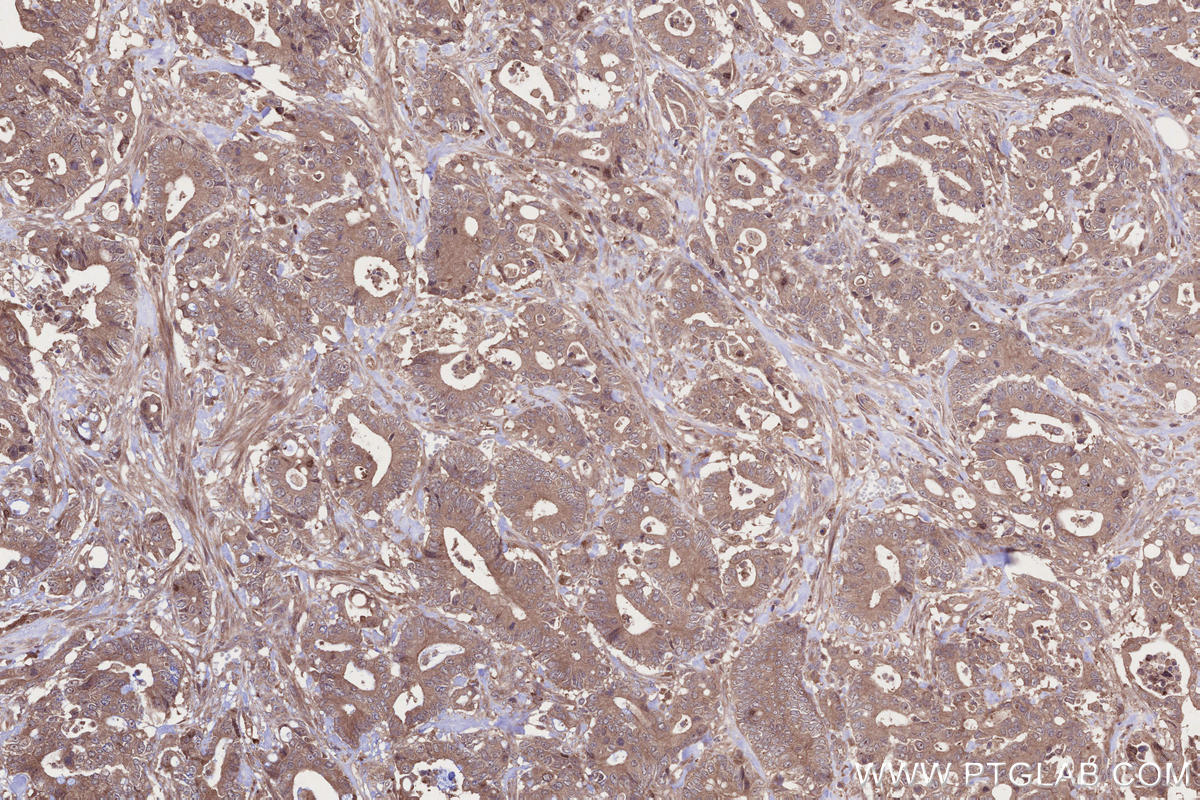
| Positive IHC detected in | human rectal cancer tissue, mouse stomach tissue, mouse testis tissue, rat stomach tissue Note: suggested antigen retrieval with TE buffer pH 9.0; (*) Alternatively, antigen retrieval may be performed with citrate buffer pH 6.0 |
| Positive IF/ICC detected in | HepG2 cells |
Recommended dilution
| Application | Dilution |
|---|---|
| Western Blot (WB) | WB : 1:500-1:2000 |
| Immunohistochemistry (IHC) | IHC : 1:500-1:2000 |
| Immunofluorescence (IF)/ICC | IF/ICC : 1:50-1:500 |
| It is recommended that this reagent should be titrated in each testing system to obtain optimal results. | |
| Sample-dependent, Check data in validation data gallery. | |
Product Information
24283-1-AP targets ANKRD53 in WB, IHC, IF/ICC, ELISA applications and shows reactivity with human, mouse, rat samples.
| Tested Reactivity | human, mouse, rat |
| Cited Reactivity | human |
| Host / Isotype | Rabbit / IgG |
| Class | Polyclonal |
| Type | Antibody |
| Immunogen |
CatNo: Ag15030 Product name: Recombinant human ANKRD53 protein Source: e coli.-derived, PGEX-4T Tag: GST Domain: 1-343 aa of BC035234 Sequence: MASAGSTARRAGSGSWHSERGEGRGARPQPTPSGSMQQANKVSLKATWTDAESKQPSQPLPDLADHLSAQATALARPRRPASLTPPRADPSPSKESDQTAIDQTAIGSYYQLFAAAVGNVEWLRFCLNQSLREIPTDDKGFTAIHFAAQWGKIACLQVLVEEYKFPVDLLTNNSQTPLHLVIHRDNTTVALPCIYYLLEKGADLNAQTCNGSTPLHLAARDGLLDCVKVLVQSGANVHAQDAMGYKPIDFCKIWNHRACARFLKDAMWKKDKKDFAREMTKMKMFKSQLTLMEHNYLIEYQGQGCSVHFPFAFSPITPETLLWQDISLLSDCGFLWRRRELSF Predict reactive species |
| Full Name | ankyrin repeat domain 53 |
| Calculated Molecular Weight | 530 aa, 60 kDa |
| Observed Molecular Weight | 60-70 kDa |
| GenBank Accession Number | BC035234 |
| Gene Symbol | ANKRD53 |
| Gene ID (NCBI) | 79998 |
| RRID | AB_2879470 |
| Conjugate | Unconjugated |
| Form | Liquid |
| Purification Method | Antigen affinity purification |
| UNIPROT ID | Q8N9V6 |
| Storage Buffer | PBS with 0.02% sodium azide and 50% glycerol, pH 7.3. |
| Storage Conditions | Store at -20°C. Stable for one year after shipment. Aliquoting is unnecessary for -20oC storage. 20ul sizes contain 0.1% BSA. |
Background Information
ANKRD53 also termed as ankyrin repeat domain 53 is a 533 amino-acid protein,which contains three ANK repeats and belongs to ankyrin family. The function of ANKRD53 is still non-known and need to be further studied. Ankyrins are membrane adaptor molecules that play important roles in coupling integral membrane proteins to the spectrin-based cytoskeleton network.
Protocols
| Product Specific Protocols | |
|---|---|
| IF protocol for ANKRD53 antibody 24283-1-AP | Download protocol |
| IHC protocol for ANKRD53 antibody 24283-1-AP | Download protocol |
| WB protocol for ANKRD53 antibody 24283-1-AP | Download protocol |
| Standard Protocols | |
|---|---|
| Click here to view our Standard Protocols |
Publications
What published studies show
The ANKRD53 Polyclonal antibody (catalog #24283-1-AP) has 2 total citations. One appears in Molecular Metabolism (2026), studying ANKRD53 downregulation in human obesity and its role in coordinating lipolysis with mitochondrial oxidative metabolism in adipocytes, using Western blot. The other is in Discover Oncology (2024), an integrative analysis of ANKRD53's potential value in stomach adenocarcinoma. The associated research fields are metabolic research (obesity/adipocyte metabolism) and oncology (stomach cancer).
| Species | Application | Title |
|---|---|---|
Mol Metab ANKRD53 is downregulated in human obesity and coordinates lipolysis with mitochondrial oxidative metabolism in adipocytes.
| ||
Discov Oncol Integrative analysis indicates the potential values of ANKRD53 in stomach adenocarcinoma |





