
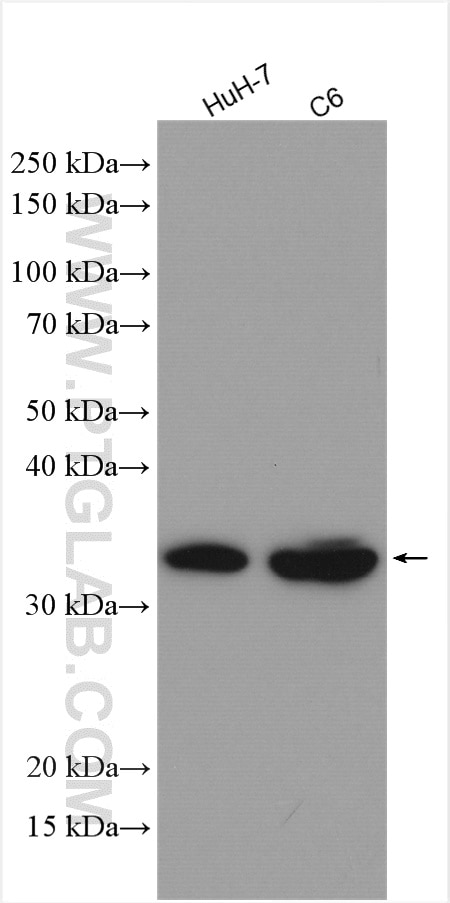
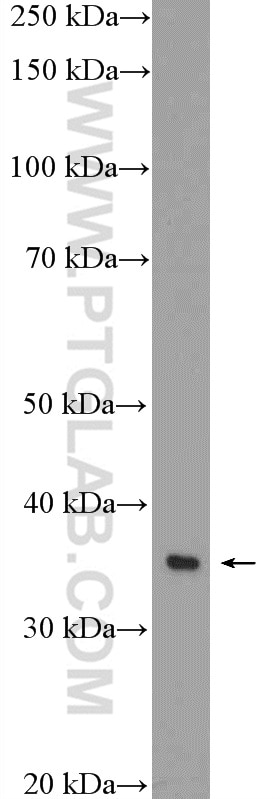
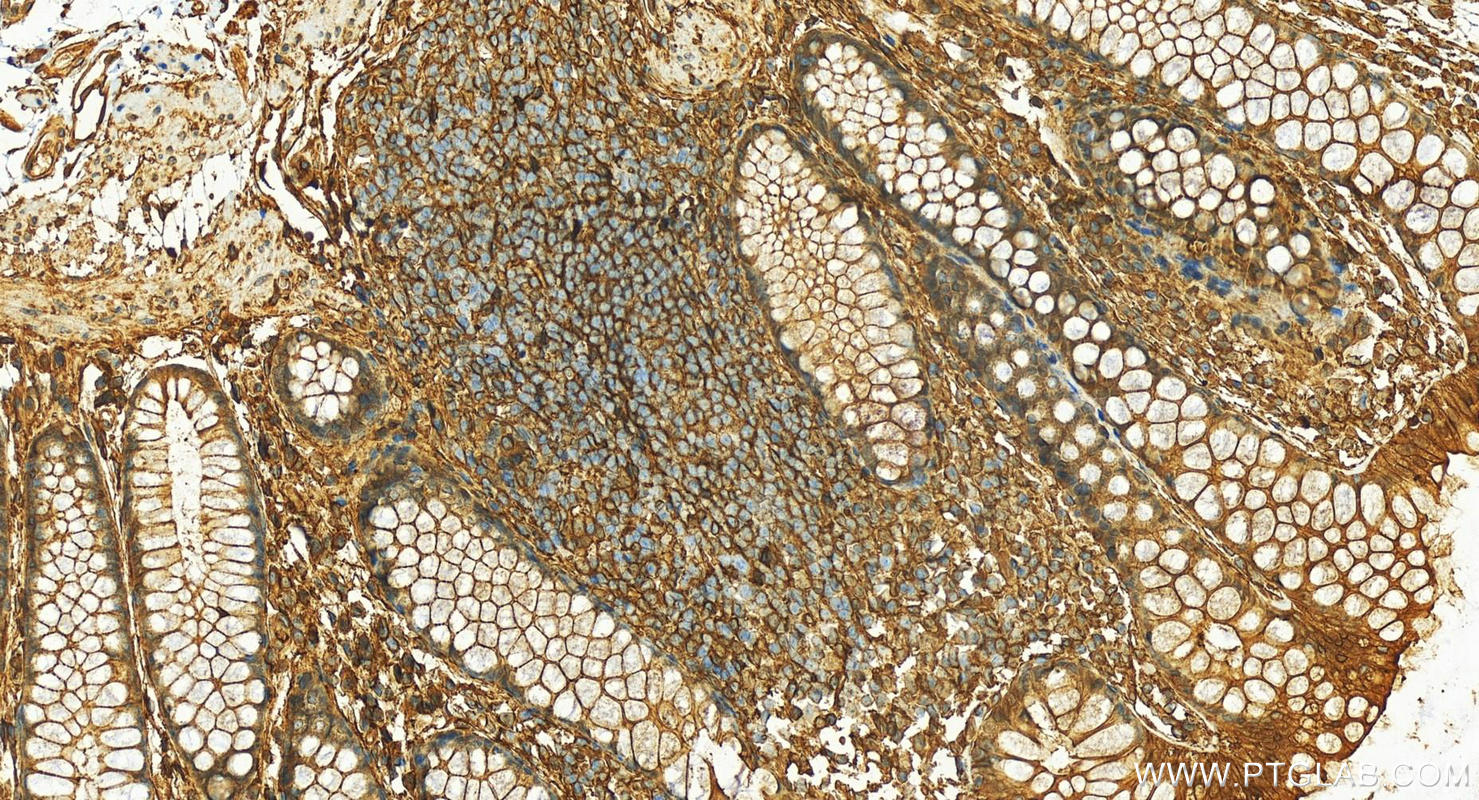

Tested Applications
| Positive WB detected in | HuH-7 cells, RAW 264.7 cells, C6 |
| Positive IHC detected in | human colon tissue Note: suggested antigen retrieval with TE buffer pH 9.0; (*) Alternatively, antigen retrieval may be performed with citrate buffer pH 6.0 |
Recommended dilution
| Application | Dilution |
|---|---|
| Western Blot (WB) | WB : 1:1000-1:8000 |
| Immunohistochemistry (IHC) | IHC : 1:400-1:1600 |
| It is recommended that this reagent should be titrated in each testing system to obtain optimal results. | |
| Sample-dependent, Check data in validation data gallery. | |
Product Information
10087-1-AP targets Annexin A4 in WB, IHC, ELISA applications and shows reactivity with human, mouse, rat samples.
| Tested Reactivity | human, mouse, rat |
| Cited Reactivity | human, mouse |
| Host / Isotype | Rabbit / IgG |
| Class | Polyclonal |
| Type | Antibody |
| Immunogen |
CatNo: Ag0130 Product name: Recombinant human Annexin IV protein Source: e coli.-derived, PGEX-4T Tag: GST Domain: 33-202 aa of BC000182 Sequence: GTDEDAIISVLAYRNTAQRQEIRTAYKSTIGRDLIDDLKSELSGNFEQVIVGMMTPTVLYDVQELRRAMKGAGTDEGCLIEILASRTPEEIRRISQTYQQQYGRSLEDDIRSDTSFMFQRVLVSLSAGGRDEGNYLDDALVRQDAQDLYEAGEKKWGTDEVKFLTVLCSR Predict reactive species |
| Full Name | annexin A4 |
| Calculated Molecular Weight | 36 kDa |
| Observed Molecular Weight | 36 kDa |
| GenBank Accession Number | BC000182 |
| Gene Symbol | Annexin A4 |
| Gene ID (NCBI) | 307 |
| RRID | AB_2057474 |
| Conjugate | Unconjugated |
| Form | Liquid |
| Purification Method | Antigen affinity purification |
| UNIPROT ID | P09525 |
| Storage Buffer | PBS with 0.02% sodium azide and 50% glycerol, pH 7.3. |
| Storage Conditions | Store at -20°C. Stable for one year after shipment. Aliquoting is unnecessary for -20oC storage. 20ul sizes contain 0.1% BSA. |
Background Information
Annexin A4 (Anxa4) is one of the Ca2 +-regulated and phospholipid-binding annexin superfamily proteins, and is located at 2p13. Anxa4 has a potential role in diagnosis, prognosis, and treatment of certain cancers. Annexin A4 shares 45 to 59% identity with other members and possibly interacts with ATP. Annexin A4 has in vitro anticoagulant activity and also inhibits phospholipase A2 activity. The Annexin A4 protein is expressed in a wide range of tissues, associated with polarized epithelial cells and is proposed to be involved in the regulation of chloride ions across the epithelial membrane.
Protocols
| Product Specific Protocols | |
|---|---|
| IHC protocol for Annexin A4 antibody 10087-1-AP | Download protocol |
| WB protocol for Annexin A4 antibody 10087-1-AP | Download protocol |
| Standard Protocols | |
|---|---|
| Click here to view our Standard Protocols |
Publications
What published studies show
The anti-Annexin A4 antibody (Cat# 10087-1-AP) has 7 total citations published in journals including Molecular & Cellular Proteomics, Aging, Scientific Reports, Journal of Immunology, Molecular Immunology, and PLoS ONE. Research fields span proteomics, HIV exosome profiling, colorectal cancer metastasis, airway progenitor cell migration, intestinal ischemia-reperfusion injury, natural antibody recognition of post-translational modifications, and selenium-binding protein metabolic pathways. Applications cited include WB and IHC in human and mouse samples.
| Species | Application | Title |
|---|---|---|
Mol Cell Proteomics Proteomics Profiling of Autologous Blood and Semen Exosomes from HIV-infected and Uninfected Individuals Reveals Compositional and Functional Variabilities. | ||
Mol Cell Proteomics Proteomics analyses of human optic nerve head astrocytes following biomechanical strain. | ||
Aging (Albany NY) Membrane-cytoplasm translocation of annexin A4 is involved in the metastasis of colorectal carcinoma. | ||
Sci Rep Anxa4 mediated airway progenitor cell migration promotes distal epithelial cell fate specification. | ||
J Immunol Pathogenic natural antibodies recognizing annexin IV are required to develop intestinal ischemia-reperfusion injury. | ||
Mol Immunol Highly pathogenic natural monoclonal antibody B4-IgM recognizes a post-translational modification comprised of acetylated N-terminal methionine followed by aspartic or glutamic acid |
Reviews
What customers say
One reviewer (Yuan Lyu) rated this antibody 5 out of 5 stars in September 2019, using a 1:1000 dilution for Western Blot and Immunoprecipitation on HeLa cells (lot 10001760). They reported that the antibody was working very well on HeLa cells. Overall, the single review reflects a positive experience with strong performance in both WB and IP applications.
The reviews below have been submitted by verified Proteintech customers who received an incentive for providing their feedback.
Yuan (Verified Customer) (09-30-2019) | The antibody is working very well on HeLa cells.
|




