

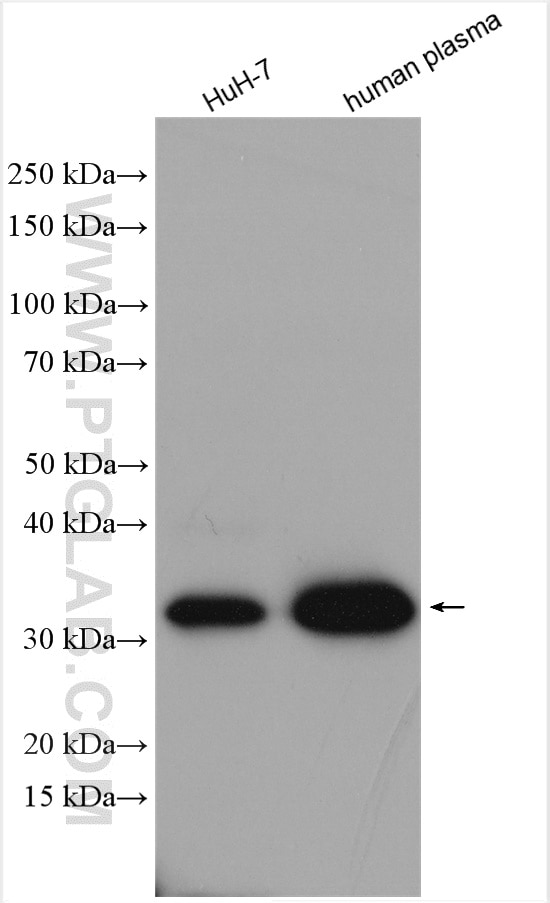



Tested Applications
| Positive WB detected in | HepG2 cells, HuH-7 cells, human plasma |
| Positive IHC detected in | human skin cancer tissue Note: suggested antigen retrieval with TE buffer pH 9.0; (*) Alternatively, antigen retrieval may be performed with citrate buffer pH 6.0 |
| Positive IF/ICC detected in | HepG2 cells |
Recommended dilution
| Application | Dilution |
|---|---|
| Western Blot (WB) | WB : 1:1000-1:6000 |
| Immunohistochemistry (IHC) | IHC : 1:300-1:1200 |
| Immunofluorescence (IF)/ICC | IF/ICC : 1:200-1:800 |
| It is recommended that this reagent should be titrated in each testing system to obtain optimal results. | |
| Sample-dependent, Check data in validation data gallery. | |
Product Information
18254-1-AP targets APOE in WB, IHC, IF/ICC, ELISA applications and shows reactivity with human samples.
| Tested Reactivity | human |
| Cited Reactivity | human, mouse |
| Host / Isotype | Rabbit / IgG |
| Class | Polyclonal |
| Type | Antibody |
| Immunogen |
CatNo: Ag13070 Product name: Recombinant human APOE protein Source: e coli.-derived, PGEX-4T Tag: GST Domain: 18-284 aa of BC003557 Sequence: AKVEQAVETEPEPELRQQTEWQSGQRWELALGRFWDYLRWVQTLSEQVQEELLSSQVTQELRALMDETMKELKAYKSELEEQLTPVAEETRARLSKELQAAQARLGADMEDVCGRLVQYRGEVQAMLGQSTEELRVRLASHLRKLRKRLLRDADDLQKRLAVYQAGAREGAERGLSAIRERLGPLVEQGRVRAATVGSLAGQPLQERAQAWGERLRARMEEMGSRTRDRLDEVKEQVAEVRAKLEEQAQQIRLQAEAFQARLKSWFE Predict reactive species |
| Full Name | Apolipoprotein E |
| Calculated Molecular Weight | 36 kDa |
| Observed Molecular Weight | 34-38 kDa |
| GenBank Accession Number | BC003557 |
| Gene Symbol | APOE |
| Gene ID (NCBI) | 348 |
| RRID | AB_2878525 |
| Conjugate | Unconjugated |
| Form | Liquid |
| Purification Method | Antigen affinity purification |
| UNIPROT ID | P02649 |
| Storage Buffer | PBS with 0.02% sodium azide and 50% glycerol, pH 7.3. |
| Storage Conditions | Store at -20°C. Stable for one year after shipment. Aliquoting is unnecessary for -20oC storage. 20ul sizes contain 0.1% BSA. |
Background Information
The apolipoprotein E (APOE) is a 299-amino acid polypeptide that mediates the binding, internalization, and catabolism of lipoprotein particles, and also serves as a ligand for the LDL (apo B/E) receptor and for the specific apo-E receptor (chylomicron remnant) of hepatic tissues. The very strong association of the APOE ɛ4 allele with AD risk and its role in the accumulation of amyloid β in brains of people and animal models solidify the biological relevance of APOE isoforms but do not provide mechanistic insight. APOE can be detected 43kDa and 69kDa dimers (PMID: 9831633).
Protocols
| Product Specific Protocols | |
|---|---|
| IF protocol for APOE antibody 18254-1-AP | Download protocol |
| IHC protocol for APOE antibody 18254-1-AP | Download protocol |
| WB protocol for APOE antibody 18254-1-AP | Download protocol |
| Standard Protocols | |
|---|---|
| Click here to view our Standard Protocols |
Publications
What published studies show
Anti-Apolipoprotein E antibody (Cat# 18254-1-AP) has 27 total citations. Publications appear in journals including Cell, Cell Metabolism, Nature Neuroscience, Cell Stem Cell, MedComm, PLoS Genetics, Journal of Virology, Arteriosclerosis Thrombosis and Vascular Biology, and British Journal of Cancer. Research fields span neuroscience (Alzheimer's disease, epilepsy, stroke), lipid metabolism, macrophage biology, oncology (glioma, pancreatic, colorectal cancer), cardiovascular disease, virology (SARS-CoV-2), and autoimmunity.
| Species | Application | Title |
|---|---|---|
Cell Metab Immune cells regulate circulating adipocyte extracellular vesicle levels in response to metabolic shifts. | ||
Cell Stem Cell Multi-omic analysis reveals retinoic acid molecular drivers for dermal fibrosis and regenerative repair in the skin. | ||
Nat Neurosci Lipid-accumulated reactive astrocytes promote disease progression in epilepsy | ||
MedComm (2020) ATP11B Modulates Microglial Lipid Metabolism and Alleviates Alzheimer's Disease Pathology
| ||
Arterioscler Thromb Vasc Biol Single-Cell RNA Sequencing of Coronary Perivascular Adipose Tissue From End-Stage Heart Failure Patients Identifies SPP1 + Macrophage Subpopulation as a Target for Alleviating Fibrosis |




