
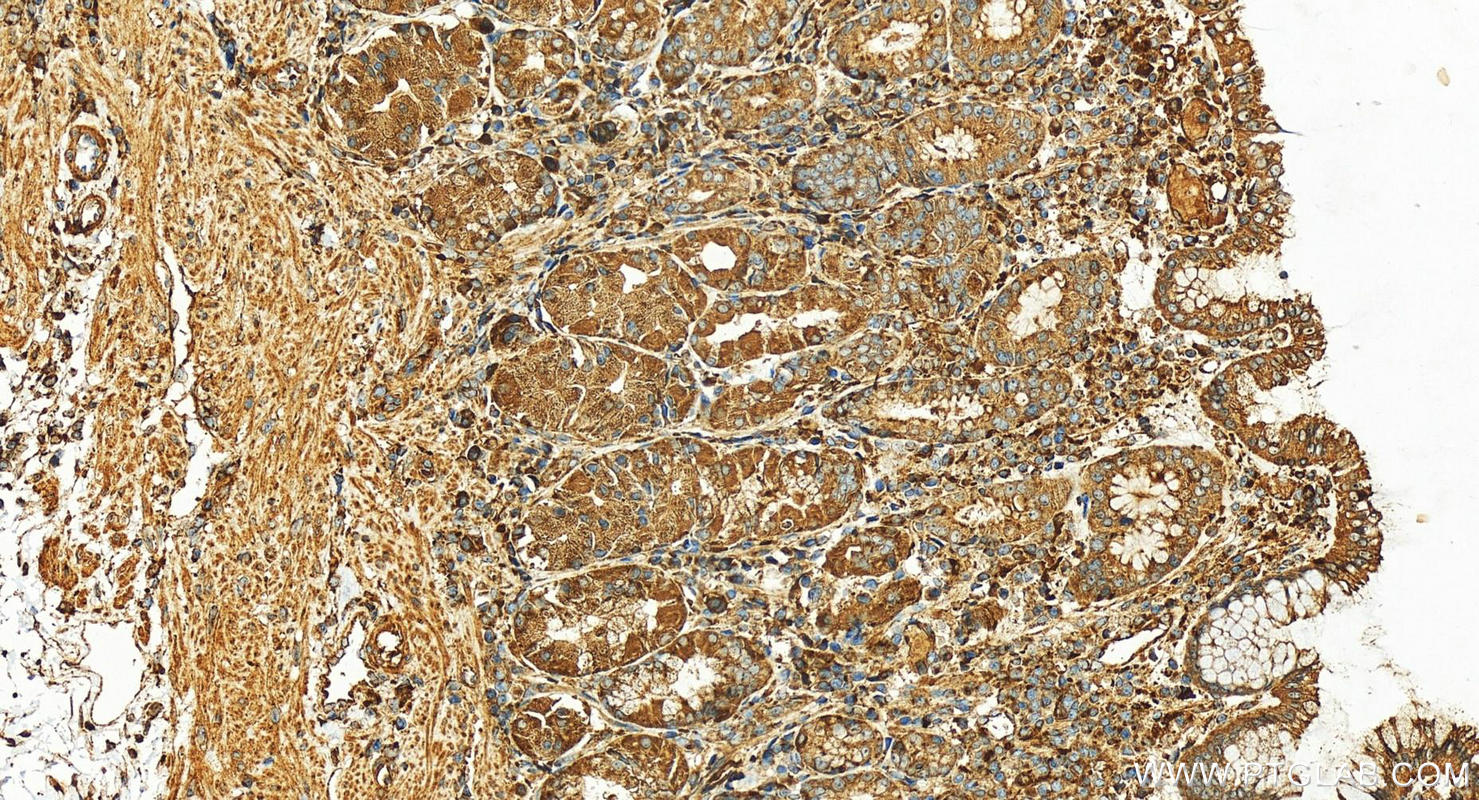

Tested Applications
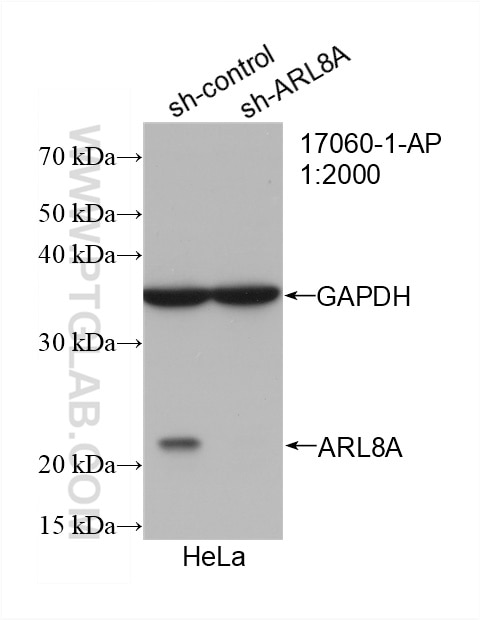
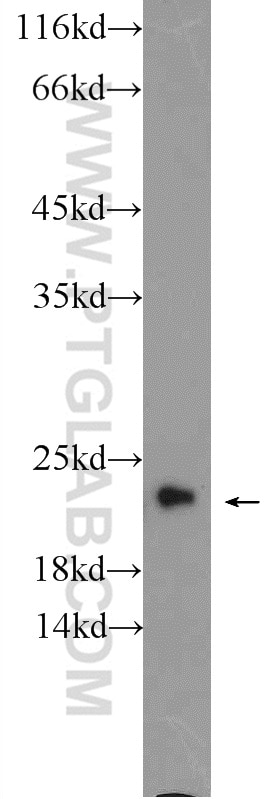
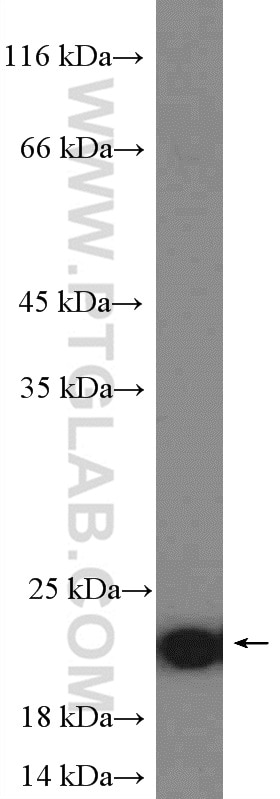
| Positive WB detected in | mouse brain tissue, HepG2 cells, HeLa cells |
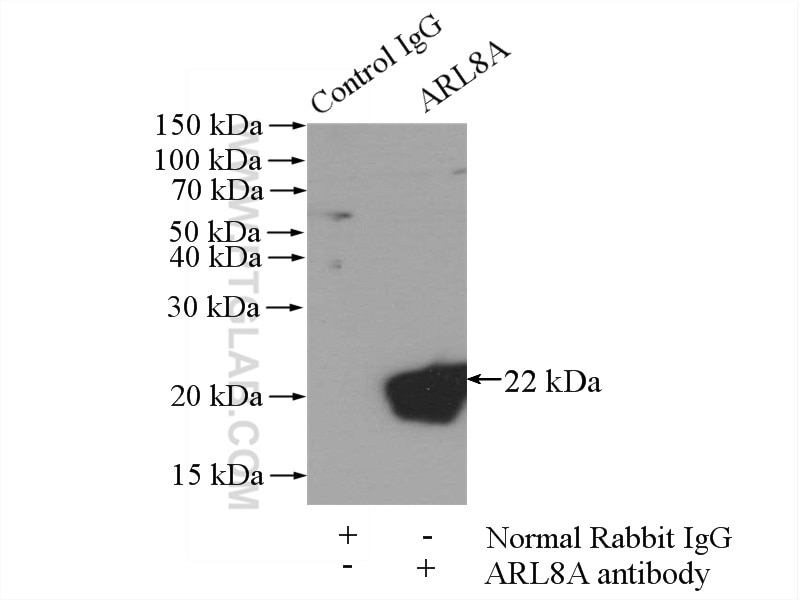
| Positive IP detected in | mouse brain tissue |
| Positive IHC detected in | human stomach tissue Note: suggested antigen retrieval with TE buffer pH 9.0; (*) Alternatively, antigen retrieval may be performed with citrate buffer pH 6.0 |
Recommended dilution
| Application | Dilution |
|---|---|
| Western Blot (WB) | WB : 1:500-1:1000 |
| Immunoprecipitation (IP) | IP : 0.5-4.0 ug for 1.0-3.0 mg of total protein lysate |
| Immunohistochemistry (IHC) | IHC : 1:50-1:500 |
| It is recommended that this reagent should be titrated in each testing system to obtain optimal results. | |
| Sample-dependent, Check data in validation data gallery. | |
Product Information
17060-1-AP targets ARL8A in WB, IHC, IF, IP, ELISA applications and shows reactivity with human, mouse samples.
| Tested Reactivity | human, mouse |
| Cited Reactivity | human, mouse, rat |
| Host / Isotype | Rabbit / IgG |
| Class | Polyclonal |
| Type | Antibody |
| Immunogen |
CatNo: Ag10788 Product name: Recombinant human ARL8A protein Source: e coli.-derived, PGEX-4T Tag: GST Domain: 1-186 aa of BC015408 Sequence: MIALFNKLLDWFKALFWKEEMELTLVGLQYSGKTTFVNVIASGQFNEDMIPTVGFNMRKITKGNVTIKLWDIGGQPRFRSMWERYCRGVSAIVYMVDAADQEKIEASKNELHNLLDKPQLQGIPVLVLGNKRDLPGALDEKELIEKMNLSAIQDREICCYSISCKEKDNIDITLQWLIQHSKSRRS Predict reactive species |
| Full Name | ADP-ribosylation factor-like 8A |
| Calculated Molecular Weight | 186 aa, 21 kDa |
| Observed Molecular Weight | 22 kDa |
| GenBank Accession Number | BC015408 |
| Gene Symbol | ARL8A |
| Gene ID (NCBI) | 127829 |
| RRID | AB_2058998 |
| Conjugate | Unconjugated |
| Form | Liquid |
| Purification Method | Antigen affinity purification |
| UNIPROT ID | Q96BM9 |
| Storage Buffer | PBS with 0.02% sodium azide and 50% glycerol, pH 7.3. |
| Storage Conditions | Store at -20°C. Stable for one year after shipment. Aliquoting is unnecessary for -20oC storage. 20ul sizes contain 0.1% BSA. |
Background Information
ARL8A (ADP-ribosylation factor-like protein 8A) is also named as ARL10B, GIE2 and belongs to the small GTPase superfamily. ARL8A is localized to lysosomes in mammalian cells (PMID: 16537643). In neurons, ARL8A mediates the anterograde axonal long-range transport of presynaptic lysosome-related vesicles that are required for presynaptic biogenesis and synaptic function. ARL8A is upregulated in many cancers such as endometrial cancer (PMID: 32070877), colorectal cancer (PMID: 30546056) and inflammatory breast cancer (PMID: 27648361), and has been associated with poor survival outcomes. ARL8A has a calculated molecular weight of 21 kDa.
Protocols
| Product Specific Protocols | |
|---|---|
| IHC protocol for ARL8A antibody 17060-1-AP | Download protocol |
| IP protocol for ARL8A antibody 17060-1-AP | Download protocol |
| WB protocol for ARL8A antibody 17060-1-AP | Download protocol |
| Standard Protocols | |
|---|---|
| Click here to view our Standard Protocols |
Publications
What published studies show
The ARL8A Polyclonal antibody (Cat# 17060-1-AP) has 8 citations. They appear in Nature Communications, Current Biology, Journal of Cell Biology, Molecular Neurobiology, Journal of Cell Science, and Journal of Physiology. Research fields include lysosomal/endolysosomal trafficking, dynein and kinesin motor coupling, autophagy, exosome secretion, neural damage repair under oxidative stress, and intracellular cargo transport. Applications cited include Western blot and immunofluorescence in human, rat, and mouse samples.
| Species | Application | Title |
|---|---|---|
Nat Commun RUFY3 and RUFY4 are ARL8 effectors that promote coupling of endolysosomes to dynein-dynactin. | ||
Nat Commun DENND6A links Arl8b to a Rab34/RILP/dynein complex, regulating lysosomal positioning and autophagy | ||
Curr Biol ARL8 Relieves SKIP Autoinhibition to Enable Coupling of Lysosomes to Kinesin-1. | ||
J Cell Biol Specific KIF1A-adaptor interactions control selective cargo recognition.
| ||
Mol Neurobiol OSBP Participates in Neural Damage Repair by Regulating Lysosome Transport Under Oxidative Stress |






