

Tested Applications
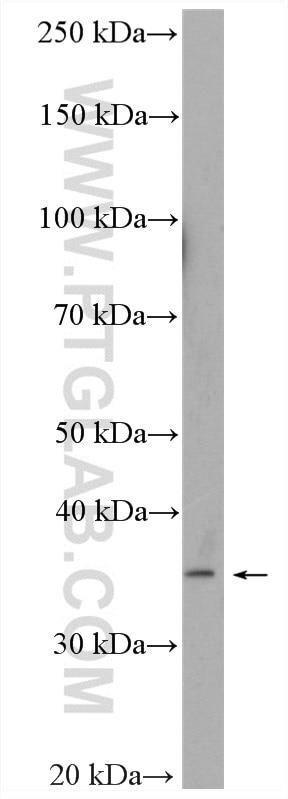
| Positive WB detected in | mouse small intestine tissue |
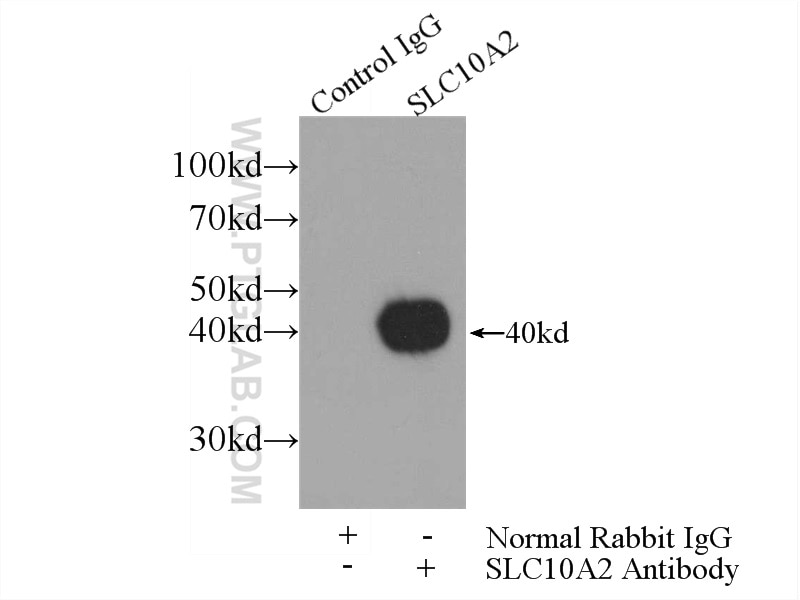
| Positive IP detected in | mouse kidney tissue |
Recommended dilution
| Application | Dilution |
|---|---|
| Western Blot (WB) | WB : 1:200-1:1000 |
| Immunoprecipitation (IP) | IP : 0.5-4.0 ug for 1.0-3.0 mg of total protein lysate |
| It is recommended that this reagent should be titrated in each testing system to obtain optimal results. | |
| Sample-dependent, Check data in validation data gallery. | |
Product Information
25245-1-AP targets SLC10A2/ASBT in WB, IHC, IF, IP, ELISA applications and shows reactivity with human, mouse samples.
| Tested Reactivity | human, mouse |
| Cited Reactivity | human, mouse, rat, hamster |
| Host / Isotype | Rabbit / IgG |
| Class | Polyclonal |
| Type | Antibody |
| Immunogen |
CatNo: Ag18808 Product name: Recombinant human SLC10A2 protein Source: e coli.-derived, PGEX-4T Tag: GST Domain: 292-348 aa of BC130523 Sequence: IYSIFQLAFAAIFLGFYVAYKKCHGKNKAEIPESKENGTEPESSFYKANGGFQPDEK Predict reactive species |
| Full Name | solute carrier family 10 (sodium/bile acid cotransporter family), member 2 |
| Calculated Molecular Weight | 348 aa, 38 kDa |
| Observed Molecular Weight | 38-40 kDa |
| GenBank Accession Number | BC130523 |
| Gene Symbol | ASBT |
| Gene ID (NCBI) | 6555 |
| RRID | AB_2879986 |
| Conjugate | Unconjugated |
| Form | Liquid |
| Purification Method | Antigen affinity purification |
| UNIPROT ID | Q12908 |
| Storage Buffer | PBS with 0.02% sodium azide and 50% glycerol, pH 7.3. |
| Storage Conditions | Store at -20°C. Stable for one year after shipment. Aliquoting is unnecessary for -20oC storage. 20ul sizes contain 0.1% BSA. |
Background Information
SLC10A2 also known as ASBT, ISBT, and NTCP2, is a sodium/bile acid cotransporter that is primarily responsible for the uptake of bile acids by apical cells in the distal ileum(PMID: 8661017). Mutations in SLC10A2 cause primary bile acid malabsorption (PBAM) and may be associated with other diseases of the liver and intestines, such as familial hypertriglyceridemia (FHTG)(PMID: 9109432).
Protocols
| Product Specific Protocols | |
|---|---|
| IP protocol for SLC10A2/ASBT antibody 25245-1-AP | Download protocol |
| WB protocol for SLC10A2/ASBT antibody 25245-1-AP | Download protocol |
| Standard Protocols | |
|---|---|
| Click here to view our Standard Protocols |
Publications
What published studies show
The SLC10A2/ASBT Polyclonal antibody (Cat# 25245-1-AP) has 30 citations across journals including Cell, Gastroenterology, Cell Host Microbe, Nature Communications, Advanced Science, Pharmacological Research, Phytomedicine, JHEP Reports, and Molecular Nutrition & Food Research. Research fields span bile acid metabolism, cholestasis, gut–liver axis signaling, cholesterol/hyperlipidemia, liver injury, colorectal cancer, gut microbiota modulation, and drug delivery/nanomedicine.
| Species | Application | Title |
|---|---|---|
Cell An anaerobic pathogen rewires host metabolism to fuel oxidative growth in the inflamed gut. | ||
Gastroenterology Solute Carrier Organic Anion Transporter Family Member 3A1 Is a Bile Acid Efflux Transporter in Cholestasis. | ||
Cell Host Microbe Veillonella intestinal colonization promotes C. difficile infection in Crohn's disease | ||
Nat Commun Hypothalamic SLC7A14 accounts for aging-reduced lipolysis in white adipose tissue of male mice | ||
Nat Commun Bile acids-mediated intracellular cholesterol transport promotes intestinal cholesterol absorption and NPC1L1 recycling | ||
Adv Sci (Weinh) The KDM6B/SLC10A2 Axis Suppresses MDSCs Recruitment via ERK/AP-1 Signaling in Colorectal Cancer.
|
Reviews
What customers say
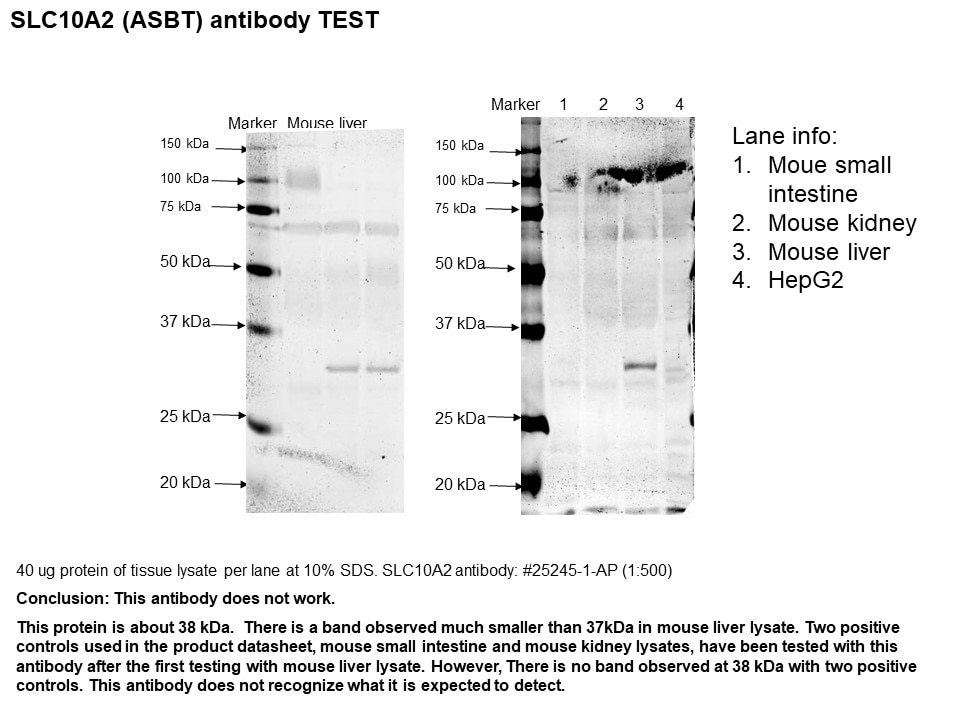
The single review for this product is negative, with a 1-star rating. The user tested it by Western Blot at a 1:500 dilution on mouse liver, mouse small intestine, mouse kidney, and HepG2 cells, and reported that it did not work as expected. No further details were provided.
The reviews below have been submitted by verified Proteintech customers who received an incentive for providing their feedback.
Hua (Verified Customer) (12-01-2020) | It does not work as expected.
 |



