

Tested Applications
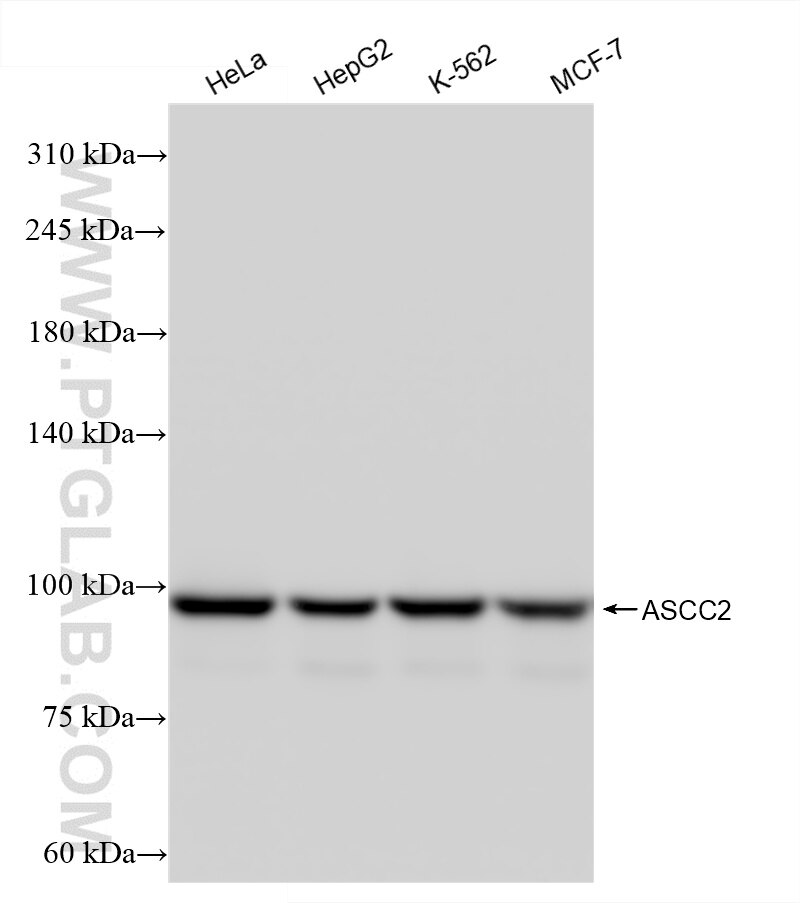
| Positive WB detected in | HeLa cells, HepG2 cells, K-562 cells, MCF-7 cells |
Recommended dilution
| Application | Dilution |
|---|---|
| Western Blot (WB) | WB : 1:5000-1:50000 |
| It is recommended that this reagent should be titrated in each testing system to obtain optimal results. | |
| Sample-dependent, Check data in validation data gallery. | |
Product Information
86086-2-RR targets ASCC2 in WB, ELISA applications and shows reactivity with human samples.
| Tested Reactivity | human |
| Host / Isotype | Rabbit / IgG |
| Class | Recombinant |
| Type | Antibody |
| Immunogen |
CatNo: Ag2100 Product name: Recombinant human ASCC2 protein Source: e coli.-derived, PGEX-4T Tag: GST Domain: 408-757 aa of BC025368 Sequence: RRKATDAKDPSVIEEPNGEPNGVTVTAEAVSQASSHPENSEEEECMGAAAAVGPAMCGVELDSLISQVKDLLPDLGEGFILACLEYYHYDPEQVINNILEERLAPTLSQLDRNLDREMKPDPTPLLTSRHNVFQNDEFDVFSRDSVDLSRVHKGKSTRKEENTRSLLNDKRAVAAQRQRYEQYSVVVEEVPLQPGESLPYHSVYYEDEYDDTYDGNQVGANDADSDDELISRRPFTIPQVLRTKVPREGQEEDDDDEEDDADEEAPKPDHFVQDPAVLREKAEARRMAFLAKKGYRHDSSTAVAGSPRGHGQSRETTQERRKKEANKATRANHNRRTMADRKRSKGMIPS Predict reactive species |
| Full Name | activating signal cointegrator 1 complex subunit 2 |
| Calculated Molecular Weight | 757 aa, 86 kDa |
| Observed Molecular Weight | 90-100 kDa |
| GenBank Accession Number | BC025368 |
| Gene Symbol | ASCC2 |
| Gene ID (NCBI) | 84164 |
| Conjugate | Unconjugated |
| Form | Liquid |
| Purification Method | Protein A purification |
| UNIPROT ID | Q9H1I8 |
| Storage Buffer | PBS with 0.02% sodium azide and 50% glycerol, pH 7.3. |
| Storage Conditions | Store at -20°C. Stable for one year after shipment. Aliquoting is unnecessary for -20oC storage. 20ul sizes contain 0.1% BSA. |
Background Information
ASCC2, also known as ASC1p100, is a subunit of the activating signal cointegrator 1 complex. ASCC2 plays a role in DNA damage repair as a component of the ASCC complex, recruiting ASCC3 and ALKBH3 to sites of DNA damage by binding to polyubiquitinated proteins that have 'Lys-63'-linked polyubiquitin chains. Additionally, it is part of the ASC-1 complex that enhances NF-kappa-B, SRF, and AP1 transactivation(PMID: 29144457, 12077347).


