
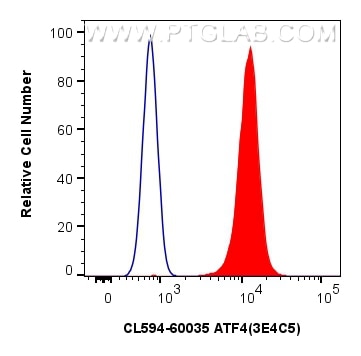
Tested Applications
| Positive FC (Intra) detected in | HeLa cells |
Recommended dilution
| Application | Dilution |
|---|---|
| Flow Cytometry (FC) (INTRA) | FC (INTRA) : 0.40 ug per 10^6 cells in a 100 µl suspension |
| It is recommended that this reagent should be titrated in each testing system to obtain optimal results. | |
| Sample-dependent, Check data in validation data gallery. | |
Published Applications
| WB | See 1 publications below |
Product Information
CL594-60035 targets ATF4 in WB, FC (Intra) applications and shows reactivity with human samples.
| Tested Reactivity | human |
| Cited Reactivity | mouse |
| Host / Isotype | Mouse / IgG1 |
| Class | Monoclonal |
| Type | Antibody |
| Immunogen |
CatNo: Ag1279 Product name: Recombinant human ATF4 protein Source: e coli.-derived, PGEX-4T Tag: GST Domain: 1-351 aa of BC022088 Sequence: MTEMSFLSSEVLVGDLMSPFDQSGLGAEESLGLLDDYLEVAKHFKPHGFSSDKAKAGSSEWLAVDGLVSPSNNSKEDAFSGTDWMLEKMDLKEFDLDALLGIDDLETMPDDLLTTLDDTCDLFAPLVQETNKQPPQTVNPIGHLPESLTKPDQVAPFTFLQPLPLSPGVLSSTPDHSFSLELGSEVDITEGDRKPDYTAYVAMIPQCIKEEDTPSDNDSGICMSPESYLGSPQHSPSTRGSPNRSLPSPGVLCGSARPKPYDPPGEKMVAAKVKGEKLDKKLKKMEQNKTAATRYRQKKRAEQEALTGECKELEKKNEALKERADSLAKEIQYLKDLIEEVRKARGKKRVP Predict reactive species |
| Full Name | activating transcription factor 4 (tax-responsive enhancer element B67) |
| Calculated Molecular Weight | 39 kDa |
| Observed Molecular Weight | 45-50 kDa |
| GenBank Accession Number | BC022088 |
| Gene Symbol | ATF4 |
| Gene ID (NCBI) | 468 |
| RRID | AB_2883410 |
| Conjugate | CoraLite®594 Fluorescent Dye |
| Excitation/Emission Maxima Wavelengths | 588 nm / 604 nm |
| Excitation Laser | Yellow-Green Laser (561 nm) |
| Form | Liquid |
| Purification Method | Protein G purification |
| UNIPROT ID | P18848 |
| Storage Buffer | PBS with 50% glycerol, 0.05% Proclin300, 0.5% BSA, pH 7.3. |
| Storage Conditions | Store at -20°C. Avoid exposure to light. Stable for one year after shipment. Aliquoting is unnecessary for -20oC storage. |
Background Information
What is the molecular weight of ATF4?
The molecular weight of ATF is 38.6 kD.
What is ATF4?
Activating transcription factor 4 (ATF4), also known as cAMP-response element-binding protein 2 (CREB2), is a substrate of RSK2 and a basic leucine-zipper transcription factor (PMIDs: 16000305, 17485283).
What the function of ATF4?
ATF4 its a transcription factor that controls the transcriptional activity of mature osteoblasts. ATF4 is particularly critical for their timely onset and terminal differentiation, as well as expression of Bsp and osteocalcin. Knockout animals displayed reduction or delay in bone mineralization and have severely reduced bone volume. ATF4 is also part of the PERK-eIF2α-ATF4-CHOP apoptosis pathway, which is activated by ER stress, and it likely plays a role related to tumor cell survival (PMIDs: 18083928, 16000305, 30134550).
What is the effect of ATF4 interaction with RSK2?
ATF4 and RSK2 posttranscriptionally regulate type I collagen synthesis. Lack of RSK2 phosphorylation of AFT4 may contribute to skeletal phenotypes associated with Coffin-Lowry Syndrome (PMID: 17485283).
Where is ATF4 expressed?
ATF4 protein is predominantly expressed in osteoblasts, although its corresponding Atf4 mRNA is ubiquitously expressed (PMID: 16000305).
What regulates ATF4 expression?
ATF4 is regulated by a ubiquitin/proteasomal pathway, which is less active in osteoblasts by inhibition with MG115 (PMID: 16000305).
How does ATF4 expression affect Ocn mRNA?
Inhibition of the degradation pathway leads to ATF4 accumulation and induces Ocn mRNA expression in non-osteoblastic cells (PMID: 16000305).
Does ATF4 have the ability to induce osteoblast-specific gene expression even in non-osteoblastic cells?
Yes, ATF4, as well as other osteoblast differentiation factors, has this ability. AFT4 interactions with Runx2 can stimulate osteoblast-specific osteocalcin gene expression. (PMIDs: 16000305, 17485283)
Publications
| Species | Application | Title |
|---|---|---|
J Clin Invest Sec13 promotes oligodendrocyte differentiation and myelin repair through autocrine pleiotrophin signaling. | ||


