
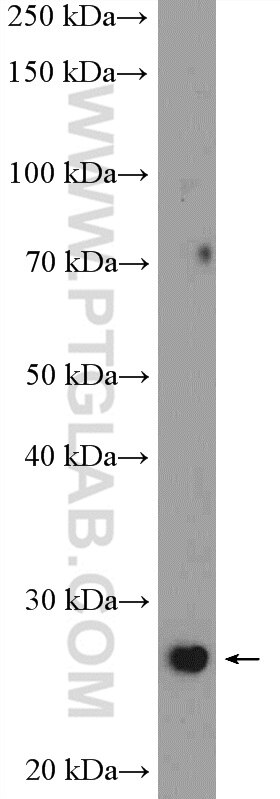
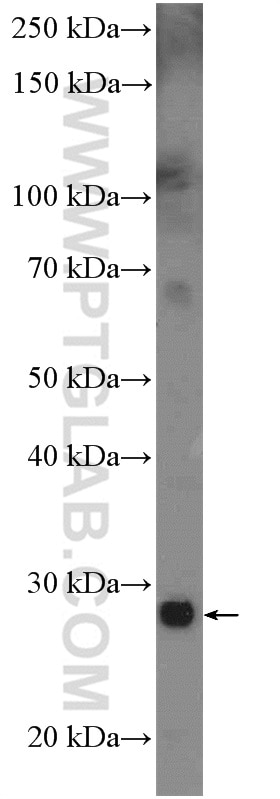

Tested Applications
| Positive WB detected in | BxPC-3 cells, A549 cells |
Recommended dilution
| Application | Dilution |
|---|---|
| Western Blot (WB) | WB : 1:200-1:1000 |
| It is recommended that this reagent should be titrated in each testing system to obtain optimal results. | |
| Sample-dependent, Check data in validation data gallery. | |
Product Information
15260-1-AP targets ATF5 in WB, ELISA applications and shows reactivity with human, mouse, rat samples.
| Tested Reactivity | human, mouse, rat |
| Cited Reactivity | mouse |
| Host / Isotype | Rabbit / IgG |
| Class | Polyclonal |
| Type | Antibody |
| Immunogen |
CatNo: Ag7214 Product name: Recombinant human ATF5 protein Source: e coli.-derived, PET28a Tag: 6*His Domain: 1-282 aa of BC005174 Sequence: MSLLATLGLELDRALLPASGLGWLVDYGKLPPAPAPLAPYEVLGGALEGGLPVGGEPLAGDGFSDWMTERVDFTALLPLEPPLPPGTLPQPSPTPPDLEAMASLLKKELEQMEDFFLDAPLLPPPSPPPLPPPPLPPAPSLPLSLPSFDLPQPPVLDTLDLLAIYCRNEAGQEEVGMPPLPPPQQPPPPSPPQPSRLAPYPHPATTRGDRKQKKRDQNKSAALRYRQRKRAEGEALEGECQGLEARNRELKERAESVEREIQYVKDLLIEVYKARSQRTRSC Predict reactive species |
| Full Name | activating transcription factor 5 |
| Calculated Molecular Weight | 31 kDa |
| Observed Molecular Weight | 27-30 kDa |
| GenBank Accession Number | BC005174 |
| Gene Symbol | ATF5 |
| Gene ID (NCBI) | 22809 |
| Conjugate | Unconjugated |
| Form | Liquid |
| Purification Method | Antigen affinity purification |
| UNIPROT ID | Q9Y2D1 |
| Storage Buffer | PBS with 0.02% sodium azide and 50% glycerol, pH 7.3. |
| Storage Conditions | Store at -20°C. Stable for one year after shipment. Aliquoting is unnecessary for -20oC storage. 20ul sizes contain 0.1% BSA. |
Background Information
ATF5, also named as Activating transcription factor 5, is a 282 amino acid protein, which belongs to the bZIP family. ATF5 is Widely expressed with higher expression levels in liver. ATF5 is actively transported to the centrosome and accumulated in the pericentriolar material (PCM) during G1 to M phase via a microtubule-dependent mechanism. During late telophase and cytokinesis, it translocates from the centrosome to the midbody (PMID: 26213385) . ATF5 as a transcription factor that either stimulates or represses gene transcription through binding of different DNA regulatory elements such as cAMP response element (CRE) (consensus: 5'-GTGACGT[AC][AG]-3'), ATF5-specific response element (ARE) (consensus: 5'-C[CT]TCT[CT]CCTT[AT]-3') but also the amino acid response element (AARE), present in many viral and cellular promoters. Critically ATF5 is involved, often in a cell type-dependent manner, in cell survival, proliferation, and differentiation (PubMed:10373550, PubMed:15358120, PubMed:21212266, PubMed:20654631).
Publications
What published studies show
The ATF5 Polyclonal antibody (Cat# 15260-1-AP) has a total of 2 citations. These appear in Hepatology and Journal of Ethnopharmacology. The research fields covered include metabolism (diet-induced obesity and insulin resistance) and cardiology/cell biology (cardiac dysfunction, mitochondrial unfolded protein response, and mitophagy). Both studies used the antibody for Western blot in mouse models.
| Species | Application | Title |
|---|---|---|
J Ethnopharmacol Xinyang tablet alleviated cardiac dysfunction in a cardiac pressure overload model by regulating the receptor-interacting serum/three-protein kinase 3/FUN14 domain containing 1-mediated mitochondrial unfolded protein response and mitophagy |



