
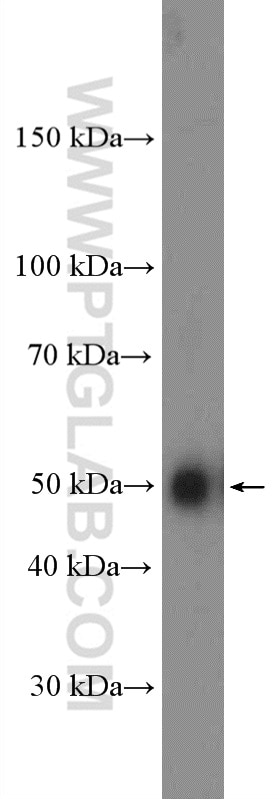
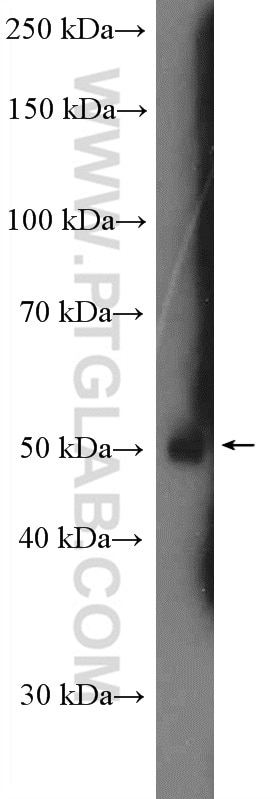
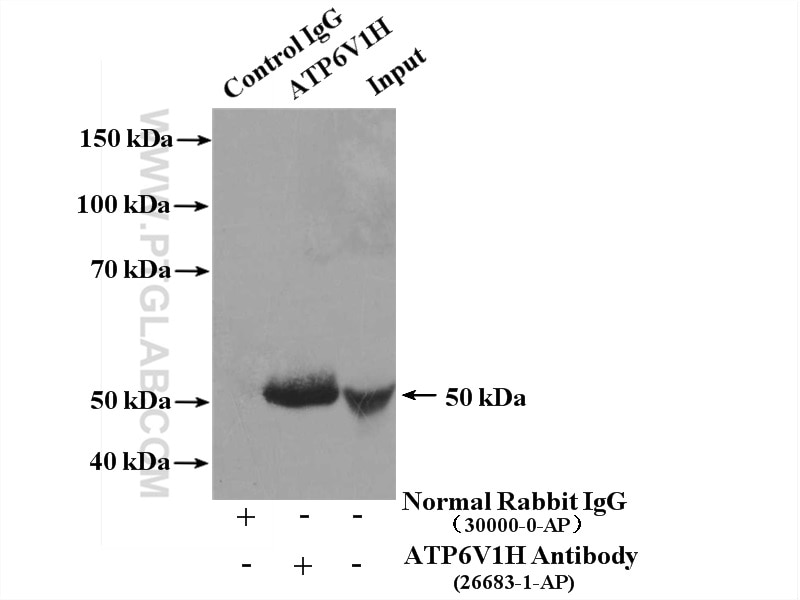

Tested Applications
| Positive WB detected in | mouse brain tissue, rat brain tissue |
| Positive IP detected in | mouse brain tissue |
Recommended dilution
| Application | Dilution |
|---|---|
| Western Blot (WB) | WB : 1:200-1:1000 |
| Immunoprecipitation (IP) | IP : 0.5-4.0 ug for 1.0-3.0 mg of total protein lysate |
| It is recommended that this reagent should be titrated in each testing system to obtain optimal results. | |
| Sample-dependent, Check data in validation data gallery. | |
Product Information
26683-1-AP targets ATP6V1H in WB, IP, ELISA applications and shows reactivity with human, mouse, rat samples.
| Tested Reactivity | human, mouse, rat |
| Cited Reactivity | human, mouse, rat |
| Host / Isotype | Rabbit / IgG |
| Class | Polyclonal |
| Type | Antibody |
| Immunogen |
CatNo: Ag24688 Product name: Recombinant human ATP6V1H protein Source: e coli.-derived, PET30a Tag: 6*His Domain: 296-483 aa of BC025275 Sequence: STERETRQEYALAMIQCKVLKQLENLEQQKYDDEDISEDIKFLLEKLGESVQDLSSFDEYSSELKSGRLEWSPVHKSEKFWRENAVRLNEKNYELLKILTKLLEVSDDPQVLAVAAHDVGEYVRHYPRGKRVIEQLGGKQLVMNHMHHEDQQVRYNALLAVQKLMVHNWEYLGKQLQSEQPQTAAARS Predict reactive species |
| Full Name | ATPase, H+ transporting, lysosomal 50/57kDa, V1 subunit H |
| Calculated Molecular Weight | 483 aa, 56 kDa |
| Observed Molecular Weight | 50 kDa |
| GenBank Accession Number | BC025275 |
| Gene Symbol | ATP6V1H |
| Gene ID (NCBI) | 51606 |
| RRID | AB_2880601 |
| Conjugate | Unconjugated |
| Form | Liquid |
| Purification Method | Antigen affinity purification |
| UNIPROT ID | Q9UI12 |
| Storage Buffer | PBS with 0.02% sodium azide and 50% glycerol, pH 7.3. |
| Storage Conditions | Store at -20°C. Stable for one year after shipment. Aliquoting is unnecessary for -20oC storage. 20ul sizes contain 0.1% BSA. |
Background Information
The vacuolar-type H(+)-ATPase (V-ATPase) is responsible for the acidification of endosomes, lysosomes, and other intracellular organelles. It is also involved in hydrogen ion transport across the plasma membrane into the extracellular space. The V-ATPase is a multisubunit complex with cytosolic and transmembrane domains.
Protocols
| Product Specific Protocols | |
|---|---|
| IP protocol for ATP6V1H antibody 26683-1-AP | Download protocol |
| WB protocol for ATP6V1H antibody 26683-1-AP | Download protocol |
| Standard Protocols | |
|---|---|
| Click here to view our Standard Protocols |
Publications
What published studies show
The ATP6V1H polyclonal antibody (Cat# 26683-1-AP) has 16 citations across journals including Nature Communications, Molecular Cell, Cell Metabolism, Autophagy, Nature Structural & Molecular Biology, Developmental Cell, Frontiers in Immunology, International Journal of Molecular Sciences, Molecular Oncology, Journal of Cellular Physiology, Biochemical and Biophysical Research Communications, and Biophysical Reports. Research fields encompass V-ATPase structure and function, lysosomal biology, autophagy, innate immunity, glioblastoma, bone loss, hepatic injury, ferroptosis, and insulin secretion.
| Species | Application | Title |
|---|---|---|
Cell Metab ABCG2 is an itaconate exporter that limits antibacterial innate immunity by alleviating TFEB-dependent lysosomal biogenesis | ||
Autophagy A CRISPR-Cas9 screen identifies LAPTM4A (lysosomal protein transmembrane 4 alpha) as a key host barrier against PRRSV infection. | ||
Autophagy YWHA/14-3-3 proteins recognize phosphorylated TFEB by a noncanonical mode for controlling TFEB cytoplasmic localization. | ||
Autophagy Inhibition of autophagy and induction of glioblastoma cell death by NEO214, a perillyl alcohol-rolipram conjugate | ||
Nat Commun The V-ATPase/ATG16L1 axis drives membrane remodeling during epithelial morphogenesis. | ||
Nat Commun The V-ATPase/ATG16L1 axis drives membrane remodeling during epithelial morphogenesis. |




