



Tested Applications
| Positive WB detected in | HEK-293 cells, mouse testis tissue, human heart tissue, HeLa cells, Jurkat cells, mouse heart tissue |
| Positive IP detected in | mouse testis tissue |
| Positive IHC detected in | human liver tissue Note: suggested antigen retrieval with TE buffer pH 9.0; (*) Alternatively, antigen retrieval may be performed with citrate buffer pH 6.0 |
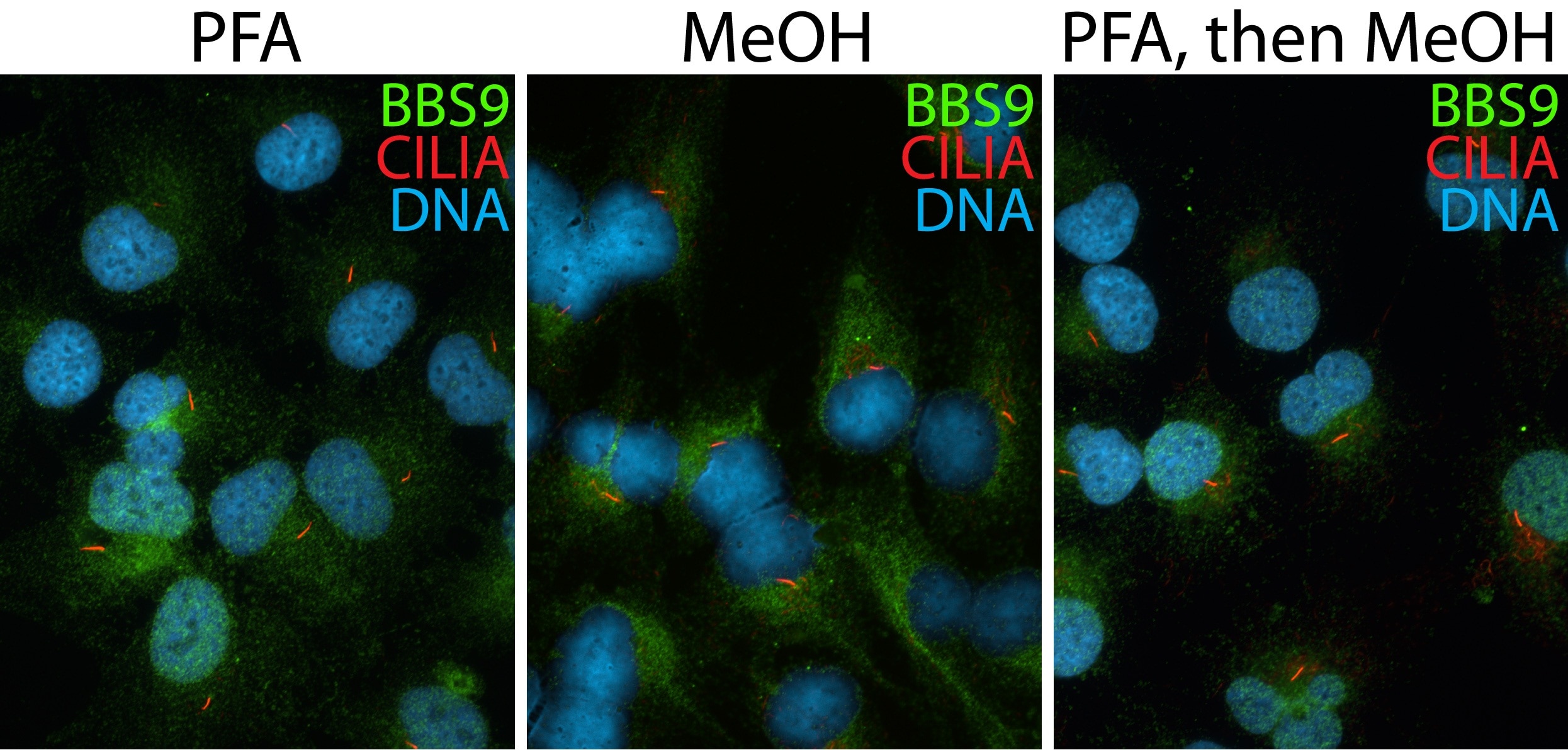
| Positive IF/ICC detected in | hTERT-RPE1 cells |
Recommended dilution
| Application | Dilution |
|---|---|
| Western Blot (WB) | WB : 1:500-1:1000 |
| Immunoprecipitation (IP) | IP : 0.5-4.0 ug for 1.0-3.0 mg of total protein lysate |
| Immunohistochemistry (IHC) | IHC : 1:20-1:200 |
| Immunofluorescence (IF)/ICC | IF/ICC : 1:10-1:100 |
| It is recommended that this reagent should be titrated in each testing system to obtain optimal results. | |
| Sample-dependent, Check data in validation data gallery. | |
Product Information
14460-1-AP targets BBS9 in WB, IHC, IF/ICC, IP, ELISA applications and shows reactivity with human, mouse samples.
| Tested Reactivity | human, mouse |
| Cited Reactivity | human, mouse |
| Host / Isotype | Rabbit / IgG |
| Class | Polyclonal |
| Type | Antibody |
| Immunogen |
CatNo: Ag5665 Product name: Recombinant human BBS9 protein Source: e coli.-derived, PET28a Tag: 6*His Domain: 1-310 aa of BC032715 Sequence: MGYLRIFSPHPAKTGDGAQAEDLLLEVDLRDPVLQVEVGKFVSGTEMLHLAVLHSRKLCVYSVSGTLGNVEHGNQCQMKLMYEHNLQRTACNMTYGSFGGVKGRDLICIQSMDGMLMVFEQESYAFGRFLPGFLLPGPLAYSSRTDSFLTVSSCQQVESYKYQVLAFATDADKRQETEQQKLGSGKRLVVDWTLNIGEQALDICIVSFNQSASSVFVLGERNFFCLKDNGQIRFMKKLDWSPSCFLPYCSVSEGTINTLIGNHNNMLHIYQDVTLKWATQLPHIPVAVRVGCLQFSLWKHLLPRSSTLEK Predict reactive species |
| Full Name | Bardet-Biedl syndrome 9 |
| Calculated Molecular Weight | 99 kDa |
| Observed Molecular Weight | 60 kDa |
| GenBank Accession Number | BC032715 |
| Gene Symbol | BBS9 |
| Gene ID (NCBI) | 27241 |
| RRID | AB_10598001 |
| Conjugate | Unconjugated |
| Form | Liquid |
| Purification Method | Antigen affinity purification |
| UNIPROT ID | Q3SYG4 |
| Storage Buffer | PBS with 0.02% sodium azide and 50% glycerol, pH 7.3. |
| Storage Conditions | Store at -20°C. Stable for one year after shipment. Aliquoting is unnecessary for -20oC storage. 20ul sizes contain 0.1% BSA. |
Protocols
| Product Specific Protocols | |
|---|---|
| IHC protocol for BBS9 antibody 14460-1-AP | Download protocol |
| IP protocol for BBS9 antibody 14460-1-AP | Download protocol |
| WB protocol for BBS9 antibody 14460-1-AP | Download protocol |
| Standard Protocols | |
|---|---|
| Click here to view our Standard Protocols |
Publications
What published studies show
The BBS9 Polyclonal antibody (Cat# 14460-1-AP) has 7 total citations. These appear in journals including Developmental Cell, PLoS Biology, EMBO Reports, Investigative Ophthalmology & Visual Science, Molecular Neurobiology, eLife, and Cell Communication and Signaling. Research fields span cilia biology and ciliogenesis, IFT/BBSome signaling, centrosome clustering, rod outer segment biogenesis, myelin regeneration in epilepsy-related cognitive impairment, and Shh signaling. Applications cited include Western blot and immunofluorescence in mouse and human samples.
| Species | Application | Title |
|---|---|---|
Dev Cell IFT27 Links the BBSome to IFT for Maintenance of the Ciliary Signaling Compartment. | ||
PLoS Biol Melanocortin 1 receptor mediates melanin production by interacting with the BBSome in primary cilia | ||
EMBO Rep IFT proteins interact with HSET to promote supernumerary centrosome clustering in mitosis. | ||
Mol Neurobiol SnRNA-seq Interprets Mechanisms by which Three Glial Cell Types Influence Myelin Regeneration in Adult Drug-Resistant Epilepsy-Related Cognitive Impairment | ||
Invest Ophthalmol Vis Sci Essential Role of the Chaperonin CCT in Rod Outer Segment Biogenesis. | ||
Reviews
What customers say
The single review for this product is highly positive, rated 5 stars. The reviewer used it on primary myoblasts for immunofluorescence and expansion microscopy, reporting that it works well for cilia and BBSome imaging. They recommended cold methanol fixation before staining and used a 1:500 dilution. Overall, the feedback highlights reliable performance and clear results in cilia-related applications.
The reviews below have been submitted by verified Proteintech customers who received an incentive for providing their feedback.
Lola (Verified Customer) (10-23-2025) | This antibody works well in immunofluorescence and expansion microscopy. Perfect for cilia and BBSome imaging. We use cold MeOH fixation before staining.
 |




