
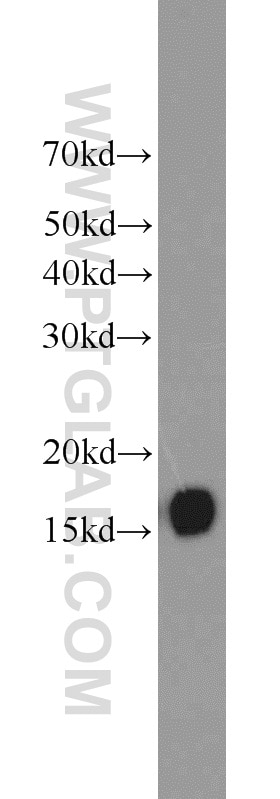
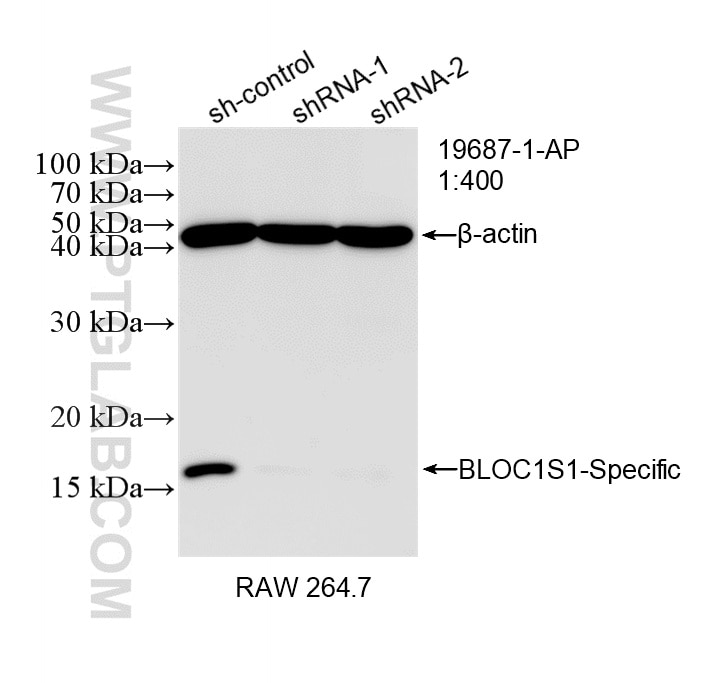
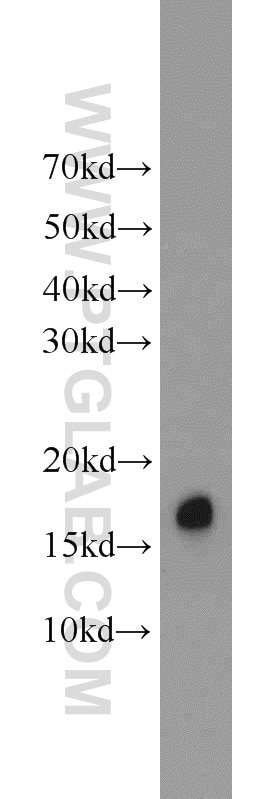
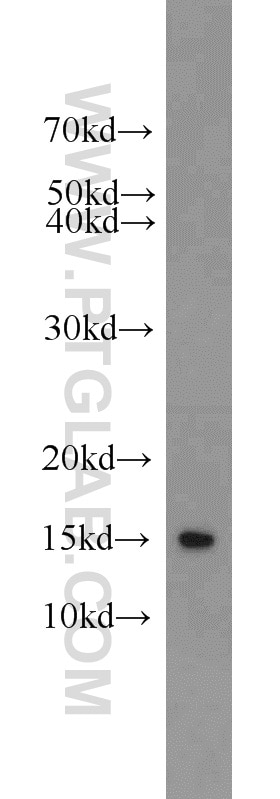

Tested Applications
| Positive WB detected in | human brain tissue, mouse brain tissue, rat brain tissue, RAW 264.7 cells |
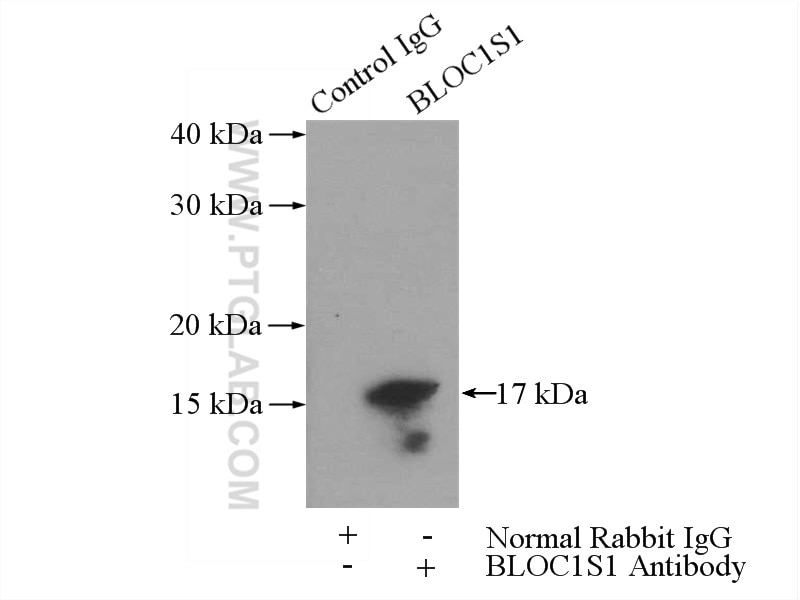
| Positive IP detected in | mouse brain tissue |
Recommended dilution
| Application | Dilution |
|---|---|
| Western Blot (WB) | WB : 1:500-1:2000 |
| Immunoprecipitation (IP) | IP : 0.5-4.0 ug for 1.0-3.0 mg of total protein lysate |
| It is recommended that this reagent should be titrated in each testing system to obtain optimal results. | |
| Sample-dependent, Check data in validation data gallery. | |
Product Information
19687-1-AP targets BLOC1S1-Specific in WB, IHC, IF, IP, ELISA applications and shows reactivity with human, mouse, rat samples.
| Tested Reactivity | human, mouse, rat |
| Cited Reactivity | human, mouse, rat |
| Host / Isotype | Rabbit / IgG |
| Class | Polyclonal |
| Type | Antibody |
| Immunogen |
Peptide Predict reactive species |
| Full Name | biogenesis of lysosomal organelles complex-1, subunit 1 |
| Calculated Molecular Weight | 17 kDa |
| Observed Molecular Weight | 14-17 kDa |
| GenBank Accession Number | NM_001487 |
| Gene Symbol | BLOC1S1 |
| Gene ID (NCBI) | 2647 |
| RRID | AB_10666440 |
| Conjugate | Unconjugated |
| Form | Liquid |
| Purification Method | Antigen affinity purification |
| UNIPROT ID | P78537 |
| Storage Buffer | PBS with 0.02% sodium azide and 50% glycerol, pH 7.3. |
| Storage Conditions | Store at -20°C. Stable for one year after shipment. Aliquoting is unnecessary for -20oC storage. 20ul sizes contain 0.1% BSA. |
Background Information
BLOC1S1, also named as BLOS1, GCN5L1 and RT14, belongs to the BLOC1S1 family. BLOC1S1 may be involved in the biogenesis of specialized organelles of the endosomal-lysosomal system. The antibody is specific to BLOC1S1.
Protocols
| Product Specific Protocols | |
|---|---|
| IP protocol for BLOC1S1-Specific antibody 19687-1-AP | Download protocol |
| WB protocol for BLOC1S1-Specific antibody 19687-1-AP | Download protocol |
| Standard Protocols | |
|---|---|
| Click here to view our Standard Protocols |
Publications
What published studies show
The GCN5L1 antibody (catalog no. 19687-1-AP) has 11 citations published in journals including Nature Communications, EMBO Journal, Circulation Research, Molecular Therapy, Autophagy, Molecular Medicine, Oxidative Medicine and Cellular Longevity, Molecular & Cellular Proteomics, Journal of Physiology and Biochemistry, FEBS Journal, and BMC Pregnancy and Childbirth. Associated research fields span neurodegeneration, ER stress, mitochondrial dysfunction, cardiovascular disease, ALS, diabetic nephropathy, oxidative stress, lipotoxicity, and cholestasis.
| Species | Application | Title |
|---|---|---|
Autophagy HIV-1 Vpr protein impairs lysosome clearance causing SNCA/alpha-synuclein accumulation in neurons. | ||
Nat Commun Decoding non-canonical mRNA decay by the endoplasmic-reticulum stress sensor IRE1α | ||
Mol Ther BLOC1S1 depletion via splice-switching oligonucleotides improves mitochondrial respiration and rescues ALS phenotypes. | ||
EMBO J Snapin promotes HIV-1 transmission from dendritic cells by dampening TLR8 signaling. | ||
Mol Med Drp1 acetylation mediated by CDK5-AMPK-GCN5L1 axis promotes cerebral ischemic injury via facilitating mitochondrial fission |






