
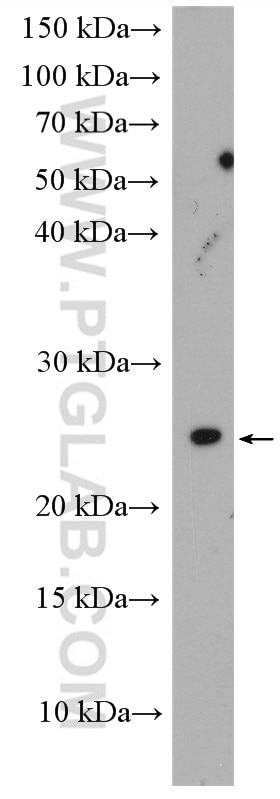
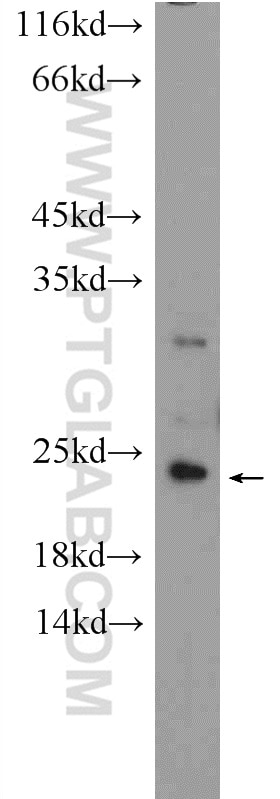

Tested Applications
| Positive WB detected in | mouse kidney tissue, mouse liver tissue |
Recommended dilution
| Application | Dilution |
|---|---|
| Western Blot (WB) | WB : 1:500-1:1000 |
| It is recommended that this reagent should be titrated in each testing system to obtain optimal results. | |
| Sample-dependent, Check data in validation data gallery. | |
Product Information
26036-1-AP targets CEP19 in WB, IF, IP, ELISA applications and shows reactivity with human, mouse, rat samples.
| Tested Reactivity | human, mouse, rat |
| Cited Reactivity | human, mouse |
| Host / Isotype | Rabbit / IgG |
| Class | Polyclonal |
| Type | Antibody |
| Immunogen |
CatNo: Ag22035 Product name: Recombinant human C3orf34 protein Source: e coli.-derived, PET28a Tag: 6*His Domain: 1-163 aa of BC007827 Sequence: MMCTAKKCGIRFQPPAIILIYESEIKGKIRQRIMPVRNFSKFSDCTRAAEQLKNNPRHKSYLEQVSLRQLEKLFSFLRGYLSGQSLAETMEQIQRETTIDPEEDLNKLDDKELAKRKSIMDELFEKNQKKKDDPNFVYDIEVEFPQDDQLQSCGWDTESADEF Predict reactive species |
| Full Name | chromosome 3 open reading frame 34 |
| Calculated Molecular Weight | 163 aa, 19 kDa |
| Observed Molecular Weight | 23 kDa |
| GenBank Accession Number | BC007827 |
| Gene Symbol | CEP19 |
| Gene ID (NCBI) | 84984 |
| RRID | AB_2651171 |
| Conjugate | Unconjugated |
| Form | Liquid |
| Purification Method | Antigen affinity purification |
| UNIPROT ID | Q96LK0 |
| Storage Buffer | PBS with 0.02% sodium azide and 50% glycerol, pH 7.3. |
| Storage Conditions | Store at -20°C. Stable for one year after shipment. Aliquoting is unnecessary for -20oC storage. 20ul sizes contain 0.1% BSA. |
Protocols
| Product Specific Protocols | |
|---|---|
| WB protocol for CEP19 antibody 26036-1-AP | Download protocol |
| Standard Protocols | |
|---|---|
| Click here to view our Standard Protocols |
Publications
What published studies show
The CEP19 Polyclonal antibody (Cat# 26036-1-AP) has 5 citations published in Nature Communications (2), Developmental Cell (2), and Scientific Reports (1). The associated research fields include ciliogenesis, intraflagellar transport, ciliary base architecture, basal foot structure, microtubule dynamics, and ciliary adhesion complexes in both human and mouse models.
| Species | Application | Title |
|---|---|---|
Nat Commun Microtubule asters anchored by FSD1 control axoneme assembly and ciliogenesis. | ||
Dev Cell Comparative Super-Resolution Mapping of Basal Feet Reveals a Modular but Distinct Architecture in Primary and Motile Cilia. | ||
Dev Cell The CEP19-RABL2 GTPase Complex Binds IFT-B to Initiate Intraflagellar Transport at the Ciliary Base. | ||
Sci Rep The apical ciliary adhesion complex is established at the basal foot of motile cilia and depends on the microtubule network |



