

Tested Applications
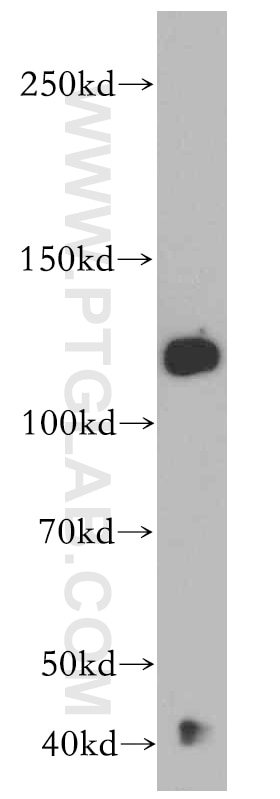
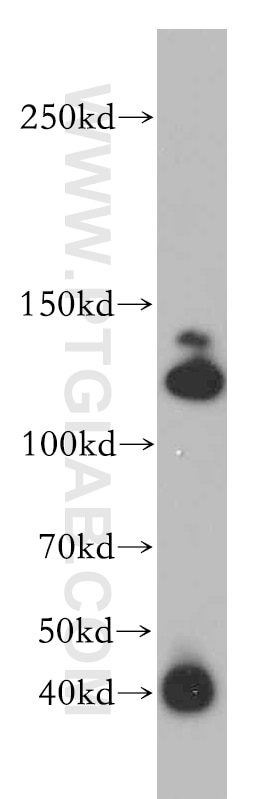
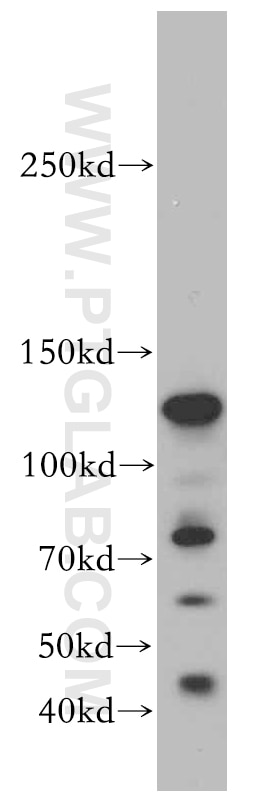
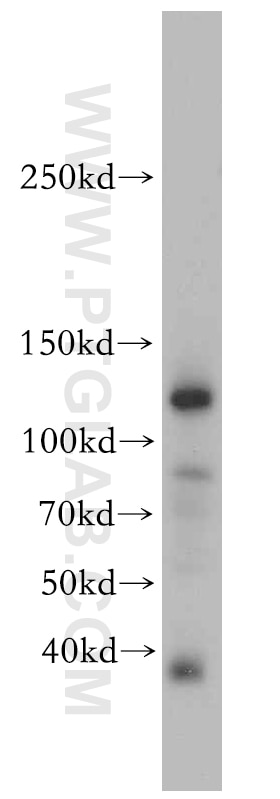
| Positive WB detected in | mouse brain tissue, human placenta tissue, mouse kidney tissue, SH-SY5Y cells |
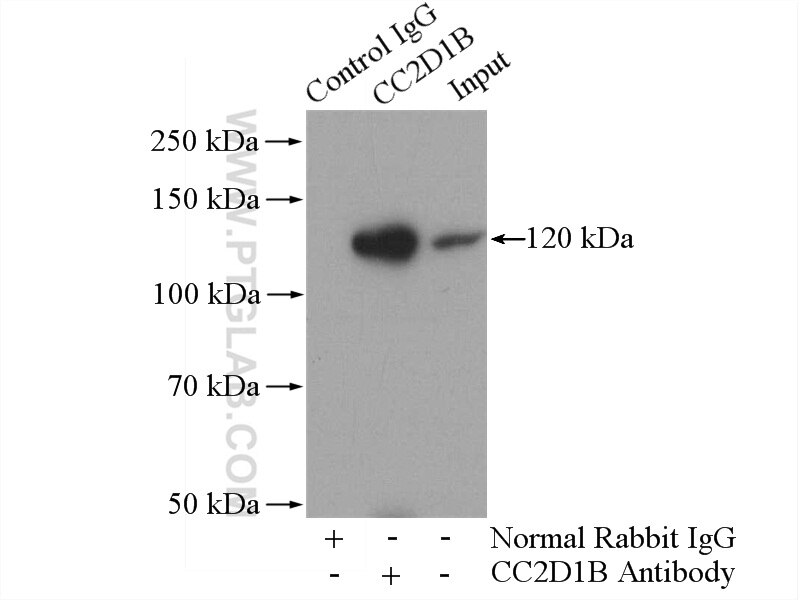
| Positive IP detected in | mouse brain tissue |
Recommended dilution
| Application | Dilution |
|---|---|
| Western Blot (WB) | WB : 1:1000-1:4000 |
| Immunoprecipitation (IP) | IP : 0.5-4.0 ug for 1.0-3.0 mg of total protein lysate |
| It is recommended that this reagent should be titrated in each testing system to obtain optimal results. | |
| Sample-dependent, Check data in validation data gallery. | |
Product Information
20774-1-AP targets CC2D1B in WB, IF, IP, ELISA applications and shows reactivity with human, mouse, rat samples.
| Tested Reactivity | human, mouse, rat |
| Cited Reactivity | human, mouse, rat |
| Host / Isotype | Rabbit / IgG |
| Class | Polyclonal |
| Type | Antibody |
| Immunogen |
CatNo: Ag14767 Product name: Recombinant human CC2D1B protein Source: e coli.-derived, PGEX-4T Tag: GST Domain: 468-767 aa of BC007912 Sequence: VAATLAAAEKLASAEDSAPADKDEDEGEPPAQAPVAKKPARPTVPSSQRLPEPRASSSKESPSPSVREQLALLEARKLQYQRAALQAKRSQDLEQAKAYLRVAKWLEAQIIQARSGRPVDLSKVPSPLTDEEGDFILIHHEDLRLSQKAEEVYAQLQKMLLEQQEKCLLFSKQFMHQGNVAETTRFEKLAQDRKKQLEILQLAQAQGLDPPTHHFELKTFQTVRIFSELNSTEMHLIIVRGMNLPAPPGVTPDDLDAFVRFEFHYPNSDQAQKSKTAVVKNTNSPEFDQLFKLNINRNHR Predict reactive species |
| Full Name | coiled-coil and C2 domain containing 1B |
| Calculated Molecular Weight | 858 aa, 94 kDa |
| Observed Molecular Weight | 120 kDa |
| GenBank Accession Number | BC007912 |
| Gene Symbol | CC2D1B |
| Gene ID (NCBI) | 200014 |
| RRID | AB_10693627 |
| Conjugate | Unconjugated |
| Form | Liquid |
| Purification Method | Antigen affinity purification |
| UNIPROT ID | Q5T0F9 |
| Storage Buffer | PBS with 0.02% sodium azide and 50% glycerol, pH 7.3. |
| Storage Conditions | Store at -20°C. Stable for one year after shipment. Aliquoting is unnecessary for -20oC storage. 20ul sizes contain 0.1% BSA. |
Background Information
CC2D1B/Freud2 and CC2D1A/Freud1 are two homologs belonging to the evolutionary conserved Lgd protein family that is involved in endosomal trafficking. CC2D1B has been identified as the novel repressor of postsynaptic 5-HT1A expression. The predicted molecular weight of CC2D1B is 89 kDa, but the observed molecular weight is around 120 kDa, which may be caused by post-translational modification. This antibody is specific to CC2D1B, which has been confirmed by siRNA test. (19423080 , 2672064)
Protocols
| Product Specific Protocols | |
|---|---|
| IP protocol for CC2D1B antibody 20774-1-AP | Download protocol |
| WB protocol for CC2D1B antibody 20774-1-AP | Download protocol |
| Standard Protocols | |
|---|---|
| Click here to view our Standard Protocols |
Publications
What published studies show
The Anti-CC2D1A antibody (Cat# 20774-1-AP) has 8 citations. These appear in Nature Communications, Molecular Cell Proteomics, Frontiers in Molecular Neuroscience, PLoS Genetics, Biological & Pharmaceutical Bulletin, and bioRxiv. Research fields span HIV antiviral mechanisms, neuronal interactome and postsynaptic biology, Schwann cell myelination, endocytic pathway regulation, breast cancer EMT/stemness, and cognitive/metabolic phenotypes. Applications include WB, IF, and IP across human, mouse, and rat species.
| Species | Application | Title |
|---|---|---|
Nat Commun Replication competent HIV-guided CRISPR screen identifies antiviral factors including targets of the accessory protein Nef | ||
Mol Cell Proteomics Interactome Analysis of the CC2D1A Scaffold Reveals Novel Neuronal Interactions and a Postsynaptic Role. | ||
Front Mol Neurosci Cc2d1b Contributes to the Regulation of Developmental Myelination in the Central Nervous System.
| ||
PLoS Genet The Mammalian Orthologs of Drosophila Lgd, CC2D1A and CC2D1B, Function in the Endocytic Pathway, but Their Individual Loss of Function Does Not Affect Notch Signalling.
| ||
Biol Pharm Bull Icariin regulates EMT and stem cell-like character in breast cancer through modulating lncRNA NEAT1/TGFβ/SMAD2 signaling pathway |
Reviews
What customers say
The product received a 4-star rating from a user who tested it on murine hippocampus and cortex tissue for Western Blot and Immunoprecipitation applications. The reviewer reported positive results, stating it worked well for their experiments. Overall, the feedback indicates satisfactory performance for these applications in mouse brain tissue.
The reviews below have been submitted by verified Proteintech customers who received an incentive for providing their feedback.
Abigail (Verified Customer) (09-16-2019) | It worked well for us
|






