
Product Information
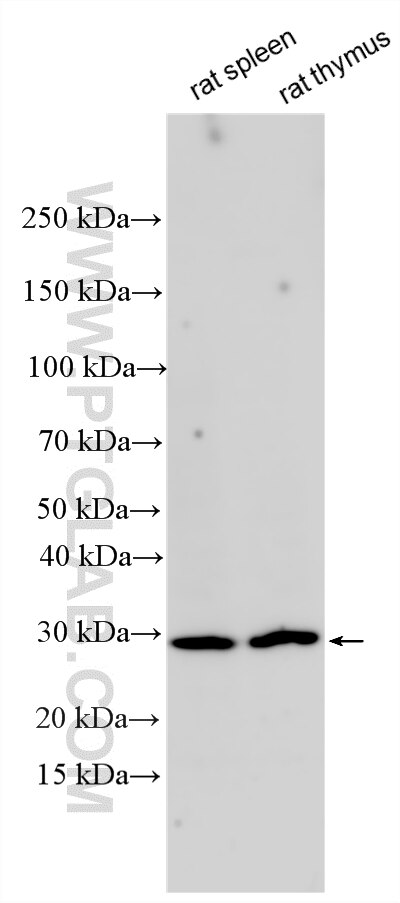
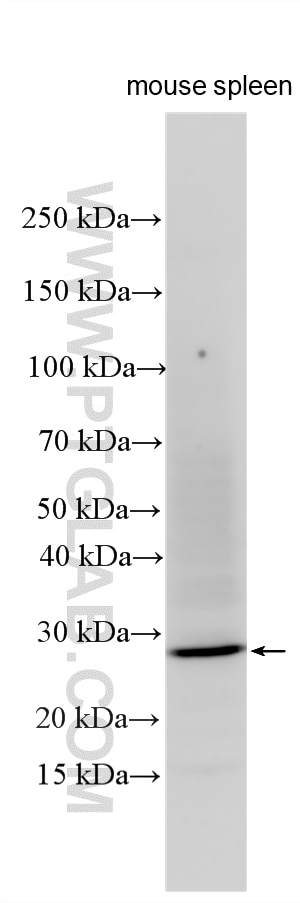
34143-1-PBS targets CD160 in WB, Indirect ELISA applications and shows reactivity with mouse, rat samples.
| Tested Reactivity | mouse, rat |
| Host / Isotype | Rabbit / IgG |
| Class | Polyclonal |
| Type | Antibody |
| Immunogen |
CatNo: Eg2585 Product name: recombinant mouse CD160 protein Source: mammalian cells-derived, pHZ-KIsec-C-rFc Tag: C-rFc Domain: 28-160 aa of NM_001163496.1 Sequence: GCIHVTSSASQKGGRLDLTCTLWHKKDEAEGLILFWCKDNPWNCSPETNLEQLRVKRDPETDGITEKSSQLVFTIEQATPSDSGTYQCCARSQKPEIYIHGHFLSVLVTGNHTEIRQRQRSHPDFSHINGTLS Predict reactive species |
| Full Name | CD160 antigen |
| Calculated Molecular Weight | 21kDa |
| Observed Molecular Weight | 27 kDa |
| GenBank Accession Number | NM_001163496.1 |
| Gene Symbol | Cd160 |
| Gene ID (NCBI) | 54215 |
| RRID | AB_3743162 |
| Conjugate | Unconjugated |
| Form | Liquid |
| Purification Method | Antigen affinity Purification |
| UNIPROT ID | O88875 |
| Storage Buffer | PBS only, pH 7.3. |
| Storage Conditions | Store at -80°C. |
Background Information
CD160 is a 27 kDa glycosylphosphatidylinositol (GPI)-anchored glycoprotein expressed on natural killer (NK) cells, T cell subsets (like cytotoxic T lymphocytes), and innate lymphoid cells. It functions as an activating or co-stimulatory receptor, depending on its ligand engagement. Its primary ligands are herpesvirus entry mediator (HVEM) and major histocompatibility complex class I chain-related molecules (MICs). The CD160-HVEM interaction plays a critical dual role: it can deliver co-stimulatory signals to enhance NK/T cell cytotoxicity and cytokine production, but it can also inhibit T cell responses by engaging HVEM-associated signaling pathways. Thus, CD160 is a key regulator in immune cell activation, tumor surveillance, and autoimmune pathology (PMID: 21324341, PMID: 24882258, PMID: 36420268, PMID: 38360636).



