
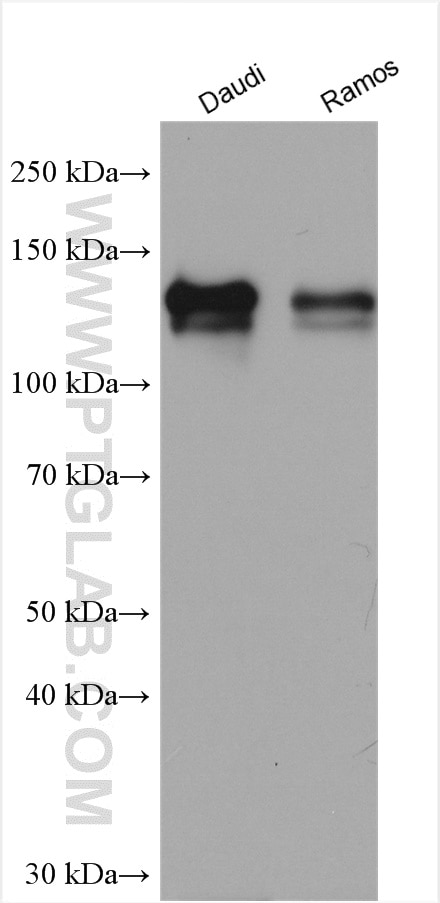
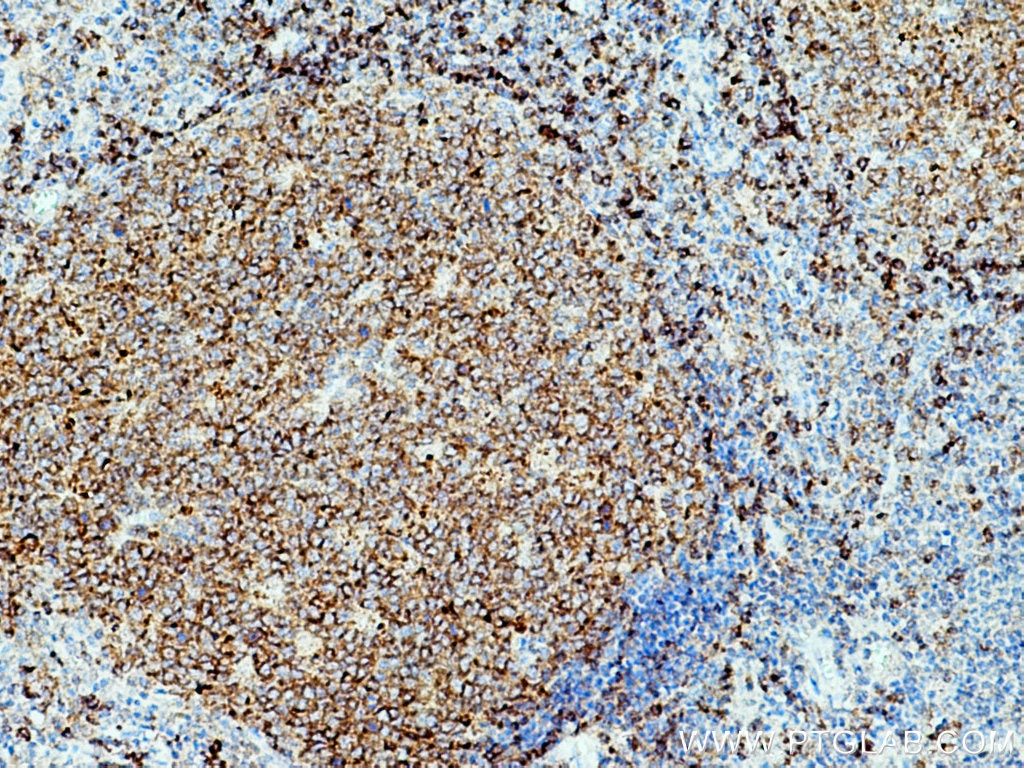
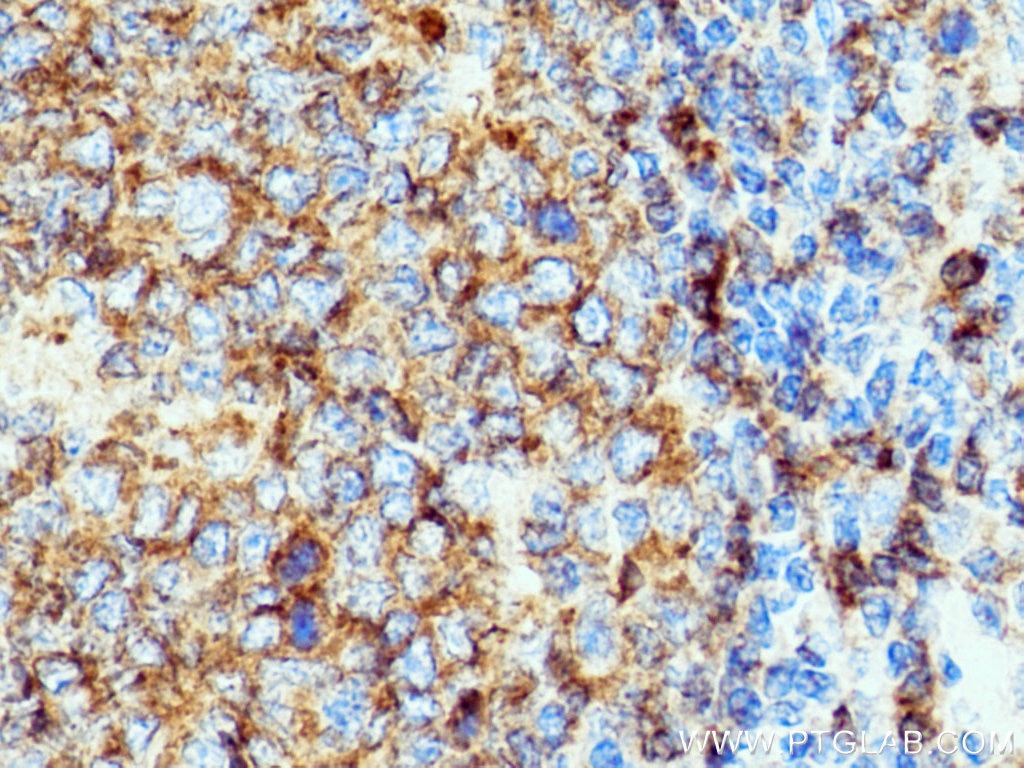

Tested Applications
| Positive WB detected in | Daudi cells, Ramos cells |
| Positive IHC detected in | human tonsillitis tissue Note: suggested antigen retrieval with TE buffer pH 9.0; (*) Alternatively, antigen retrieval may be performed with citrate buffer pH 6.0 |
Recommended dilution
| Application | Dilution |
|---|---|
| Western Blot (WB) | WB : 1:1000-1:4000 |
| Immunohistochemistry (IHC) | IHC : 1:50-1:500 |
| It is recommended that this reagent should be titrated in each testing system to obtain optimal results. | |
| Sample-dependent, Check data in validation data gallery. | |
Product Information
21894-1-AP targets CD22 in WB, IHC, IF, ELISA applications and shows reactivity with human samples.
| Tested Reactivity | human |
| Cited Reactivity | human |
| Host / Isotype | Rabbit / IgG |
| Class | Polyclonal |
| Type | Antibody |
| Immunogen |
CatNo: Ag16607 Product name: Recombinant human CD22 protein Source: e coli.-derived, PGEX-4T Tag: GST Domain: 166-515 aa of BC109306 Sequence: ILHSPAVEGSQVEFLCMSLANPLPTNYTWYHNGKEMQGRTEEKVHIPKILPWHAGTYSCVAENILGTGQRGPGAELDVQYPPKKVTTVIQNPMPIREGDTVTLSCNYNSSNPSVTRYEWKPHGAWEEPSLGVLKIQNVGWDNTTIACAACNSWCSWASPVALNVQYAPRDVRVRKIKPLSEIHSGNSVSLQCDFSSSHPKEVQFFWEKNGRLLGKESQLNFDSISPEDAGSYSCWVNNSIGQTASKAWTLEVLYAPRRLRVSMSPGDQVMEGKSATLTCESDANPPVSHYTWFDWNNQSLPYHSQKLRLEPVKVQHSGAYWCQGTNSVGKGRSPLSTLTVYYSPETIGRR Predict reactive species |
| Full Name | CD22 molecule |
| Calculated Molecular Weight | 847 aa, 95 kDa |
| Observed Molecular Weight | 120-140 kDa |
| GenBank Accession Number | BC109306 |
| Gene Symbol | CD22 |
| Gene ID (NCBI) | 933 |
| RRID | AB_2878937 |
| Conjugate | Unconjugated |
| Form | Liquid |
| Purification Method | Antigen affinity purification |
| UNIPROT ID | P20273 |
| Storage Buffer | PBS with 0.02% sodium azide and 50% glycerol, pH 7.3. |
| Storage Conditions | Store at -20°C. Stable for one year after shipment. Aliquoting is unnecessary for -20oC storage. 20ul sizes contain 0.1% BSA. |
Background Information
CD22, also known as Siglec-2 (sialic acid binding Ig-like lectin 2) or BL-CAM (B-lymphocyte cell adhesion molecule), is a 130-140 kDa, B-cell restricted, type I transmembrane glycoprotein belonging to the immunoglobulin gene superfamily. The expression of CD22 is developmentally regulated. It is expressed at low levels in the cytoplasm of pro-B and pre-B cells and present on the cell surface only at mature stages of B-cell differentiation. Cell surface expression is lost during terminal differentiation into plasma cell and after B-cell activation. CD22 is an inhibitory receptor for B-cell receptor (BCR) signalling, preferentially binds to alpha-2,6-linked sialic acid and mediates B-cell B-cell interactions. It plays a crucial role in activation and differentiation of the B-cell.
Protocols
| Product Specific Protocols | |
|---|---|
| IHC protocol for CD22 antibody 21894-1-AP | Download protocol |
| WB protocol for CD22 antibody 21894-1-AP | Download protocol |
| Standard Protocols | |
|---|---|
| Click here to view our Standard Protocols |
Publications
What published studies show
The CD22 Polyclonal antibody (catalog number 21894-1-AP) has 3 total citations. These appear in Nature Communications, Frontiers in Cellular Neuroscience, and Oncology Letters. The associated research fields include SARS-CoV-2-induced pneumonia (RNA processing dysregulation), Alzheimer's disease (CD22-mediated Aβ clearance in microglia via INPP5D signaling), and osteosarcoma (prognostic biomarkers related to metastasis and immune infiltration).
| Species | Application | Title |
|---|---|---|
Nat Commun SARS-CoV-2 N protein-induced Dicer, XPO5, SRSF3, and hnRNPA3 downregulation causes pneumonia | ||
Oncol Lett Identification of prognostic biomarkers associated with metastasis and immune infiltration in osteosarcoma. |




