
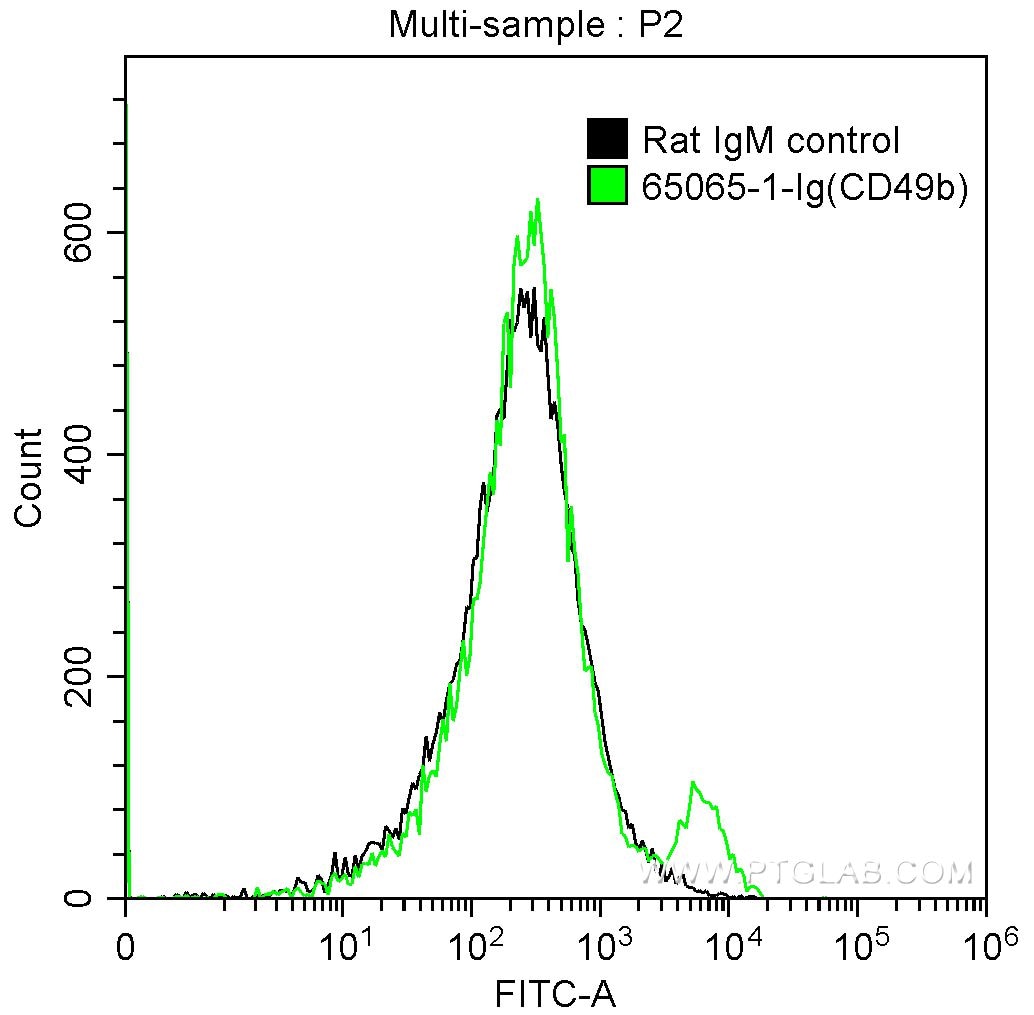

Tested Applications
| Positive FC detected in | mouse splenocytes |
Recommended dilution
| Application | Dilution |
|---|---|
| Flow Cytometry (FC) | FC : 0.5 ug per 10^6 cells in 100 μl suspension |
| This reagent has been tested for flow cytometric analysis. It is recommended that this reagent should be titrated in each testing system to obtain optimal results. | |
| Sample-dependent, Check data in validation data gallery. | |
Product Information
65065-1-Ig targets CD49b in FC applications and shows reactivity with Mouse samples.
| Tested Reactivity | Mouse |
| Cited Reactivity | mouse |
| Host / Isotype | Rat / IgM, kappa |
| Class | Monoclonal |
| Type | Antibody |
| Immunogen |
NK cells isolated from C57BL/6 mice Predict reactive species |
| Full Name | integrin alpha 2 |
| GenBank Accession Number | BC065139 |
| Gene Symbol | CD49b |
| Gene ID (NCBI) | 16398 |
| RRID | AB_2918372 |
| Conjugate | Unconjugated |
| Form | Liquid |
| Purification Method | Affinity purification |
| UNIPROT ID | Q62469 |
| Storage Buffer | Borate buffered saline, pH 8.2. |
| Storage Conditions | Store at 2-8°C. Stable for one year after shipment. |
Background Information
Integrins are a large family of α/β transmembrane receptors playing a key role in cell-cell interactions and cell adhesion to the extracellular matrix (PMID: 30374344). CD49b, also known as integrin alpha-2, is a 150 kDa transmembrane glycoprotein expressed on a wide variety of cell types including platelets, megakaryocytes, NK cells, NKT cells, neutrophils, and long-term activated T cells (PMID: 18802064; 2415516). Integrin alpha-2/beta-1 (also known as VLA-2) is a receptor for laminin, collagen, collagen C-propeptides, fibronectin and E-cadherin (PMID: 2557634). It is responsible for adhesion of platelets and other cells to collagens, modulation of collagen and collagenase gene expression, force generation and organization of newly synthesized extracellular matrix.
Publications
What published studies show
The Anti-Mouse CD49b (DX5) antibody (Cat# 65065-1-Ig) has 1 citation. It was published in Nanoscale Advances (IF 6.3), in a study on bacteria-mediated tumor immunotherapy via photothermally-programmed PD-1 expression. The research field encompasses tumor immunotherapy and photothermal therapy, with the antibody applied in flow cytometry for mouse samples.
| Species | Application | Title |
|---|---|---|
Nanoscale Adv Bacteria-mediated tumor immunotherapy via photothermally-programmed PD1 expression |


