

Tested Applications
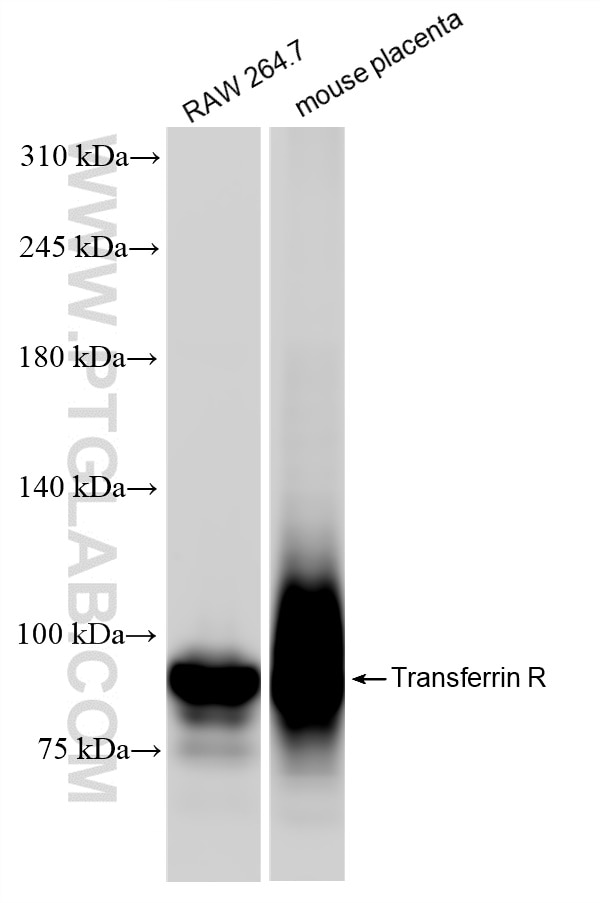
| Positive WB detected in | RAW 264.7 cells, mouse placenta tissue |
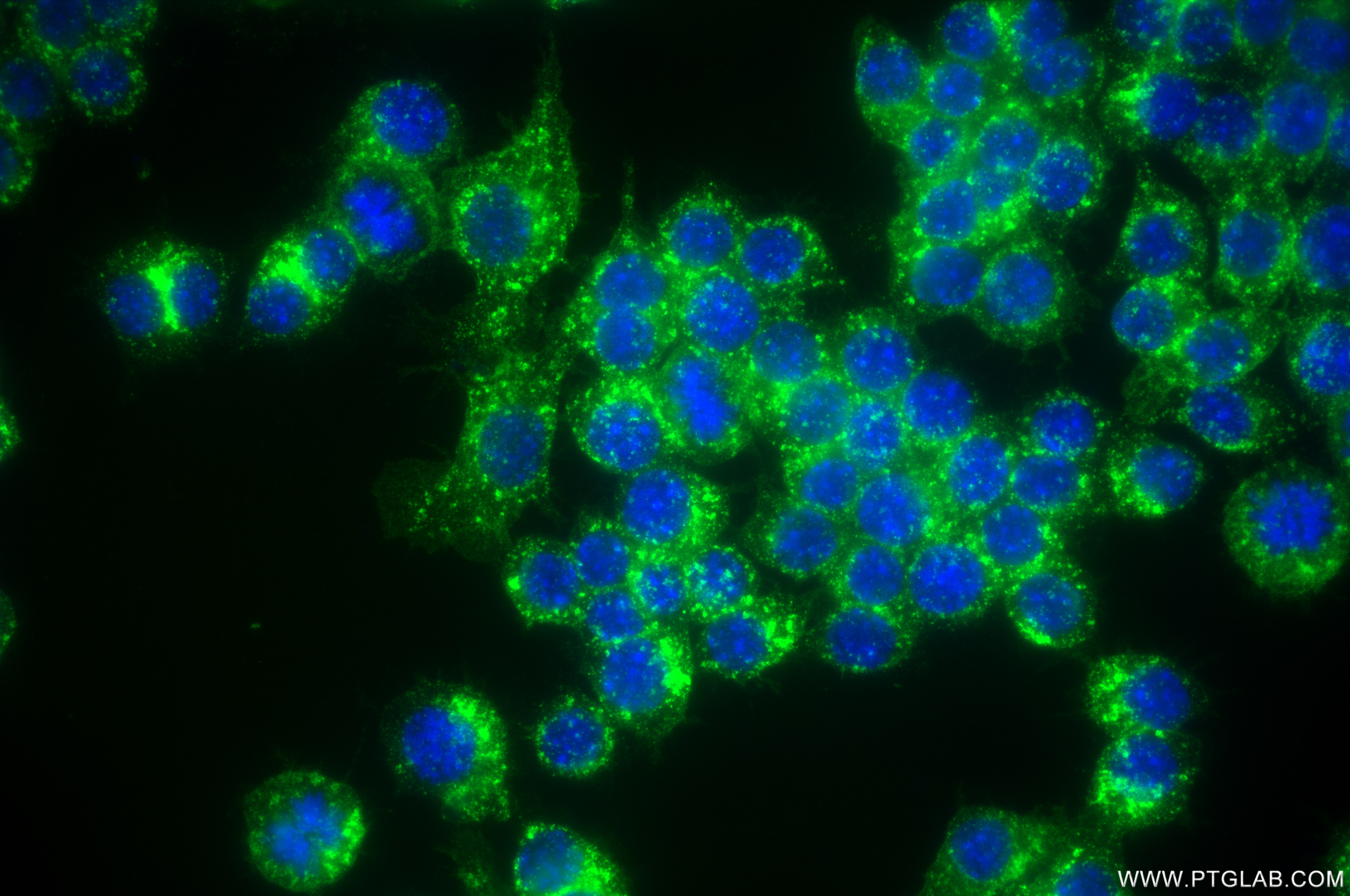
| Positive IF/ICC detected in | RAW 264.7 cells |
Recommended dilution
| Application | Dilution |
|---|---|
| Western Blot (WB) | WB : 1:2000-1:10000 |
| Immunofluorescence (IF)/ICC | IF/ICC : 1:200-1:800 |
| It is recommended that this reagent should be titrated in each testing system to obtain optimal results. | |
| Sample-dependent, Check data in validation data gallery. | |
Product Information
84766-4-RR targets CD71 in WB, IF/ICC, ELISA applications and shows reactivity with mouse samples.
| Tested Reactivity | mouse |
| Cited Reactivity | human, mouse |
| Host / Isotype | Rabbit / IgG |
| Class | Recombinant |
| Type | Antibody |
| Immunogen |
Recombinant protein Predict reactive species |
| Full Name | transferrin receptor |
| Calculated Molecular Weight | 86kDa |
| Observed Molecular Weight | 85-100 kDa |
| GenBank Accession Number | NM_011638.4 |
| Gene Symbol | CD71 |
| Gene ID (NCBI) | 22042 |
| RRID | AB_3743712 |
| Conjugate | Unconjugated |
| Form | Liquid |
| Purification Method | Protein A purification |
| UNIPROT ID | Q62351 |
| Storage Buffer | PBS with 0.02% sodium azide and 50% glycerol, pH 7.3. |
| Storage Conditions | Store at -20°C. Stable for one year after shipment. Aliquoting is unnecessary for -20oC storage. 20ul sizes contain 0.1% BSA. |
Background Information
CD71, also known as transferrin receptor protein 1 (TfR1), is a transmembrane glycoprotein composed of two disulfide-linked monomers, each of 90 kDa molecular weight. Each monomer binds one holo-transferrin molecule creating an iron-Tf-TfR complex that enters the cell by endocytosis. CD71 is present on actively proliferating cells and is essential for iron transport into proliferating cells.
Protocols
| Product Specific Protocols | |
|---|---|
| IF protocol for CD71 antibody 84766-4-RR | Download protocol |
| WB protocol for CD71 antibody 84766-4-RR | Download protocol |
| Standard Protocols | |
|---|---|
| Click here to view our Standard Protocols |
Publications
What published studies show
The CD71 Recombinant monoclonal antibody (Catalog 84766-4-RR) has a total of 12 citations. It appears across journals including Gut Microbes (IF 15.3), Phytomedicine (two papers), Mater Today Bio, Biomed Pharmacother, Front Immunol, Toxicology, Ann Med, Cell Signal, J Cereb Blood Flow Metab, Acta Biochim Biophys Sin, and Exp Cell Res. The research fields center on ferroptosis and iron metabolism, alongside liver injury, sarcopenia, osteoarthritis, cardiac injury, lung cancer, Sertoli cell toxicity, colorectal cancer, pulmonary hypertension, and sepsis-induced lung injury. Applications reported are primarily WB, testing human and mouse samples.
| Species | Application | Title |
|---|---|---|
Gut Microbes Lachnospiraceae bacterium alleviates alcohol-associated liver disease by enhancing N-acetyl-glutamic acid levels and inhibiting ferroptosis through the KEAP1-NRF2 pathway | ||
Phytomedicine Cistanche deserticola extract and its active components, echinacoside, ameliorate sarcopenia by activating the IGF-1/PI3K-AKT pathway to modulate ferroptosis. | ||
Phytomedicine Multi-omics reveals that 4'-O-β-D-glucosyl-5-O-methylvisamminol ameliorates acute liver injury by modulating the miR-30e-3p/Tfrc axis and a multi-dimensional network of ferroptosis, inflammation, metabolism, and gut microbiota. | ||
Mater Today Bio Application of a novel myristoylproteomics approach identifies GLIPR2 as a key pro-ferroptotic substrate in non-small cell lung cancer. | ||
Biomed Pharmacother p16INK4a downregulation alleviates temporomandibular joint osteoarthritis combined with type 2 diabetes by driving M2 polarization | ||
Front Immunol Vitamin D ameliorates prediabetic cardiac injure via modulation of the ErbB4/ferroptosis signaling axis. |




