
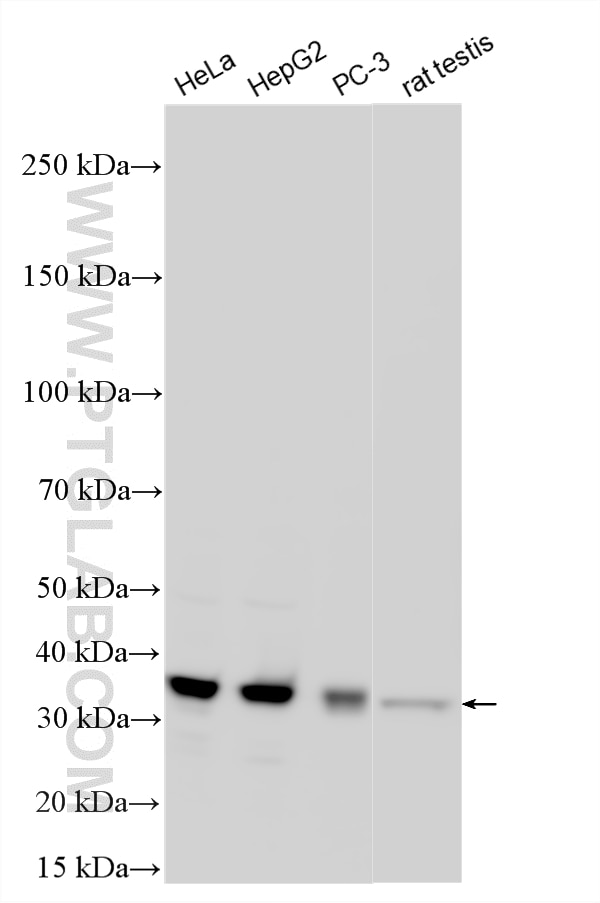


Tested Applications
| Positive WB detected in | HeLa cells, HepG2 cells, PC-3 cells, rat testis tissue |
| Positive IP detected in | HeLa cells |
Recommended dilution
| Application | Dilution |
|---|---|
| Western Blot (WB) | WB : 1:2000-1:12000 |
| Immunoprecipitation (IP) | IP : 0.5-4.0 ug for 1.0-3.0 mg of total protein lysate |
| It is recommended that this reagent should be titrated in each testing system to obtain optimal results. | |
| Sample-dependent, Check data in validation data gallery. | |
Product Information
26208-1-AP targets CENPK in WB, IHC, IP, ELISA applications and shows reactivity with human, rat samples.
| Tested Reactivity | human, rat |
| Cited Reactivity | human |
| Host / Isotype | Rabbit / IgG |
| Class | Polyclonal |
| Type | Antibody |
| Immunogen |
CatNo: Ag23823 Product name: Recombinant human CENPK protein Source: e coli.-derived, PET28a Tag: 6*His Domain: 1-269 aa of BC005400 Sequence: MNQEDLDPDSTTDVGDVTNTEEELIRECEEMWKDMEECQNKLSLIGTETLTDSNAQLSLLIMQVKCLTAELSQWQKKTPETIPLTEDVLITLGKEEFQKLRQDLEMVLSTKESKNEKLKEDLEREQRWLDEQQQIMESLNVLHSELKNKVETFSESRIFNELKTKMLNIKEYKEKLLSTLGEFLEDHFPLPDRSVKKKKKNIQESSVNLITLHEMLEILINRLFDVPHDPYVKISDSFWPPYVELLLRNGIALRHPEDPTRIRLEAFHQ Predict reactive species |
| Full Name | centromere protein K |
| Observed Molecular Weight | 32-35 kDa |
| GenBank Accession Number | BC005400 |
| Gene Symbol | CENPK |
| Gene ID (NCBI) | 64105 |
| RRID | AB_2880427 |
| Conjugate | Unconjugated |
| Form | Liquid |
| Purification Method | Antigen affinity purification |
| UNIPROT ID | Q9BS16 |
| Storage Buffer | PBS with 0.02% sodium azide and 50% glycerol, pH 7.3. |
| Storage Conditions | Store at -20°C. Stable for one year after shipment. Aliquoting is unnecessary for -20oC storage. 20ul sizes contain 0.1% BSA. |
Protocols
| Product Specific Protocols | |
|---|---|
| IP protocol for CENPK antibody 26208-1-AP | Download protocol |
| WB protocol for CENPK antibody 26208-1-AP | Download protocol |
| Standard Protocols | |
|---|---|
| Click here to view our Standard Protocols |
Publications
What published studies show
The anti-CENPK antibody (Cat# 26208-1-AP) has 6 total citations. Citations appear in Cancer Cell Int, Bioengineered, Transl Oncol, Toxicol Appl Pharmacol (×2), and Onco Targets Ther. Research fields span oncology, including lung adenocarcinoma prognosis, thyroid carcinoma proliferation and migration, intrahepatic cholangiocarcinoma stemness, breast carcinoma (FAK/PI3K/AKT/mTOR pathway), clear cell renal cell carcinoma (YAP1/TAZ signaling), and hepatocellular carcinoma progression. All studies used human samples with WB or IHC applications.
| Species | Application | Title |
|---|---|---|
Cancer Cell Int Bioinformatics analysis combined with experiments predicts CENPK as a potential prognostic factor for lung adenocarcinoma.
| ||
Bioengineered Overexpression of centromere protein K (CENPK) gene in Differentiated Thyroid Carcinoma promote cell Proliferation and Migration
| ||
Transl Oncol m6A demethylase ALKBH5 maintains stemness of intrahepatic cholangiocarcinoma by sustaining BUB1B expression and cell proliferation | ||
Toxicol Appl Pharmacol The inhibition of centromere protein K causes anticancer effects in breast carcinoma via effects on the FAK/PI3K/AKT/mTOR pathway
| ||
Toxicol Appl Pharmacol Centromere protein K enhances the activation of YAP1/TAZ signal cascade to drive the progression of clear cell renal cell carcinoma
| ||
Onco Targets Ther Downregulation of CENPK suppresses hepatocellular carcinoma malignant progression through regulating YAP1. |



