

Product Information
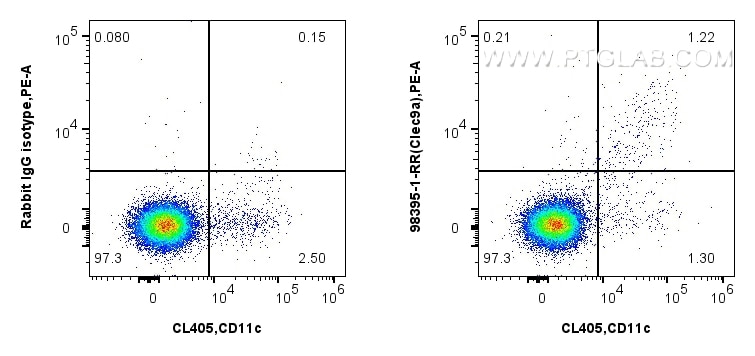
98395-1-PBS targets CLEC9A/CD370 in FC applications and shows reactivity with mouse samples.
| Tested Reactivity | mouse |
| Host / Isotype | Rabbit / IgG |
| Class | Recombinant |
| Type | Antibody |
| Immunogen |
CatNo: Eg2730 Product name: Recombinant Mouse CLEC9A/CD370 protein (rFc Tag) Source: mammalian cells-derived, V37 Tag: C-rFc Domain: 57-264 aa of NM_001205363.1 Sequence: KFFQVSSLVLEQQERLIQQDTALVNLTQWQRKYTLEYCQALLQRSLHSGTDASTGPVLLTSPQMVPQTLDSKETGSDCSPCPHNWIQNGKSCYYVFERWEMWNISKKSCLKEGASLFQIDSKEEMEFISSIGKLKGGNKYWVGVFQDGISGSWFWEDGSSPLSDLLPAERQRSAGQICGYLKDSTLISDKCDSWKYFICEKKAFGSCI Predict reactive species |
| Full Name | C-type lectin domain family 9, member a |
| Calculated Molecular Weight | 30 kDa |
| GenBank Accession Number | NM_001205363.1 |
| Gene Symbol | Clec9a |
| Gene ID (NCBI) | 232414 |
| RRID | AB_3746039 |
| Conjugate | Unconjugated |
| Form | Liquid |
| Purification Method | Protein A purification |
| UNIPROT ID | Q8BRU4-4 |
| Storage Buffer | PBS only, pH 7.3. |
| Storage Conditions | Store at -80°C. |
Background Information
CLEC9A (C-type lectin domain family 9 member A), also known as DNGR1, CD370, is a type II membrane protein that contains C-type lectin domain. The C-type lectin domain family members share a common protein fold and have diverse functions, such as cell adhesion, cell-cell signaling, glycoprotein turnover, and roles in inflammation and immune response. Mouse Clec9A is primarily restricted to dendritic cells (DCs) and selectively expressed in mouse CD8+ conventional DCs (cDCs) and plasmacytoid DCs (pDCs), whereas human CLEC9A is also expressed on human DC subtypes. CLEC9A functions as an activating receptor that recruits Syk kinase and can induce the production of proinflammatory cytokines. (PMID: 25553393; PMID: 15476922; PMID: 18669894; PMID: 18408006)


