
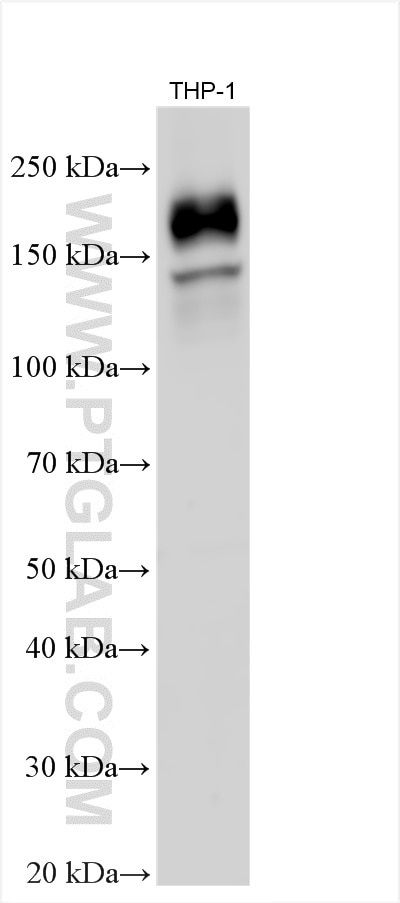
Tested Applications
| Positive WB detected in | THP-1 cells |
Recommended dilution
| Application | Dilution |
|---|---|
| Western Blot (WB) | WB : 1:500-1:1000 |
| It is recommended that this reagent should be titrated in each testing system to obtain optimal results. | |
| Sample-dependent, Check data in validation data gallery. | |
Product Information
34701-1-AP targets CSF1R/CD115 in WB, ELISA applications and shows reactivity with human samples.
| Tested Reactivity | human |
| Host / Isotype | Rabbit / IgG |
| Class | Polyclonal |
| Type | Antibody |
| Immunogen |
Recombinant protein Predict reactive species |
| Full Name | colony stimulating factor 1 receptor |
| Calculated Molecular Weight | 972 aa, 108 kDa |
| Observed Molecular Weight | 140, 160 kDa |
| GenBank Accession Number | BC047521 |
| Gene Symbol | CSF1R/CD115 |
| Gene ID (NCBI) | 1436 |
| Conjugate | Unconjugated |
| Form | Liquid |
| Purification Method | Antigen affinity Purification |
| UNIPROT ID | P07333 |
| Storage Buffer | PBS with 0.02% sodium azide and 50% glycerol, pH 7.3. |
| Storage Conditions | Store at -20°C. Stable for one year after shipment. Aliquoting is unnecessary for -20oC storage. 20ul sizes contain 0.1% BSA. |
Background Information
CSF1R (colony-stimulating factor 1 receptor), also known as CD115, is a receptor tyrosine kinase of the class III receptor tyrosine kinase family that regulates the development and function of the mononuclear phagocyte system. It is primarily expressed on monocytes, macrophages, microglia, and their progenitors. CSF1R is activated by its ligands colony-stimulating factor 1 (CSF1/M-CSF) and interleukin-34 (IL-34), leading to receptor dimerization and activation of downstream signaling pathways, including PI3K/AKT, MAPK/ERK, JAK/STAT, and SRC family kinases. Through these pathways, CSF1R regulates cell survival, proliferation, differentiation, migration, and phagocytic activity.
Protocols
| Product Specific Protocols | |
|---|---|
| WB protocol for CSF1R/CD115 antibody 34701-1-AP | Download protocol |
| Standard Protocols | |
|---|---|
| Click here to view our Standard Protocols |


