

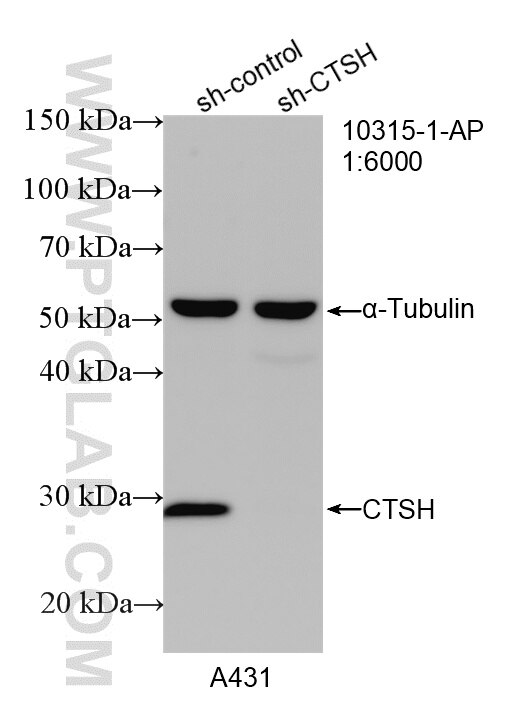



Tested Applications
| Positive WB detected in | A431 cells, HaCat cells, Raji cells, U-937 cells |
| Positive IHC detected in | mouse lung tissue Note: suggested antigen retrieval with TE buffer pH 9.0; (*) Alternatively, antigen retrieval may be performed with citrate buffer pH 6.0 |
| Positive IF/ICC detected in | HepG2 cells |
Recommended dilution
| Application | Dilution |
|---|---|
| Western Blot (WB) | WB : 1:1000-1:6000 |
| Immunohistochemistry (IHC) | IHC : 1:500-1:2000 |
| Immunofluorescence (IF)/ICC | IF/ICC : 1:200-1:800 |
| It is recommended that this reagent should be titrated in each testing system to obtain optimal results. | |
| Sample-dependent, Check data in validation data gallery. | |
Product Information
10315-1-AP targets Cathepsin H in WB, IHC, IF/ICC, ELISA applications and shows reactivity with human, mouse, rat samples.
| Tested Reactivity | human, mouse, rat |
| Cited Reactivity | human, mouse, rat |
| Host / Isotype | Rabbit / IgG |
| Class | Polyclonal |
| Type | Antibody |
| Immunogen |
CatNo: Ag0361 Product name: Recombinant human CTSH protein Source: e coli.-derived, PGEX-4T Tag: GST Domain: 58-289 aa of BC002479 Sequence: FASNWRKINAHNNGNHTFKMALNQFSDMSFAEIKHKYLWSEPQNCSATKSNYLRGTGPYPPSVDWRKKGNFVSPVKNQGACGSCWTFSTTGALESAIAIATGKMLSLAEQQLVDCAQDFNNHGCQGGLPSQAFEYILYNKGIMGEDTYPYQGKDGYCKFQPGKAIGFVKDVANITIYDEEAMVEAVALYNPVSFAFEVTQDFMMYRTGIYSSTSCHKTPDKVNHAVLAVGYG Predict reactive species |
| Full Name | cathepsin H |
| Calculated Molecular Weight | 41 kDa, 28 kDa |
| Observed Molecular Weight | 28, 41 kDa |
| GenBank Accession Number | BC002479 |
| Gene Symbol | Cathepsin H |
| Gene ID (NCBI) | 1512 |
| RRID | AB_2087534 |
| Conjugate | Unconjugated |
| Form | Liquid |
| Purification Method | Antigen affinity purification |
| UNIPROT ID | P09668 |
| Storage Buffer | PBS with 0.02% sodium azide and 50% glycerol, pH 7.3. |
| Storage Conditions | Store at -20°C. Stable for one year after shipment. Aliquoting is unnecessary for -20oC storage. 20ul sizes contain 0.1% BSA. |
Background Information
Cathepsin H (CTSH, synonyms: CPSB, MGC1519, minichain) is a lysosomal cysteine proteinase important in the overall degradation of lysosomal proteins. It is composed of a dimer of disulfide-linked heavy and light chains, both produced from a single protein precursor. This protein, which belongs to the peptidase C1 protein family, can act both as an aminopeptidase and as an endopeptidase. Increased expression of this gene has been correlated with malignant progression of prostate tumors.Cathepsin H is a unique member of the cysteine cathepsins that acts primarily as an aminopeptidase. Like other cysteine cathepsins, it is synthesized as an inactive precursor and activated by proteolytic removal of its propeptide. In human cells, Cathepsin H exists an autocatalytic form, proceeding from an inactive 41 kDa pro-form, through a 30 kDa intermediate form, to the 28 kDa mature form (PMID: 22704610).
Protocols
| Product Specific Protocols | |
|---|---|
| IF protocol for Cathepsin H antibody 10315-1-AP | Download protocol |
| IHC protocol for Cathepsin H antibody 10315-1-AP | Download protocol |
| WB protocol for Cathepsin H antibody 10315-1-AP | Download protocol |
| Standard Protocols | |
|---|---|
| Click here to view our Standard Protocols |
Publications
What published studies show
The Cathepsin H (CTSH) polyclonal antibody (Cat# 10315-1-AP) has been cited in 12 publications across journals including Nature, Immunity, Nucleic Acids Research, Cell Reports Medicine, NPJ Precision Oncology, Oncogene, Biofabrication, Journal of Inflammation Research, PLoS One, Frontiers in Pediatrics, Microscopy, and Advances in Genetics. Associated research fields span oncology, immunology, epigenetics (m6A), neurodegeneration, pulmonary fibrosis, diabetic complications, thyroid cancer, and developmental biology.
| Species | Application | Title |
|---|---|---|
Nature Anti-tumour immunity controlled through mRNA m6A methylation and YTHDF1 in dendritic cells. | ||
Immunity Repression of RIPK1 kinase by INPP5D inhibits expression of diverse proinflammatory mediators and late-onset Alzheimer's disease risk factors | ||
Nucleic Acids Res Characterization of gRNA-dependent and gRNA-independent off-target binding sites of PspCas13b and RfxCas13d in mammalian cells. | ||
Cell Rep Med Distinct immune microenvironment of lung adenocarcinoma in never-smokers from smokers | ||
NPJ Precis Oncol Integrating bulk, single-cell, and spatial transcriptomics to identify and functionally validate novel targets to enhance immunotherapy in NSCLC | ||
Oncogene Cathepsin H regulated by the thyroid hormone receptors associate with tumor invasion in human hepatoma cells. |




