
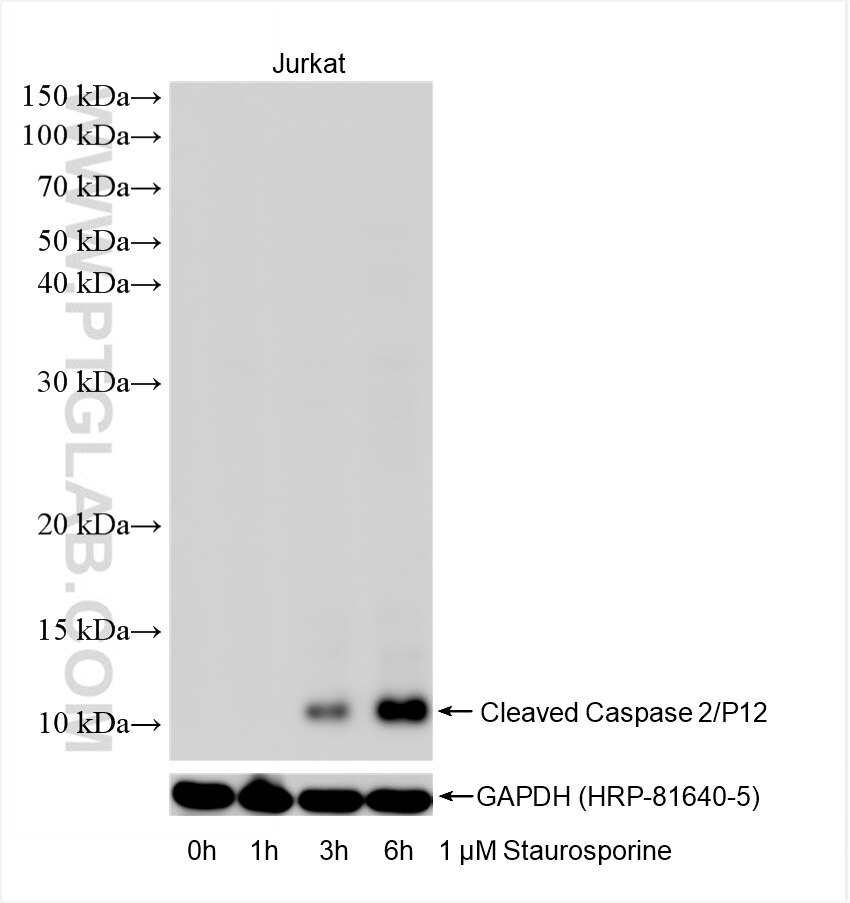
Tested Applications
| Positive WB detected in | Staurosporine treated Jurkat cells |
Recommended dilution
| Application | Dilution |
|---|---|
| Western Blot (WB) | WB : 1:1000-1:4000 |
| It is recommended that this reagent should be titrated in each testing system to obtain optimal results. | |
| Sample-dependent, Check data in validation data gallery. | |
Product Information
88209-2-RR targets Cleaved Caspase 2/P12 in WB, ELISA applications and shows reactivity with human samples.
| Tested Reactivity | human |
| Host / Isotype | Rabbit / IgG |
| Class | Recombinant |
| Type | Antibody |
| Immunogen |
Peptide Predict reactive species |
| Full Name | caspase 2, apoptosis-related cysteine peptidase |
| Calculated Molecular Weight | 452 aa, 51 kDa |
| Observed Molecular Weight | 12 kDa |
| GenBank Accession Number | BC002427 |
| Gene Symbol | Caspase 2 |
| Gene ID (NCBI) | 835 |
| Conjugate | Unconjugated |
| Form | Liquid |
| Purification Method | Protein A purification |
| UNIPROT ID | P42575 |
| Storage Buffer | PBS with 0.02% sodium azide and 50% glycerol, pH 7.3. |
| Storage Conditions | Store at -20°C. Stable for one year after shipment. Aliquoting is unnecessary for -20oC storage. 20ul sizes contain 0.1% BSA. |
Background Information
CASP2(Caspase-2) is also named as ICH1, NEDD2 and belongs to the peptidase C14A family.It is involved in the activation cascade of caspases responsible for apoptosis execution and might function by either activating some proteins required for cell death or inactivating proteins necessary for cell survival. Caspase 2 is synthesized in its inactive prozymogen form and is activated upon stimulation by apoptosis signals. During activation, the prozymogen is cleaved at a specific site, producing a smaller p12 subunit and a larger p18 subunit. The p12-p18 tetramer structure is the core form in which Caspase 2 functions.
Protocols
| Product Specific Protocols | |
|---|---|
| WB protocol for Cleaved Caspase 2/P12 antibody 88209-2-RR | Download protocol |
| Standard Protocols | |
|---|---|
| Click here to view our Standard Protocols |


