


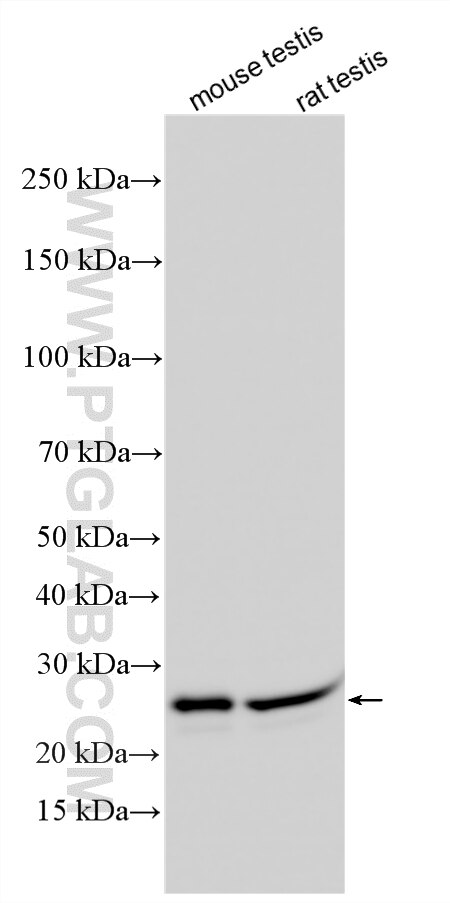



Tested Applications
| Positive WB detected in | HEK-293 cells, HeLa cells, mouse testis tissue, U-937 cells, MDA-MB-231 cells, rat testis tissue |
| Positive IP detected in | HeLa cells |
| Positive IF/ICC detected in | HeLa cells |
Recommended dilution
| Application | Dilution |
|---|---|
| Western Blot (WB) | WB : 1:2000-1:12000 |
| Immunoprecipitation (IP) | IP : 0.5-4.0 ug for 1.0-3.0 mg of total protein lysate |
| Immunofluorescence (IF)/ICC | IF/ICC : 1:50-1:500 |
| It is recommended that this reagent should be titrated in each testing system to obtain optimal results. | |
| Sample-dependent, Check data in validation data gallery. | |
Product Information
14810-1-AP targets DCUN1D5 in WB, IHC, IF/ICC, IP, ELISA applications and shows reactivity with human, mouse, rat samples.
| Tested Reactivity | human, mouse, rat |
| Cited Reactivity | human |
| Host / Isotype | Rabbit / IgG |
| Class | Polyclonal |
| Type | Antibody |
| Immunogen |
CatNo: Ag6534 Product name: Recombinant human DCUN1D5 protein Source: e coli.-derived, PGEX-4T Tag: GST Domain: 1-237 aa of BC004169 Sequence: MPVKKKRKSPGVAAAVAEDGGLKKCKISSYCRSQPPARLISGEEHFSSKKCLAWFYEYAGPDEVVGPEGMEKFCEDIGVEPENIIMLVLAWKLEAESMGFFTKEEWLKGMTSLQCDCTEKLQNKFDFLRSQLNDISSFKNIYRYAFDFARDKDQRSLDIDTAKSMLALLLGRTWPLFSVFYQYLEQSKYRVMNKDQWYNVLEFSRTVHADLSNYDEDGAWPVLLDEFVEWQKVRQTS Predict reactive species |
| Full Name | DCN1, defective in cullin neddylation 1, domain containing 5 (S. cerevisiae) |
| Calculated Molecular Weight | 28 kDa |
| Observed Molecular Weight | 28 kDa |
| GenBank Accession Number | BC004169 |
| Gene Symbol | DCUN1D5 |
| Gene ID (NCBI) | 84259 |
| RRID | AB_2088468 |
| Conjugate | Unconjugated |
| Form | Liquid |
| Purification Method | Antigen affinity purification |
| UNIPROT ID | Q9BTE7 |
| Storage Buffer | PBS with 0.02% sodium azide and 50% glycerol, pH 7.3. |
| Storage Conditions | Store at -20°C. Stable for one year after shipment. Aliquoting is unnecessary for -20oC storage. 20ul sizes contain 0.1% BSA. |
Background Information
Conjugation of Nedd8 to a cullin protein, termed neddylation, is an evolutionarily conserved process that functions to activate the cullin-RING family E3 ubiquitin ligases, leading to increased proteasomal degradation of a wide range of substrate proteins. Cellular neddylation requires the action of DCN1 (Defective in cullin neddylation protein 1), which, in humans, consists of five homologues designated as DCNL1-5. DCUN1D5 gene encodes the 28 kDa DCUN1 domain-containing protein 5 containing a C-terminal potentiating neddylation domain. The cellular function of DCUN1D5 needs to be explored, recently, a mono-ubiquitination-mediated mechanism that governs nuclear-cytoplasmic trafficking of hDCNL1, was reported to regulate hDCNL1-dependent activation of the cullin-RING E3 ubiquitin ligases in selected cellular compartments.
Protocols
| Product Specific Protocols | |
|---|---|
| IF protocol for DCUN1D5 antibody 14810-1-AP | Download protocol |
| IP protocol for DCUN1D5 antibody 14810-1-AP | Download protocol |
| WB protocol for DCUN1D5 antibody 14810-1-AP | Download protocol |
| Standard Protocols | |
|---|---|
| Click here to view our Standard Protocols |
Publications
What published studies show
Anti-DCUN1D5 (Cat# 14810-1-AP) has 5 total citations published in Communications Biology, Biology Direct, Discover Oncology, Asian Pacific Journal of Cancer Prevention, and eLife. Research fields span cancer biology, including osteosarcoma immune remodeling and cisplatin resistance, triple-negative breast cancer progression, bladder cancer prognosis biomarkers, DNA damage response, and cullin-RING ubiquitin ligase function via the NEDD8 pathway.
| Species | Application | Title |
|---|---|---|
Commun Biol Single-cell analysis links DCUN1D5 to immune remodeling and cisplatin resistance in recurrent osteosarcoma | ||
Biol Direct YY1 mediated DCUN1D5 transcriptional activation promotes triple-negative breast cancer progression by targeting FN1/PI3K/AKT pathway | ||
Discov Oncol DCUN1D5 is a novel potential biomarker for predicting the prognosis of bladder cancer. | ||
Asian Pac J Cancer Prev In vitro biological characterization of DCUN1D5 in DNA damage response. | ||
Elife SENP8 limits aberrant neddylation of NEDD8 pathway components to promote cullin-RING ubiquitin ligase function. |





