
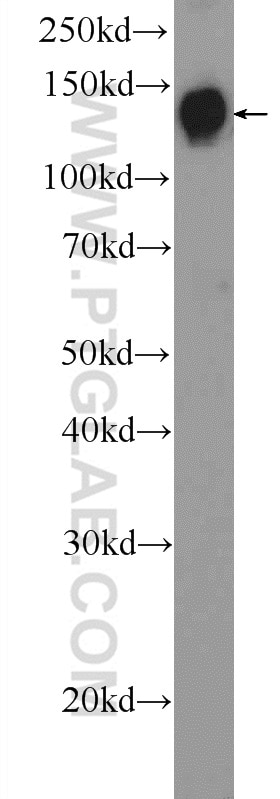
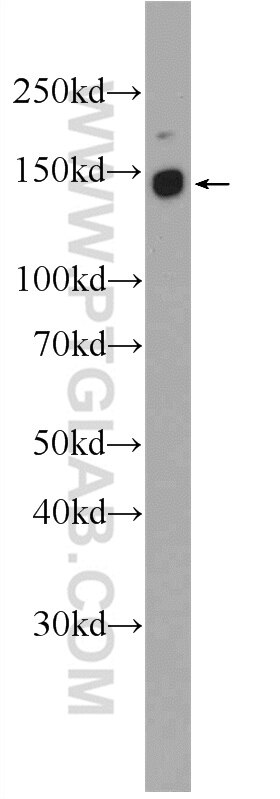

Tested Applications
| Positive WB detected in | mouse stomach tissue |
Recommended dilution
| Application | Dilution |
|---|---|
| Western Blot (WB) | WB : 1:500-1:2000 |
| It is recommended that this reagent should be titrated in each testing system to obtain optimal results. | |
| Sample-dependent, Check data in validation data gallery. | |
Product Information
24414-1-AP targets DENND3 in WB, ELISA applications and shows reactivity with human, mouse samples.
| Tested Reactivity | human, mouse |
| Cited Reactivity | human |
| Host / Isotype | Rabbit / IgG |
| Class | Polyclonal |
| Type | Antibody |
| Immunogen |
CatNo: Ag19859 Product name: Recombinant human DENND3 protein Source: e coli.-derived, PET28a Tag: 6*His Domain: 1-360 aa of BC133023 Sequence: MRSLRKKREKPRPEQWKGLPGPPRAPEPEDVAVPGGVDLLTLPQLCFPGGVCVATEPKEDCVHFLVLTDVCGNRTYGVVAQYYRPLHDEYCFYNGKTHRECPGCFVPFAVCVVSRFPYYNSLKDCLSCLLALLKPCKDFEVDSHIKDFAAKLSLIPSPPPGPLHLVFNMKSLQIVLPARADPESPILDLDLHLPLLCFRPEKVLQILTCILTEQRIVFFSSDWALLTLVTECFMAYLYPLQWQHPFVPILSDQMLDFVMAPTSFLMGCHLDHFEEVSKEADGLVLINIDHGSITYSKSTDDNVDIPDVPLLAAQTFIQRDVKNHLNYEHRVFNSEEFLKTRAPGDHQFYKQVLDTYMFHS Predict reactive species |
| Full Name | DENN/MADD domain containing 3 |
| Calculated Molecular Weight | 1198 aa, 135 kDa |
| Observed Molecular Weight | 135-145 kDa |
| GenBank Accession Number | BC133023 |
| Gene Symbol | DENND3 |
| Gene ID (NCBI) | 22898 |
| RRID | AB_2879533 |
| Conjugate | Unconjugated |
| Form | Liquid |
| Purification Method | Antigen affinity purification |
| UNIPROT ID | A2RUS2 |
| Storage Buffer | PBS with 0.02% sodium azide and 50% glycerol, pH 7.3. |
| Storage Conditions | Store at -20°C. Stable for one year after shipment. Aliquoting is unnecessary for -20oC storage. 20ul sizes contain 0.1% BSA. |
Background Information
DENND3 may play a role in protein transport from recycling endosomes to lysosomes regulating, for instance, the degradation of the transferrin receptor
Publications
What published studies show
The DENND3 Polyclonal antibody (Cat# 24414-1-AP) has 1 citation. It was used in a Western blot study published in Heliyon (2024), which identified lysosome-related hub genes as potential biomarkers and analyzed immune infiltrations in moyamoya disease using bioinformatics and machine-learning approaches. The research field encompasses neurovascular disease, lysosomal biology, and computational biology.
| Species | Application | Title |
|---|---|---|
Heliyon Identification of lysosome-related hub genes as potential biomarkers and immune infiltrations of moyamoya disease by multiple bioinformatics methods and machine-learning strategies |



