
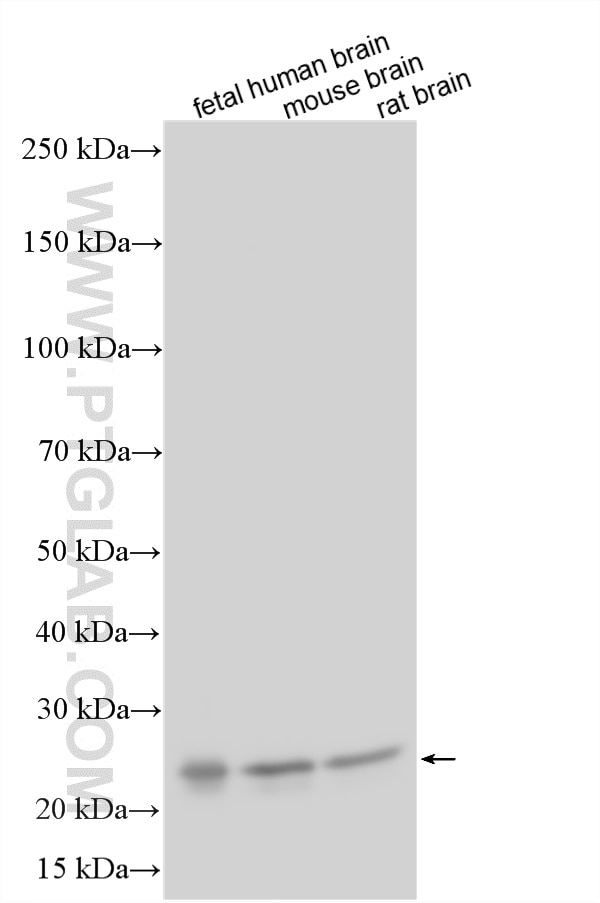

Tested Applications
| Positive WB detected in | fetal human brain tissue, mouse brain tissue, rat brain tissue |
Recommended dilution
| Application | Dilution |
|---|---|
| Western Blot (WB) | WB : 1:500-1:1000 |
| It is recommended that this reagent should be titrated in each testing system to obtain optimal results. | |
| Sample-dependent, Check data in validation data gallery. | |
Product Information
10592-1-AP targets DLX5 in WB, IHC, IF, ELISA applications and shows reactivity with human, mouse, rat samples.
| Tested Reactivity | human, mouse, rat |
| Cited Reactivity | human, mouse, rat |
| Host / Isotype | Rabbit / IgG |
| Class | Polyclonal |
| Type | Antibody |
| Immunogen |
CatNo: Ag0910 Product name: Recombinant human DLX5 protein Source: e coli.-derived, PGEX-4T Tag: GST Domain: 1-289 aa of BC006226 Sequence: MTGVFDRRVPSIRSGDFQAPFQTSAAMHHPSQESPTLPESSATDSDYYSPTGGAPHGYCSPTSASYGKALNPYQYQYHGVNGSAGSYPAKAYADYSYASSYHQYGGAYNRVPSATNQPEKEVTEPEVRMVNGKPKKVRKPRTIYSSFQLAALQRRFQKTQYLALPERAELAASLGLTQTQVKIWFQNKRSKIKKIMKNGEMPPEHSPSSSDPMACNSPQSPAVWEPQGSSRSLSHHPHAHPPTSNQSPASSYLENSASWYTSAASSINSHLPPPGSLQHPLALASGTLY Predict reactive species |
| Full Name | distal-less homeobox 5 |
| Calculated Molecular Weight | 32 kDa |
| Observed Molecular Weight | 35 kDa |
| GenBank Accession Number | BC006226 |
| Gene Symbol | DLX5 |
| Gene ID (NCBI) | 1749 |
| RRID | AB_2090724 |
| Conjugate | Unconjugated |
| Form | Liquid |
| Purification Method | Antigen affinity purification |
| UNIPROT ID | P56178 |
| Storage Buffer | PBS with 0.02% sodium azide and 50% glycerol, pH 7.3. |
| Storage Conditions | Store at -20°C. Stable for one year after shipment. Aliquoting is unnecessary for -20oC storage. 20ul sizes contain 0.1% BSA. |
Background Information
DLX5 belongs to the DLX family of homeobox transcription factors (Dlx1, Dlx2, Dlx5 and Dlx6), which is expressed in overlapping domains at different stages of cell differentiation in the subpallium and controls differentiation of GABAergic neurons. DLX5 is an immediate early BMP-responsive transcriptional activator that essential for osteoblast differentiation. It can bind to and stimulate the homeodomain-response element of the ALPL and SP7 promoter. DLX5 can form homodimer with DLX2(~34kd) and heterodimer with MSX2(~29kd).
Protocols
| Product Specific Protocols | |
|---|---|
| WB protocol for DLX5 antibody 10592-1-AP | Download protocol |
| Standard Protocols | |
|---|---|
| Click here to view our Standard Protocols |
Publications
What published studies show
The DLX5 Polyclonal antibody (Cat# 10592-1-AP) has 12 citations across journals including Nucleic Acids Research, Acta Biomaterialia, Biomedical Journal, Arthritis Research & Therapy, Frontiers in Cell and Developmental Biology, International Dental Journal, Journal of Cellular Physiology, PLoS ONE, Journal of Oral and Maxillofacial Surgery, Experimental & Therapeutic Medicine, Journal of Anatomy, and Iranian Journal of Biotechnology. Research fields span osteoblast differentiation, bone development, squamous cell carcinoma, lung adenocarcinoma, esophageal cancer, cholangiocarcinoma, periodontitis, osteonecrosis, and palatal development.
| Species | Application | Title |
|---|---|---|
Nucleic Acids Res Activation of bivalent factor DLX5 cooperates with master regulator TP63 to promote squamous cell carcinoma.
| ||
Acta Biomater Osteoinductivity and biomechanical assessment of a 3D printed demineralized bone matrix-ceramic composite in a rat spine fusion model. | ||
Biomed J Autophagy-induced osteoblast-derived exosomes maintain bone formation and prevent osteoporosis by remodeling gut microbiota-metabolism | ||
Arthritis Res Ther Ossification process involving the human thoracic ligamentum flavum: role of transcription factors. | ||
Front Cell Dev Biol Persistent Wnt/β-catenin signaling disables soft palatogenesis and palatal osteogenesis by inducing mesenchymal condensation. | ||
Int Dent J FBXO5 alleviates apical periodontitis by facilitating TP53 protein degradation. |


