
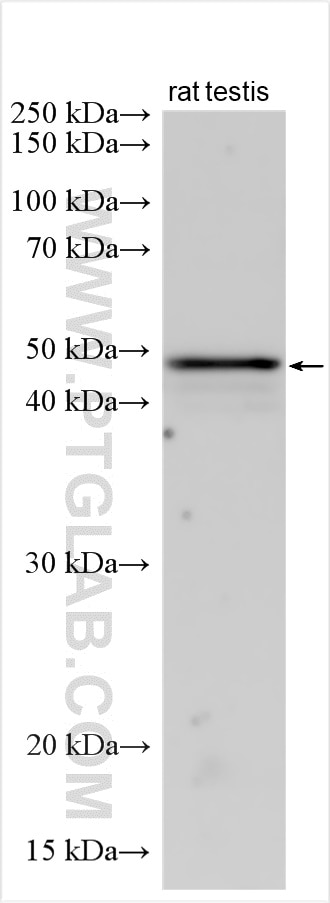
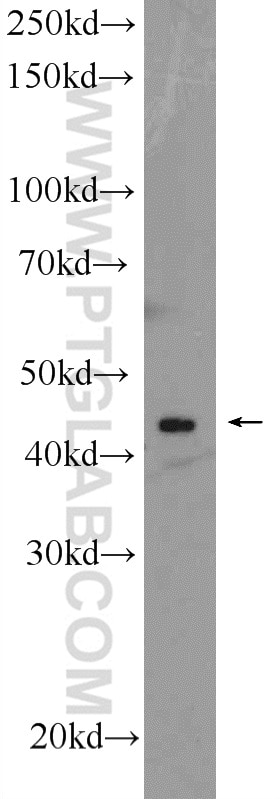
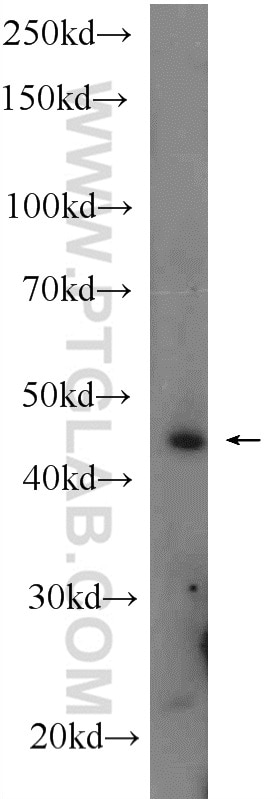
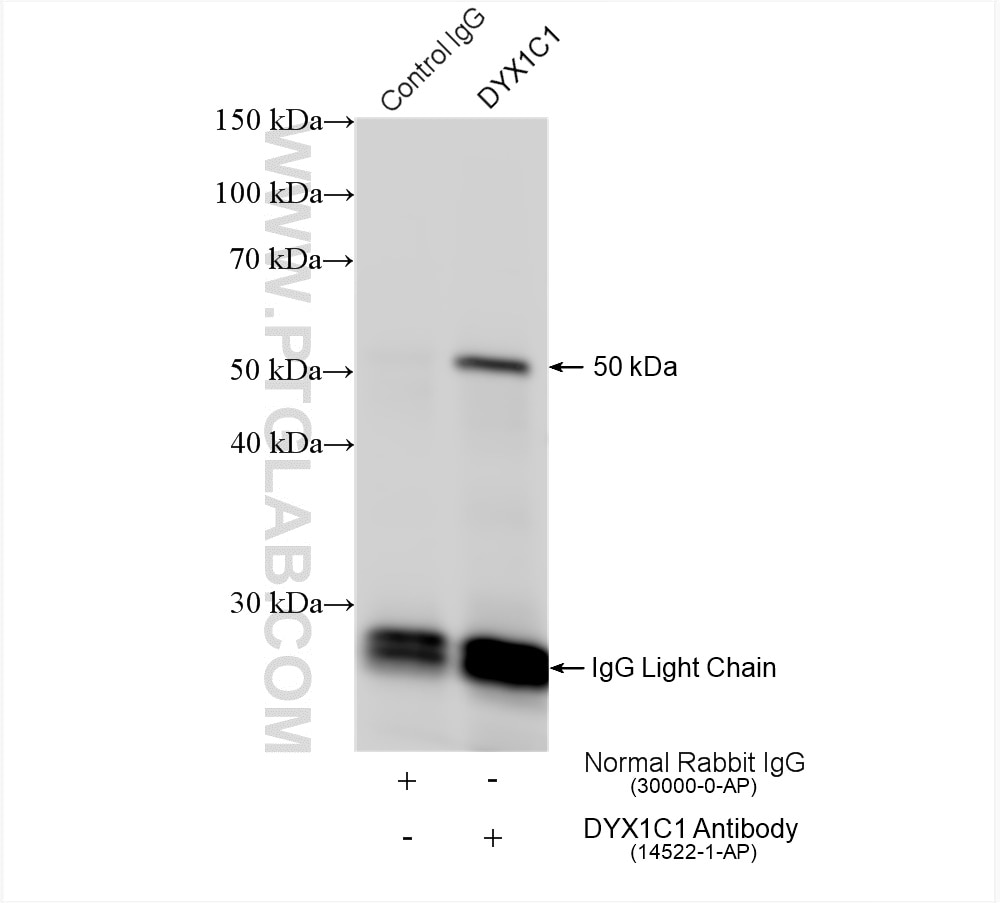

Tested Applications
| Positive WB detected in | rat testis tissue, mouse testis tissue |
| Positive IP detected in | mouse testis tissue |
Recommended dilution
| Application | Dilution |
|---|---|
| Western Blot (WB) | WB : 1:1000-1:6000 |
| Immunoprecipitation (IP) | IP : 0.5-4.0 ug for 1.0-3.0 mg of total protein lysate |
| It is recommended that this reagent should be titrated in each testing system to obtain optimal results. | |
| Sample-dependent, Check data in validation data gallery. | |
Product Information
14522-1-AP targets DYX1C1 in WB, IHC, IF, IP, ELISA applications and shows reactivity with human, mouse, rat samples.
| Tested Reactivity | human, mouse, rat |
| Cited Reactivity | human, mouse, rat |
| Host / Isotype | Rabbit / IgG |
| Class | Polyclonal |
| Type | Antibody |
| Immunogen |
CatNo: Ag5997 Product name: Recombinant human DYX1C1 protein Source: e coli.-derived, PET28a Tag: 6*His Domain: 1-381 aa of BC062564 Sequence: MPLQVSDYSWQQTKTAVFLSLPLKGVCVRDTDVFCTENYLKVNFPPFLFEAFLYAPIDDESSKAKIGNDTIVFTLYKKEAAMWETLSVTGVDKEMMQRIREKSILQAQERAKEATEAKAAAKREDQKYALSVMMKIEEEERKKIEDMKENERIKATKALEAWKEYQRKAEEQKKIQREEKLCQKEKQIKEGRKKIKYKSLTRNLASRNLAPKGRNSENIFTEKLKEDSIPAPRSVGSIKINFTPRVFPTALRESQVAEEEEWLHKQAEARRAMNTDIAELCDLKEEEKNPEWLKDKGNKLFATENYLAAINAYNLAIRLNNKMPLLYLNRAVCHLKLKNLHKAIEDSSKEFCSLEGIECQASEPKLSHHIPSDLHVYIQMA Predict reactive species |
| Full Name | dyslexia susceptibility 1 candidate 1 |
| Calculated Molecular Weight | 49 kDa |
| Observed Molecular Weight | 48 kDa |
| GenBank Accession Number | BC062564 |
| Gene Symbol | DYX1C1 |
| Gene ID (NCBI) | 161582 |
| RRID | AB_2093955 |
| Conjugate | Unconjugated |
| Form | Liquid |
| Purification Method | Antigen affinity purification |
| UNIPROT ID | Q8WXU2 |
| Storage Buffer | PBS with 0.02% sodium azide and 50% glycerol, pH 7.3. |
| Storage Conditions | Store at -20°C. Stable for one year after shipment. Aliquoting is unnecessary for -20oC storage. 20ul sizes contain 0.1% BSA. |
Background Information
DYX1C1 initially was described as the first candidate gene for developmental dyslexia. The protein contains three TPR motifs and one p23 domain, all commonly known for their protein-protein interactions. It also has been linked to neuronal migration. Recently it has been reported that the expression of DYX1C1 protein is lost in breast cancer and patients who have lost DYX1C1 expression have a poor overall survival,indicating that DYX1C1 is a potential prognostic biomarker in breast cancer.
Protocols
| Product Specific Protocols | |
|---|---|
| IP protocol for DYX1C1 antibody 14522-1-AP | Download protocol |
| WB protocol for DYX1C1 antibody 14522-1-AP | Download protocol |
| Standard Protocols | |
|---|---|
| Click here to view our Standard Protocols |
Publications
What published studies show
The DYX1C1 antibody (Cat# 14522-1-AP) has 6 total citations published in Nature Genetics, Biological Psychiatry, Molecular Endocrinology, BMC Cancer, Pediatric Research, and BMC Molecular Cell Biology. Research fields span ciliary biology and axonemal dynein assembly, neuronal migration and dyslexia genetics, estrogen receptor regulation of DYX1C1, breast cancer prognosis, rat cerebral cortex development, and protein-protein interaction studies with DCDC2. Applications include WB, IF, IHC, and IP across human, mouse, and rat species.
| Species | Application | Title |
|---|---|---|
Nat Genet DYX1C1 is required for axonemal dynein assembly and ciliary motility.
| ||
Biol Psychiatry Molecular networks of DYX1C1 gene show connection to neuronal migration genes and cytoskeletal proteins. | ||
Mol Endocrinol The rs3743205 SNP is important for the regulation of the dyslexia candidate gene DYX1C1 by estrogen receptor β and DNA methylation. | ||
BMC Cancer The dyslexia candidate gene DYX1C1 is a potential marker of poor survival in breast cancer. | ||
Pediatr Res Spatiotemporal expression pattern of dyslexia susceptibility 1 candidate 1 (DYX1C1) during rat cerebral cortex development | ||
BMC Mol Cell Biol Genetic and protein interaction studies between the ciliary dyslexia candidate genes DYX1C1 and DCDC2 |





