

Tested Applications
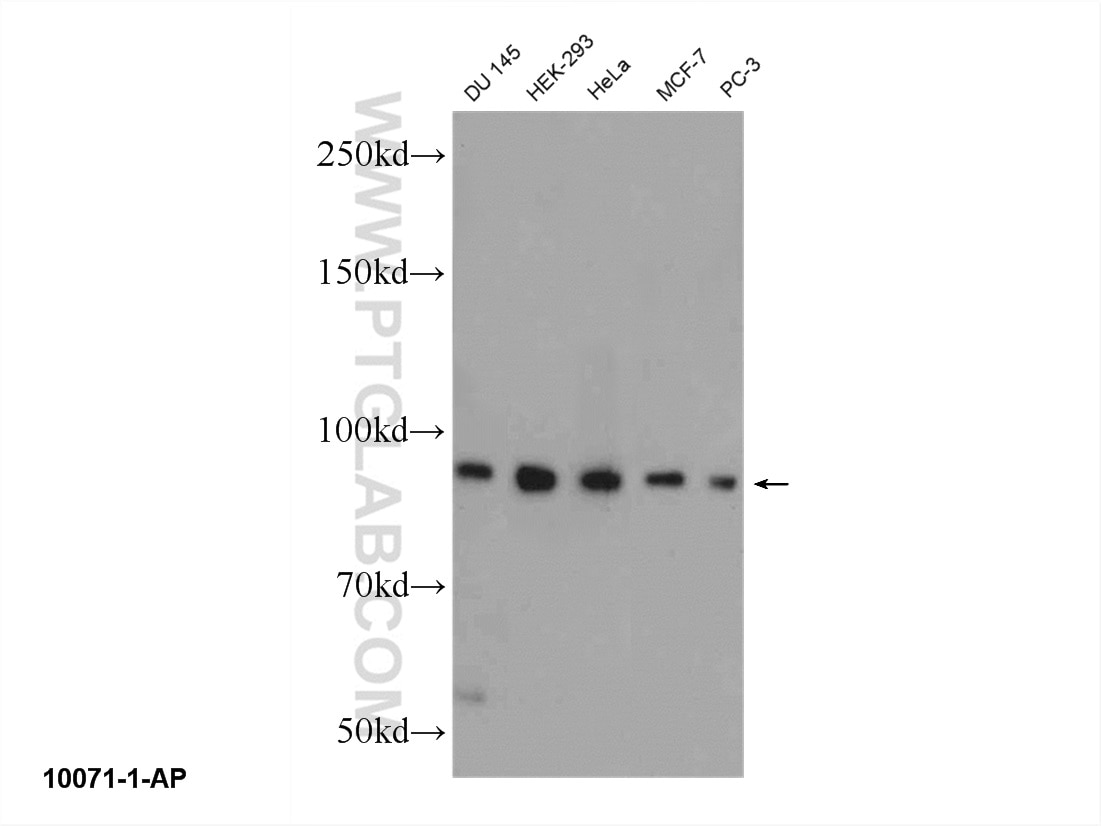
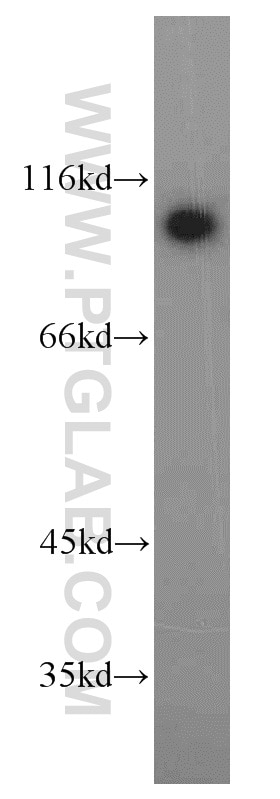
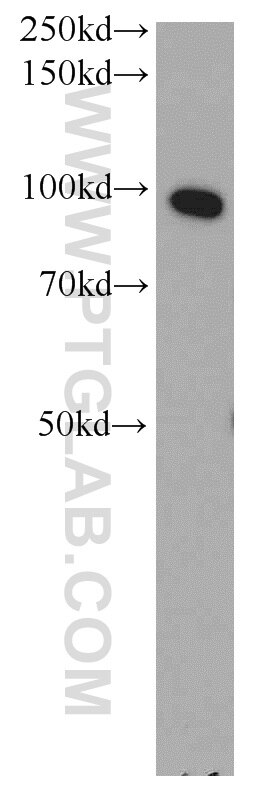
| Positive WB detected in | DU 145 cells, HeLa cells, HepG2 cells |
| Positive IHC detected in | mouse testis tissue Note: suggested antigen retrieval with TE buffer pH 9.0; (*) Alternatively, antigen retrieval may be performed with citrate buffer pH 6.0 |
Recommended dilution
| Application | Dilution |
|---|---|
| Western Blot (WB) | WB : 1:200-1:1000 |
| Immunohistochemistry (IHC) | IHC : 1:50-1:500 |
| It is recommended that this reagent should be titrated in each testing system to obtain optimal results. | |
| Sample-dependent, Check data in validation data gallery. | |
Product Information
10071-1-AP targets ELAC2 in WB, IF, ELISA applications and shows reactivity with human, mouse, rat samples.
| Tested Reactivity | human, mouse, rat |
| Cited Reactivity | human, mouse, rabbit |
| Host / Isotype | Rabbit / IgG |
| Class | Polyclonal |
| Type | Antibody |
| Immunogen |
CatNo: Ag0105 Product name: Recombinant human ELAC2 protein Source: e coli.-derived, PGEX-4T Tag: GST Domain: 86-385 aa of BC004158 Sequence: NCGEGVQRLMQEHKLKVARLDNIFLTRMHWSNVGGLSGMILTLKETGLPKCVLSGPPQLEKYLEAIKIFSGPLKGIELAVRPHSAPEYEDETMTVYQIPIHSEQRRGKHQPWQSPERPLSRLSPERSSDSELNENEPHLPHGVSQRRGVRDSSLVVAFICKLHLKRGNFLVLKAKEMGLPVGTAAIAPIIAAVKDGKSITHEGREILAEELCTPPDPGAAFVVVECPDESFIQPICENATFQRYQGKADAPVALVVHMAPASVLVDSRYQQWMERFGPDTQHLVLNENCASVHNLRSHKI Predict reactive species |
| Full Name | elaC homolog 2 (E. coli) |
| Calculated Molecular Weight | 92 kDa |
| Observed Molecular Weight | 92 kDa |
| GenBank Accession Number | BC004158 |
| Gene Symbol | ELAC2 |
| Gene ID (NCBI) | 60528 |
| RRID | AB_2096551 |
| Conjugate | Unconjugated |
| Form | Liquid |
| Purification Method | Antigen affinity purification |
| UNIPROT ID | Q9BQ52 |
| Storage Buffer | PBS with 0.02% sodium azide and 50% glycerol, pH 7.3. |
| Storage Conditions | Store at -20°C. Stable for one year after shipment. Aliquoting is unnecessary for -20oC storage. 20ul sizes contain 0.1% BSA. |
Background Information
Putative prostate cancer susceptibility protein (ELAC2) is encoded by HPC2/ELAC2 gene. HPC2 is a potential prostate cancer predisposition gene playing a role in genetic susceptibility to prostate cancer.It is a zinc phosphodiesterase, which displays some tRNA 3'-processing endonuclease activity and probably involved in tRNA maturation, by removing a 3'-trailer from precursor tRNA.Defects in ELAC2 may be a cause of susceptibility to prostate cancer (PC).
Protocols
| Product Specific Protocols | |
|---|---|
| IHC protocol for ELAC2 antibody 10071-1-AP | Download protocol |
| WB protocol for ELAC2 antibody 10071-1-AP | Download protocol |
| Standard Protocols | |
|---|---|
| Click here to view our Standard Protocols |
Publications
What published studies show
The ELAC2 Polyclonal antibody (Cat# 10071-1-AP) has 13 citations spanning journals including Cell Metabolism, Nature Communications, Nucleic Acids Research, Science Advances, EMBO Molecular Medicine, Cell Reports, Molecular & Cellular Proteomics, RNA Biology, Life, PLoS ONE, and bioRxiv. Research fields covered include mitochondrial RNA processing, ribosome assembly, tRNA 3′-end maturation, mitochondrial cristae organization, obesity, prostate cancer, neurological disease, and APOBEC3 protein interactions. Applications are predominantly Western blot, with some immunofluorescence.
| Species | Application | Title |
|---|---|---|
Cell Metab Initial steps in RNA processing and ribosome assembly occur at mitochondrial DNA nucleoids. | ||
Cell Metab Aging-induced tRNAGlu-derived fragment impairs glutamate biosynthesis by targeting mitochondrial translation-dependent cristae organization | ||
Nat Commun Dedicated surveillance mechanism controls G-quadruplex forming non-coding RNAs in human mitochondria. | ||
Reviews
What customers say
Able is busy answering your previous question. Please try again later.
The reviews below have been submitted by verified Proteintech customers who received an incentive for providing their feedback.
Yan (Verified Customer) (10-23-2025) | Works well for SDS-PAGE. Tested in primary fibroblasts, MCF-7 and BJ-5ta cells
|




