



Tested Applications
| Positive WB detected in | mouse brain tissue, rat brain tissue |
| Positive IP detected in | mouse brain tissue |
| Positive IHC detected in | human brain tissue Note: suggested antigen retrieval with TE buffer pH 9.0; (*) Alternatively, antigen retrieval may be performed with citrate buffer pH 6.0 |
| Positive IF-P detected in | mouse brain tissue |
| Positive IF/ICC detected in | PC-12 cells |
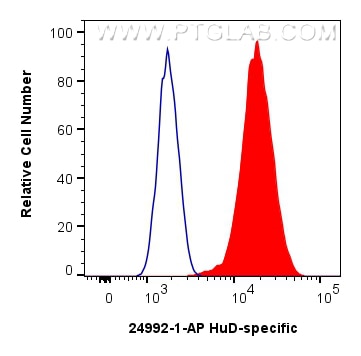
| Positive FC (Intra) detected in | SH-SY5Y cells |
Recommended dilution
| Application | Dilution |
|---|---|
| Western Blot (WB) | WB : 1:1000-1:4000 |
| Immunoprecipitation (IP) | IP : 0.5-4.0 ug for 1.0-3.0 mg of total protein lysate |
| Immunohistochemistry (IHC) | IHC : 1:50-1:500 |
| Immunofluorescence (IF)-P | IF-P : 1:50-1:500 |
| Immunofluorescence (IF)/ICC | IF/ICC : 1:50-1:500 |
| Flow Cytometry (FC) (INTRA) | FC (INTRA) : 0.25 ug per 10^6 cells in a 100 µl suspension |
| It is recommended that this reagent should be titrated in each testing system to obtain optimal results. | |
| Sample-dependent, Check data in validation data gallery. | |
Product Information
24992-1-AP targets HuD-specific in WB, IHC, IF/ICC, IF-P, FC (Intra), IP, RIP, ELISA applications and shows reactivity with human, mouse, rat samples.
| Tested Reactivity | human, mouse, rat |
| Cited Reactivity | human, mouse |
| Host / Isotype | Rabbit / IgG |
| Class | Polyclonal |
| Type | Antibody |
| Immunogen |
CatNo: Ag21830 Product name: Recombinant human ELAVL4 protein Source: e coli.-derived, PGEX-4T Tag: GST Domain: 1-40 aa of BC036071 Sequence: MVMIISTMEPQVSNGPTSNTSNGPSSNNRNCPSPMQTGAT Predict reactive species |
| Full Name | ELAV (embryonic lethal, abnormal vision, Drosophila)-like 4 (Hu antigen D) |
| Calculated Molecular Weight | 380 aa, 42 kDa |
| Observed Molecular Weight | 40 kDa |
| GenBank Accession Number | BC036071 |
| Gene Symbol | ELAVL4 |
| Gene ID (NCBI) | 1996 |
| RRID | AB_2879835 |
| Conjugate | Unconjugated |
| Form | Liquid |
| Purification Method | Antigen affinity purification |
| UNIPROT ID | P26378 |
| Storage Buffer | PBS with 0.02% sodium azide and 50% glycerol, pH 7.3. |
| Storage Conditions | Store at -20°C. Stable for one year after shipment. Aliquoting is unnecessary for -20oC storage. 20ul sizes contain 0.1% BSA. |
Background Information
ELAVL4, also named as HuD, is a 380 amino acid protein, which belongs to the RRM elav family. ELAVL4 may play a role in neuron-specific RNA processing and protects CDKN1A mRNA from decay by binding to its 3'-UTR. PC12 cells expressing T7±HuD were treated with thio-specific (BMH) or amine-specific (DSS) chemical crosslinking reagents, and the resultant crosslinked complexes in the cell extracts were analyzed by immunoblotting with anti-T7 antibody. In addition to the monomeric HuD of 41 kDa, three specific crosslinked complexes could be detected using either of the crosslinkers. Two of the complexes had molecular masses of ~80 and 120 kDa, and were likely to be the dimer and trimer of HuD, respectively. (PMID: 12384599 )
Protocols
| Product Specific Protocols | |
|---|---|
| FC protocol for HuD-specific antibody 24992-1-AP | Download protocol |
| IF protocol for HuD-specific antibody 24992-1-AP | Download protocol |
| IHC protocol for HuD-specific antibody 24992-1-AP | Download protocol |
| IP protocol for HuD-specific antibody 24992-1-AP | Download protocol |
| WB protocol for HuD-specific antibody 24992-1-AP | Download protocol |
| Standard Protocols | |
|---|---|
| Click here to view our Standard Protocols |
Publications
What published studies show
The HuD-specific (ELAVL4) polyclonal antibody (Cat# 24992-1-AP) has 8 citations. These appear in journals including Acta Neuropathologica, FASEB Journal, Progress in Neurobiology, Carbohydrate Polymers, European Journal of Pharmacology, Frontiers in Nutrition, Frontiers in Pharmacology, and Journal of Nutritional Biochemistry. Research fields span neurodegenerative diseases (ALS, Alzheimer's), RNA-binding protein biology, lung cancer, gut microbiota, slow-transit constipation, and the NLRP3 inflammasome pathway.
| Species | Application | Title |
|---|---|---|
Carbohydr Polym An inulin from Asparagus cochinchinensis relieves slow transit constipation associated with Akkermansia muciniphila enrichment, kynurenic acid restoration, and NLRP3 attenuation. | ||
Acta Neuropathol Nuclear depletion of RNA-binding protein ELAVL3 (HuC) in sporadic and familial amyotrophic lateral sclerosis. | ||
Eur J Pharmacol Icariside II ameliorates slow transit constipation by inhibiting macrophage polarization and suppressing the cGAS-STING pathway. | ||
Front Nutr Aqueous extract of Solanum americanum Mill. relieves functional constipation by modulating the enteric nervous system and gut micro-ecosystems | ||
J Nutr Biochem Batatasin III Alleviates Slow Transit Constipation by Regulating Gut Microbiota and Inhibiting the NLRP3-IL-1β Pathway | ||
Prog Neurobiol RNA-binding protein ELAVL4/HuD ameliorates Alzheimer's disease-related molecular changes in human iPSC-derived neurons. |




