
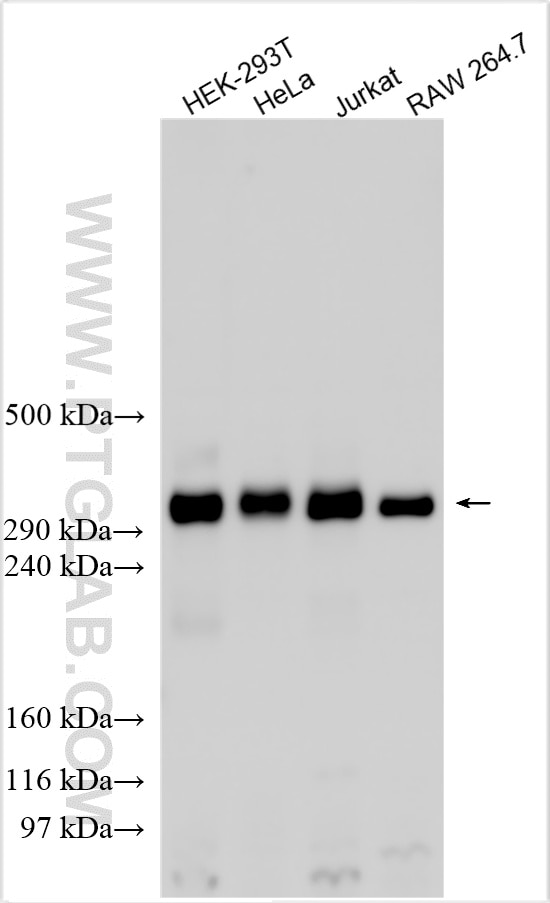
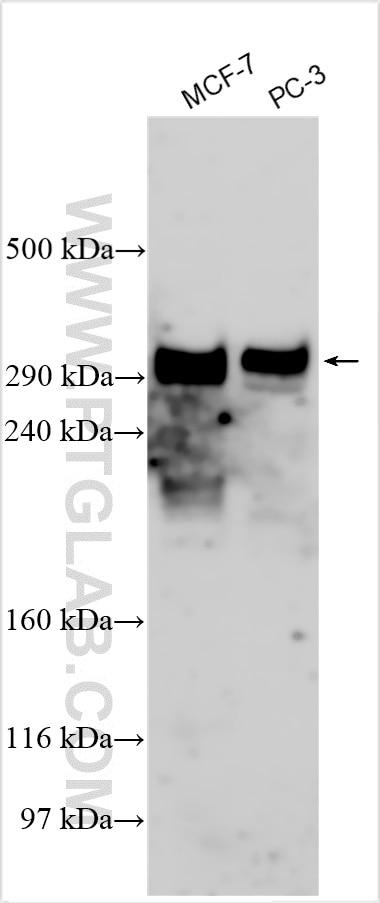

Tested Applications
| Positive WB detected in | HEK-293T cells, MCF-7 cells, HeLa cells, Jurkat cells, RAW 264.7 cells, PC-3 cells |
It is recommended to use NETN lysis buffer for sample preparation during WB detection.
Recommended dilution
| Application | Dilution |
|---|---|
| Western Blot (WB) | WB : 1:500-1:1000 |
| It is recommended that this reagent should be titrated in each testing system to obtain optimal results. | |
| Sample-dependent, Check data in validation data gallery. | |
Product Information
20695-1-AP targets p300 in WB, IHC, IF, IP, CoIP, ChIP, ELISA applications and shows reactivity with human, mouse samples.
| Tested Reactivity | human, mouse |
| Cited Reactivity | human, mouse, rat |
| Host / Isotype | Rabbit / IgG |
| Class | Polyclonal |
| Type | Antibody |
| Immunogen |
Peptide Predict reactive species |
| Full Name | E1A binding protein p300 |
| Calculated Molecular Weight | 264 kDa |
| Observed Molecular Weight | 300 kDa |
| GenBank Accession Number | NM_001429 |
| Gene Symbol | EP300 |
| Gene ID (NCBI) | 2033 |
| RRID | AB_3085614 |
| Conjugate | Unconjugated |
| Form | Liquid |
| Purification Method | Antigen affinity purification |
| UNIPROT ID | Q09472 |
| Storage Buffer | PBS with 0.02% sodium azide and 50% glycerol, pH 7.3. |
| Storage Conditions | Store at -20°C. Stable for one year after shipment. Aliquoting is unnecessary for -20oC storage. 20ul sizes contain 0.1% BSA. |
Background Information
p300 is a 300 kDa global transcriptional coactivator with histone acetyltransferase (HAT) activity. p300 binds to chromosomal histones and modulates the chromatin conformation by acetylation of its histones, leading to activation of various gene transcriptions. p300 plays a critical role in DNA repair synthesis after DNA damage induced by ultraviolet or radiation. p300 is overexpressed in various types of cancer, which is associated with worse patient outcomes (PMID: 27322077).
Protocols
| Product Specific Protocols | |
|---|---|
| WB protocol for p300 antibody 20695-1-AP | Download protocol |
| Standard Protocols | |
|---|---|
| Click here to view our Standard Protocols |
Publications
What published studies show
The p300 Polyclonal antibody (Cat# 20695-1-AP) has 50 total citations across journals including Nature Communications, Advanced Science, Cell Reports, Cell Death & Disease, Cancer Letters, Free Radical Biology and Medicine, and Journal of Medicinal Chemistry. Research fields encompass epigenetics (histone lactylation/acetylation), oncology (lung, liver, prostate, bladder, breast cancers), cardiometabolic disease, neurodegeneration, inflammation, atherosclerosis, and metabolic reprogramming. Primary application is Western blotting, with IHC, IP, CoIP, IF, and ChIP also cited.
| Species | Application | Title |
|---|---|---|
Cell Metab Targeting gut microbial nitrogen recycling and cellular uptake of ammonium to improve bortezomib resistance in multiple myeloma | ||
Nat Commun NPM3 functions as a lactyltransferase to promote necroptosis in male diabetic cardiomyopathy mice models via FASN transcription modulation. | ||
Nat Commun Exercise-induced histone lactylation in monocyte-derived macrophages restores cardiac immune homeostasis and function in sepsis-induced cardiomyopathy. | ||
Nat Commun Histone lactylation increases CXCL1 expression for neutrophil infiltration and immune escape in pancreatic cancer. | ||
J Adv Res Microglia Dld-K127 lactylation promotes Parkinson's disease via regulating the metabolism of lactate-pyruvate transformation. | ||
Adv Sci (Weinh) Lactylation Enhances the Activity of Lactate Dehydrogenase A and Promotes the Chemoresistance to Cisplatin Through Facilitating DNA Nonhomologous End Junction in Lung Adenocarcinoma. |



