

Product Information
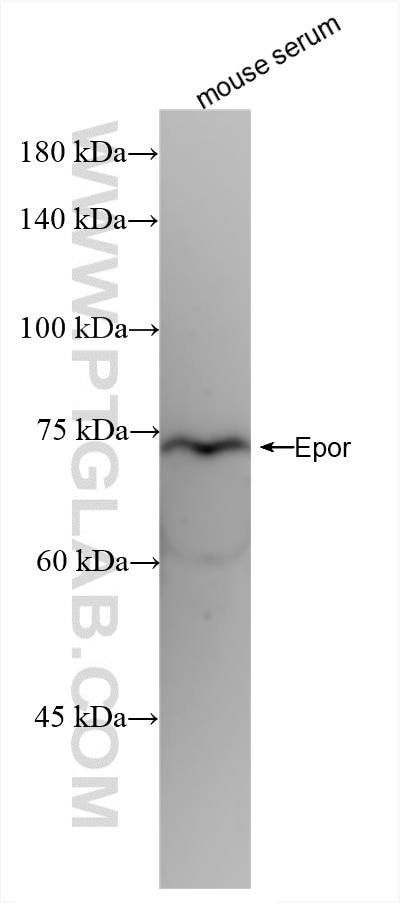
85901-1-PBS targets EPOR in WB, Indirect ELISA applications and shows reactivity with mouse samples.
| Tested Reactivity | mouse |
| Host / Isotype | Rabbit / IgG |
| Class | Recombinant |
| Type | Antibody |
| Immunogen |
CatNo: Eg2711 Product name: Recombinant Mouse Epor protein (rFc Tag) Source: mammalian cells-derived, V37 Tag: C-rFc Domain: 25-249 aa of NM_010149.3 Sequence: APSPSLPDPKFESKAALLASRGSEELLCFTQRLEDLVCFWEEAASSGMDFNYSFSYQLEGESRKSCSLHQAPTVRGSVRFWCSLPTADTSSFVPLELQVTEASGSPRYHRIIHINEVVLLDAPAGLLARRAEEGSHVVLRWLPPPGAPMTTHIRYEVDVSAGNRAGGTQRVEVLEGRTECVLSNLRGGTRYTFAVRARMAEPSFSGFWSAWSEPASLLTASDLDP Predict reactive species |
| Full Name | erythropoietin receptor |
| Calculated Molecular Weight | 55 kDa |
| Observed Molecular Weight | 73 kDa |
| GenBank Accession Number | NM_010149.3 |
| Gene Symbol | Epor |
| Gene ID (NCBI) | 13857 |
| RRID | AB_3744458 |
| Conjugate | Unconjugated |
| Form | Liquid |
| Purification Method | Protein A purification |
| UNIPROT ID | P14753-1 |
| Storage Buffer | PBS only, pH 7.3. |
| Storage Conditions | Store at -80°C. |
Background Information
Erythropoietin (EPO) receptor (EPOR) is a glycoprotein that belongs to the type I superfamily of single-transmembrane cytokine receptors. It consists of an extracellular domain that binds to the EPO ligand, a transmembrane domain and an intracellular domain. The interaction of EPO and EPOR triggers the activation of several signaling pathways that induce erythropoiesis, including JAK2/STAT5, PI3K/AKT, and MAPK (PMID: 34281163). EPOR is present on erythroid progenitor cells and has also been detected on a wide variety of non-hematopoietic cells (PMID: 36233351). The calculated molecular weight of EPOR is 55 kDa. EPOR undergoes posttranslational modification and the apparent molecular weight of 66-78 kDa has been reported (PMID: 8943308; 12088257).


