


Tested Applications
| Positive WB detected in | THP-1 cells, HCT 116 cells, HT-29 cells |
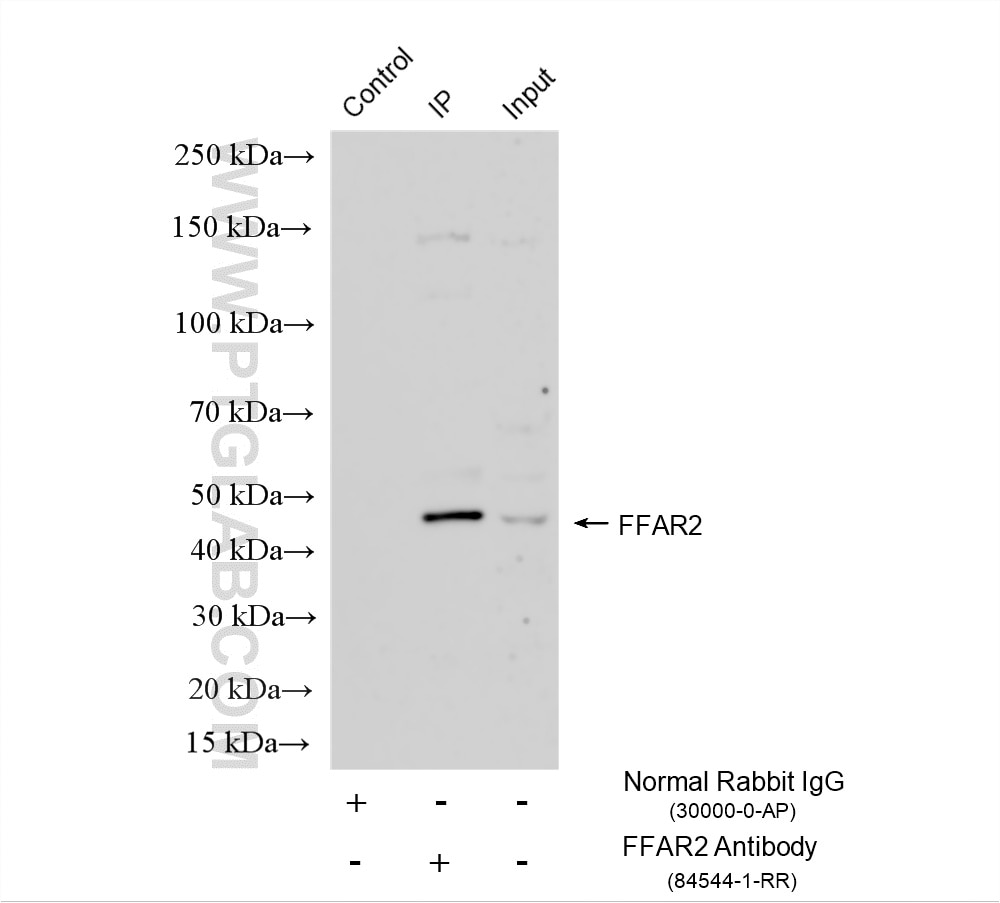
| Positive IP detected in | HCT 116 cells |
Recommended dilution
| Application | Dilution |
|---|---|
| Western Blot (WB) | WB : 1:500-1:2000 |
| Immunoprecipitation (IP) | IP : 0.5-4.0 ug for 1.0-3.0 mg of total protein lysate |
| It is recommended that this reagent should be titrated in each testing system to obtain optimal results. | |
| Sample-dependent, Check data in validation data gallery. | |
Product Information
84544-1-RR targets FFAR2 in WB, IP, ELISA applications and shows reactivity with human samples.
| Tested Reactivity | human |
| Cited Reactivity | human, mouse |
| Host / Isotype | Rabbit / IgG |
| Class | Recombinant |
| Type | Antibody |
| Immunogen |
Peptide Predict reactive species |
| Full Name | free fatty acid receptor 2 |
| Calculated Molecular Weight | 330 aa, 37 kDa |
| Observed Molecular Weight | 37 kDa |
| GenBank Accession Number | BC096198 |
| Gene Symbol | FFAR2 |
| Gene ID (NCBI) | 2867 |
| RRID | AB_3672049 |
| Conjugate | Unconjugated |
| Form | Liquid |
| Purification Method | Protein A purification |
| UNIPROT ID | O15552 |
| Storage Buffer | PBS with 0.02% sodium azide and 50% glycerol, pH 7.3. |
| Storage Conditions | Store at -20°C. Stable for one year after shipment. Aliquoting is unnecessary for -20oC storage. 20ul sizes contain 0.1% BSA. |
Background Information
Free fatty acid receptors (FFAR) play significant roles in various physiological processes through interaction with their ligands, fatty acids. Free fatty acid receptor 2 (FFAR2, also known as FFA2 or GPR43) is a receptor for short-chain fatty acids (SCFAs) and plays a role in the regulation of whole-body energy homeostasis and intestinal immunity (PMID: 12684041). It has been considered a therapeutic target for metabolic and inflammatory conditions (PMID: 23589301). FFAR2 has a calculated molecular weight of 37 kDa and can be glycosylated. The higher apparent molecular weight of 50 kDa has been reported, probably due to glycosylation (PMID: 31707282; 28131568).
Protocols
| Product Specific Protocols | |
|---|---|
| IP protocol for FFAR2 antibody 84544-1-RR | Download protocol |
| WB protocol for FFAR2 antibody 84544-1-RR | Download protocol |
| Standard Protocols | |
|---|---|
| Click here to view our Standard Protocols |
Publications
What published studies show
The FFAR2 Recombinant monoclonal antibody (241696B4), catalog number 84544-1-RR, has 5 citations. These appear in Cell Metabolism, Translational Neurodegeneration, Journal of Experimental & Clinical Cancer Research, Journal of Translational Medicine, and International Journal of Molecular Sciences. Research fields span metabolic disorders (obesity, MASLD), neurodegeneration (Parkinson's disease), and oncology (hepatocarcinogenesis, pancreatic cancer), with applications in WB and IP across human and mouse samples.
| Species | Application | Title |
|---|---|---|
Cell Metab Maternal vitamin B12 deprivation exacerbates offspring obesity by reducing early-life colonization with Bifidobacterium pseudolongum. | ||
Transl Neurodegener Bacteroides coprocola protects dopaminergic neurons in rotenone-induced Parkinson's disease mouse model by modulating gut microbiota dysbiosis and inhibiting the NLRP3 signaling pathway. | ||
J Exp Clin Cancer Res Colon-Targeted astragalus polysaccharide nanoparticles prevent NAFLD-Driven hepatocarcinogenesis via microbiota remodeling and NF-κB Inhibition. | ||
J Transl Med Intratumoral microbiota promote pancreatic cancer progression via NaAc-mediated activation of the GPR43/AMPK/HADH pathway. | ||
Int J Mol Sci Gut Microbiota-Derived Propionic Acid Mediates ApoA-I-Induced Amelioration of MASLD via Activation of GPR43-Ca(2+)-CAMKII-ATGL Hepatic Lipolysis. |



