

Tested Applications
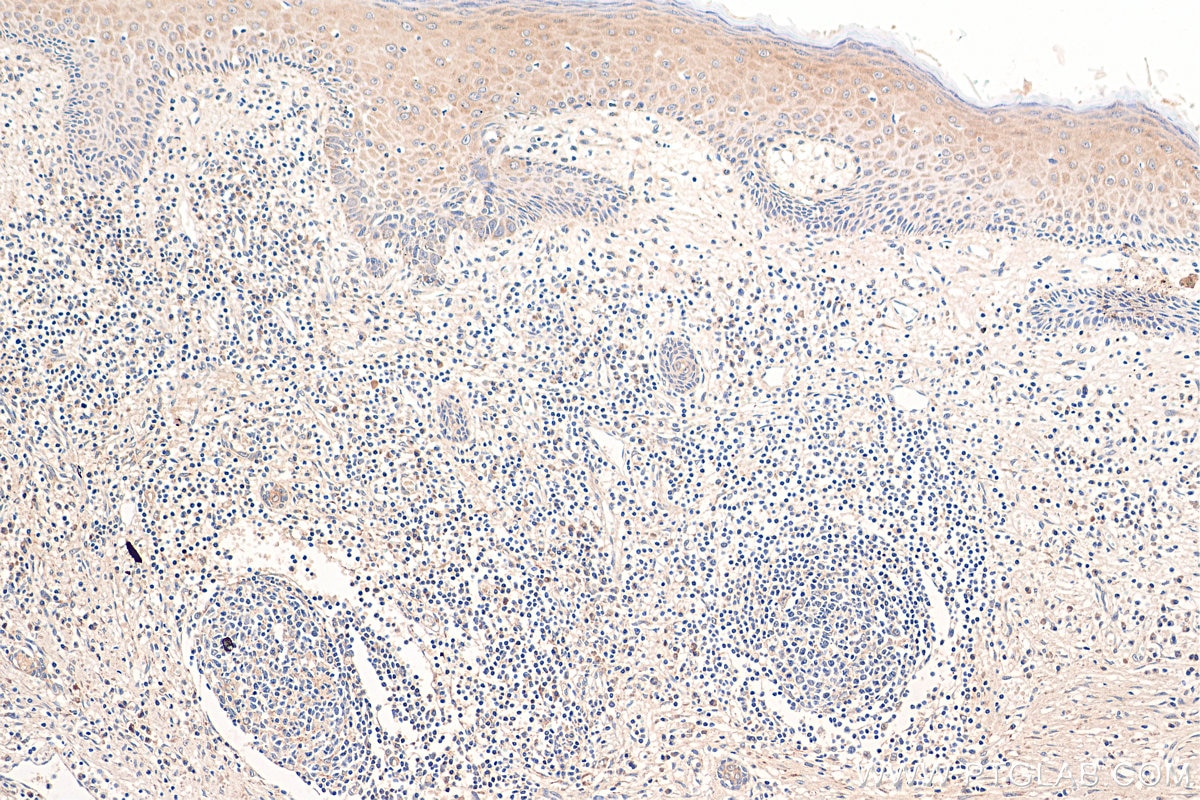
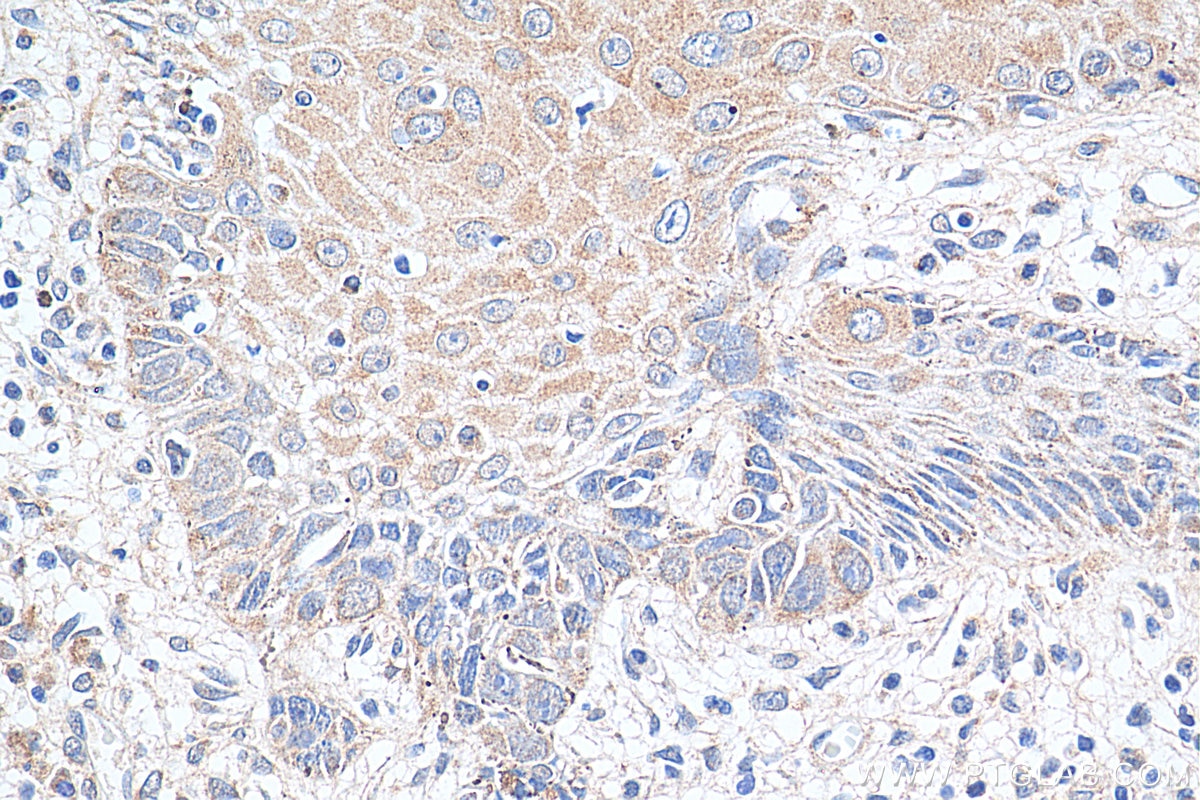
| Positive IHC detected in | human skin cancer tissue Note: suggested antigen retrieval with TE buffer pH 9.0; (*) Alternatively, antigen retrieval may be performed with citrate buffer pH 6.0 |
Recommended dilution
| Application | Dilution |
|---|---|
| Immunohistochemistry (IHC) | IHC : 1:50-1:500 |
| It is recommended that this reagent should be titrated in each testing system to obtain optimal results. | |
| Sample-dependent, Check data in validation data gallery. | |
Product Information
25006-1-AP targets FGFBP1 in WB, IHC, IF, ELISA applications and shows reactivity with human, mouse samples.
| Tested Reactivity | human, mouse |
| Cited Reactivity | human, mouse |
| Host / Isotype | Rabbit / IgG |
| Class | Polyclonal |
| Type | Antibody |
| Immunogen |
CatNo: Ag6357 Product name: Recombinant human FGFBP1 protein Source: e coli.-derived, PET28a Tag: 6*His Domain: 1-234 aa of BC003628 Sequence: MKICSLTLLSFLLLAAQVLLVEGKKKVKNGLHSKVVSEQKDTLGNTQIKQKSRPGNKGKFVTKDQANCRWAATEQEEGISLKVECTQLDHEFSCVFAGNPTSCLKLKDERVYWKQVARNLRSQKDICRYSKTAVKTRVCRKDFPESSLKLVSSTLFGNTKPRKEKTEMSPREHIKGKETTPSSLAVTQTMATKAPECVEDPDMANQRKTALEFCGETWSSLCTFFLSIVQDTSC Predict reactive species |
| Full Name | fibroblast growth factor binding protein 1 |
| Calculated Molecular Weight | 26 kDa |
| GenBank Accession Number | BC003628 |
| Gene Symbol | FGFBP1 |
| Gene ID (NCBI) | 9982 |
| RRID | AB_2879843 |
| Conjugate | Unconjugated |
| Form | Liquid |
| Purification Method | Antigen affinity purification |
| UNIPROT ID | Q14512 |
| Storage Buffer | PBS with 0.02% sodium azide and 50% glycerol, pH 7.3. |
| Storage Conditions | Store at -20°C. Stable for one year after shipment. Aliquoting is unnecessary for -20oC storage. 20ul sizes contain 0.1% BSA. |
Background Information
FGFBP1, also named as HBP17, is prominent for its role as the chaperone for fibroblast growth factor-2 (FGF-2), which plays a crucial role in angiogenesis as well as promoting tumor growth. HBp17/FGFBP-1 has been proposed as a candidate biomarker for a number of cancers since it is frequently found to be elevated in many cancer types including in the tissue and cell lines of oral squamous cell carcinomas (OSCC).
Protocols
| Product Specific Protocols | |
|---|---|
| IHC protocol for FGFBP1 antibody 25006-1-AP | Download protocol |
| Standard Protocols | |
|---|---|
| Click here to view our Standard Protocols |
Publications
What published studies show
The FGFBP1 Polyclonal antibody (Cat# 25006-1-AP) has 8 total citations. These appear in journals including Molecular Cell, Cell Death & Disease, Cell Mol Gastroenterol Hepatol, Frontiers in Immunology, Pharmaceutical Biology, Frontiers in Pharmacology, Translational Oncology, and American Journal of Cancer Research. Research fields span embryo implantation morphogenesis, triple-negative breast cancer, intestinal tumorigenesis, bladder cancer, nasopharyngeal carcinoma, lymphoma, and colorectal cancer metastasis.
| Species | Application | Title |
|---|---|---|
Mol Cell A transient transcriptional activation governs unpolarized-to-polarized morphogenesis during embryo implantation | ||
Cell Death Dis Inhibitory effect of the novel tyrosine kinase inhibitor DCC-2036 on triple-negative breast cancer stem cells through AXL-KLF5 positive feedback loop | ||
Cell Mol Gastroenterol Hepatol Dietary Stearic Acid Accelerates Intestinal Tumorigenesis via Fatty Acid-binding Protein 5 Without Promoting Obesity. | ||
Front Immunol FGFBP1 as a potential biomarker predicting bacillus Calmette-Guérin response in bladder cancer | ||
Pharm Biol Study on the biological mechanism of urolithin a on nasopharyngeal carcinoma in vitro | ||
Front Pharmacol B4 suppresses lymphoma progression by inhibiting fibroblast growth factor binding protein 1 through intrinsic apoptosis |



