
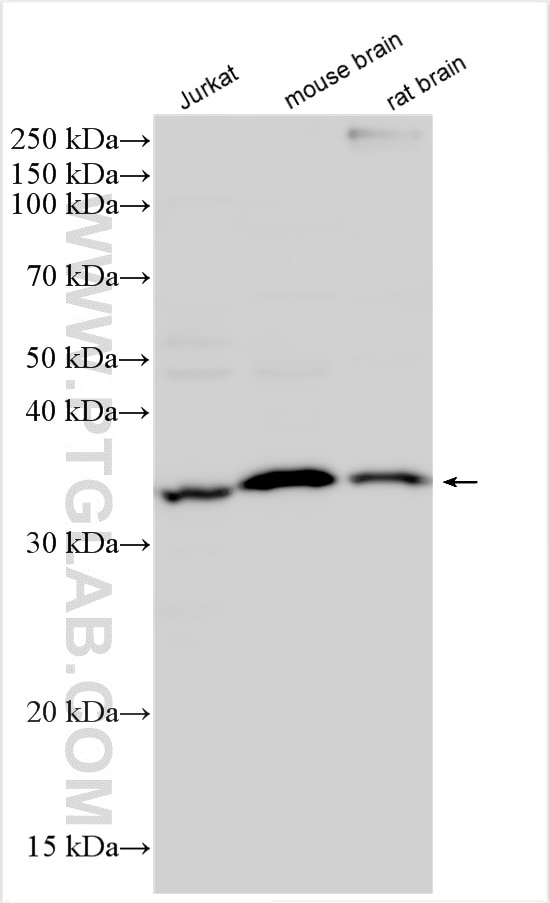
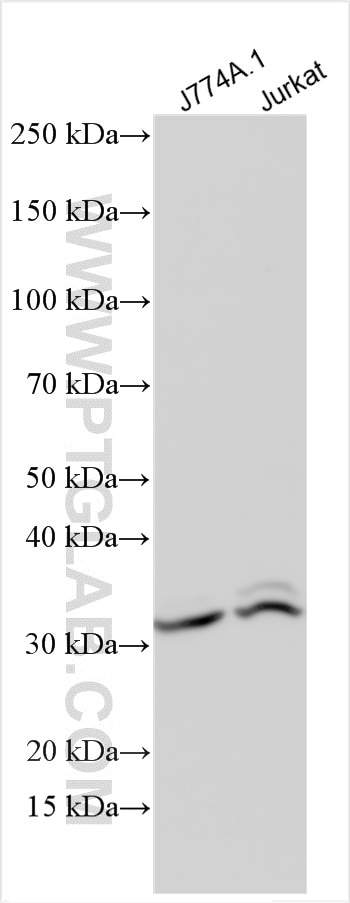
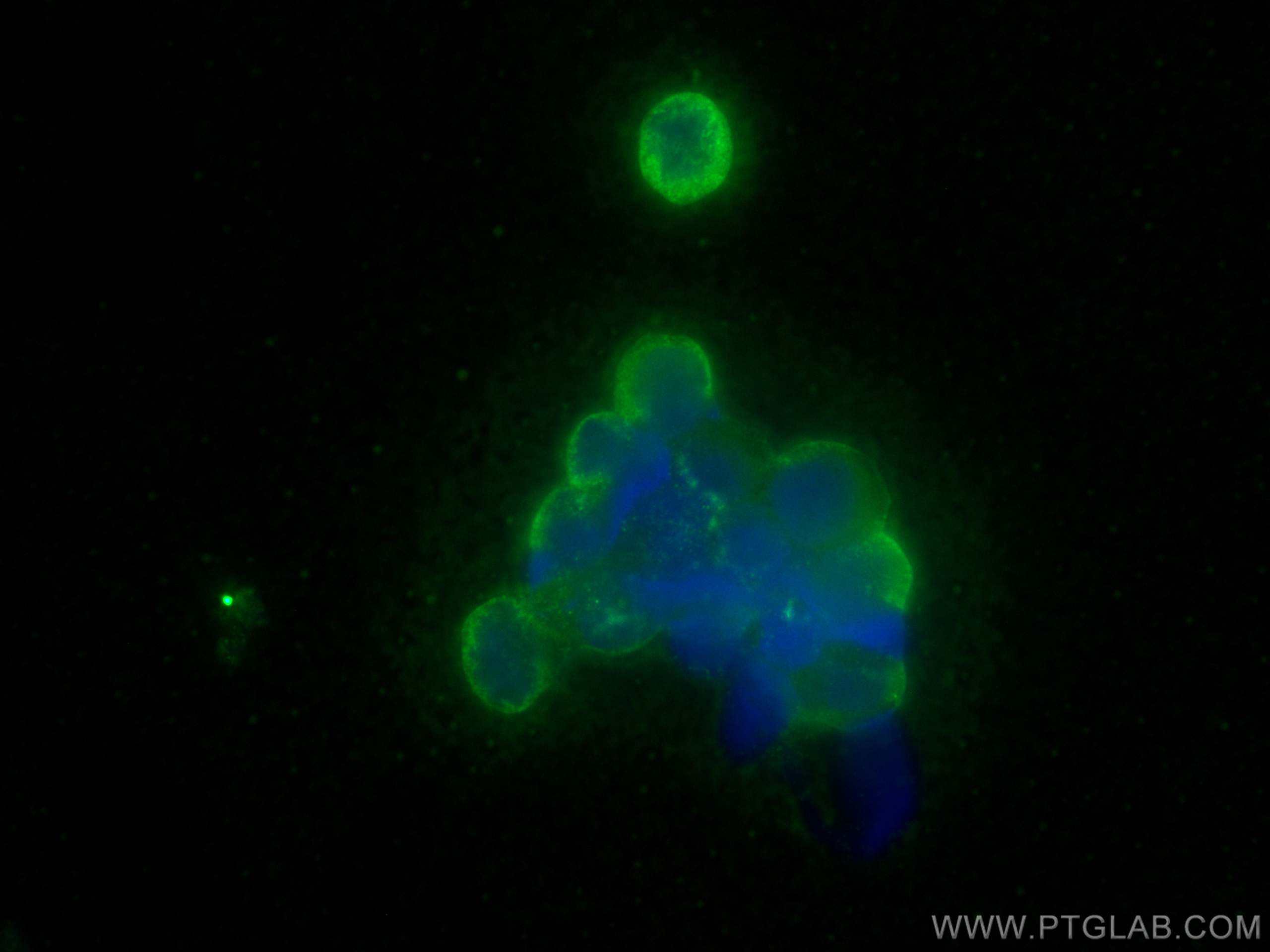

Tested Applications
| Positive WB detected in | Jurkat cells, J774A.1 cells, mouse brain tissue, rat brain tissue |
| Positive IF/ICC detected in | Raji cells |
Recommended dilution
| Application | Dilution |
|---|---|
| Western Blot (WB) | WB : 1:1000-1:4000 |
| Immunofluorescence (IF)/ICC | IF/ICC : 1:200-1:800 |
| It is recommended that this reagent should be titrated in each testing system to obtain optimal results. | |
| Sample-dependent, Check data in validation data gallery. | |
Product Information
30601-1-AP targets Fas/CD95 in WB, IF/ICC, ELISA applications and shows reactivity with human, mouse, rat samples.
| Tested Reactivity | human, mouse, rat |
| Cited Reactivity | human, mouse |
| Host / Isotype | Rabbit / IgG |
| Class | Polyclonal |
| Type | Antibody |
| Immunogen |
CatNo: Ag30426 Product name: Recombinant mouse Fas/CD95 protein Source: e coli.-derived, PGEX-4T Tag: GST Domain: 22-169 aa of NM_007987 Sequence: QGTNSISESLKLRRRVRETDKNCSEGLYQGGPFCCQPCQPGKKKVEDCKMNGGTPTCAPCTEGKEYMDKNHYADKCRRCTLCDEEHGLEVETNCTLTQNTKCKCKPDFYCDSPGCEHCVRCASCEHGTLEPCTATSNTNCRKQSPRNR Predict reactive species |
| Full Name | Fas (TNF receptor superfamily member 6) |
| Calculated Molecular Weight | 37 kDa |
| Observed Molecular Weight | 30-40 kDa |
| GenBank Accession Number | NM_007987 |
| Gene Symbol | Fas/CD95 |
| Gene ID (NCBI) | 14102 |
| RRID | AB_3086371 |
| Conjugate | Unconjugated |
| Form | Liquid |
| Purification Method | Antigen affinity purification |
| UNIPROT ID | P25446 |
| Storage Buffer | PBS with 0.02% sodium azide and 50% glycerol, pH 7.3. |
| Storage Conditions | Store at -20°C. Stable for one year after shipment. Aliquoting is unnecessary for -20oC storage. 20ul sizes contain 0.1% BSA. |
Background Information
FAS, also named as CD95, APO-1, APT1, FAS1 and TNFRSF6, is a receptor for TNFSF6/FASLG. It is a cell surface receptor belonging to the TNF receptor superfamily, can mediate apoptosis by ligation with an agonistic anti-Fas antibody or Fas ligand. Stimulation of Fas results in the aggregation of its intracellular death domains, leading to the formation of the death-inducing signaling complex (DISC). FAS-mediated apoptosis may have a role in the induction of peripheral tolerance, in the antigen-stimulated suicide of mature T-cells, or both.
Protocols
| Product Specific Protocols | |
|---|---|
| IF protocol for Fas/CD95 antibody 30601-1-AP | Download protocol |
| WB protocol for Fas/CD95 antibody 30601-1-AP | Download protocol |
| Standard Protocols | |
|---|---|
| Click here to view our Standard Protocols |
Publications
What published studies show
Fas/CD95 Polyclonal antibody (30601-1-AP) has 5 total citations, published in: Frontiers in Immunology, Neuroscience Research, Journal of Traditional Chinese Medicine, Journal of Cardiovascular Pharmacology, and Journal of Molecular Histology.
Research fields associated with these citations:
- Immunology/rheumatoid arthritis (neutrophil polarization and pain hypersensitivity)
- Neuroscience (hippocampal myelin damage and neuropathic pain)
- Traditional Chinese medicine/cardiology (coronary microvascular dysfunction)
- Cardiovascular pharmacology (endothelial injury in coronary artery disease with diabetes)
- Metabolic liver disease (MASLD progression, lipogenesis and macrophage inflammation)
Applications used were predominantly Western blot (WB), across human and mouse samples.
| Species | Application | Title |
|---|---|---|
Front Immunol Ganoderma lucidum spore powder alleviates rheumatoid arthritis-associated pain hypersensitivity through inhibiting accumulation, N1 polarization, and ROS production of neutrophils in mice | ||
Neurosci Res Hippocampal myelin damage contributes to cognitive impairment in a rat model of trigeminal neuropathic pain: Neuroprotective and anti-inflammatory effects of atorvastatin. | ||
J Tradit Chin Med Matrine alleviates coronary microvascular dysfunction in ischemia with non-obstructive coronary artery disease mice induced by advanced glycation end products inhibition of the reactive oxygen species-mediated endoplasmic reticulum stress in cardiac microvascular endothelial cells | ||
J Cardiovasc Pharmacol SGLT2 Inhibitors Attenuate Neutrophil-Mediated Endothelial Injury in Coronary Artery Disease With Type 2 Diabetes Mellitus Through a GREM1-Associated Smad Signaling Axis. | ||
J Mol Histol Apigenin attenuates MASLD progression by suppressing lipogenesis and macrophage M1-like inflammatory activation: involvement of SMAD4-associated signaling. |




