

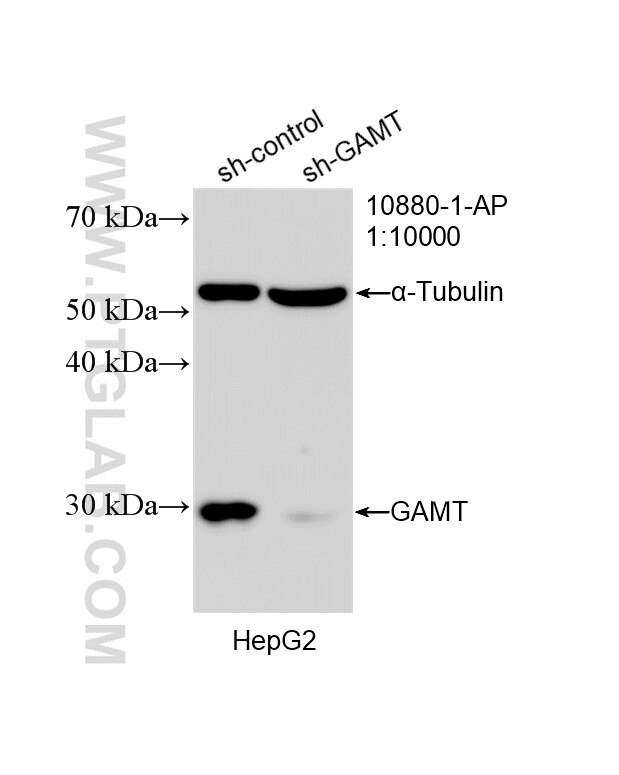



Tested Applications
| Positive WB detected in | HEK-293 cells, mouse liver tissue, rat liver tissue, HepG2 cells, SH-SY5Y cells |
| Positive IHC detected in | human liver tissue, human prostate cancer tissue Note: suggested antigen retrieval with TE buffer pH 9.0; (*) Alternatively, antigen retrieval may be performed with citrate buffer pH 6.0 |
Recommended dilution
| Application | Dilution |
|---|---|
| Western Blot (WB) | WB : 1:2000-1:16000 |
| Immunohistochemistry (IHC) | IHC : 1:50-1:500 |
| It is recommended that this reagent should be titrated in each testing system to obtain optimal results. | |
| Sample-dependent, Check data in validation data gallery. | |
Product Information
10880-1-AP targets GAMT in WB, IHC, IF, ELISA applications and shows reactivity with human, mouse, rat samples.
| Tested Reactivity | human, mouse, rat |
| Cited Reactivity | human, mouse, rat, zebrafish |
| Host / Isotype | Rabbit / IgG |
| Class | Polyclonal |
| Type | Antibody |
| Immunogen |
CatNo: Ag1327 Product name: Recombinant human GAMT protein Source: e coli.-derived, PGEX-4T Tag: GST Domain: 1-236 aa of BC016760 Sequence: MSAPSATPIFAPGENCSPAWGAAPAAYDAADTHLRILGKPVMERWETPYMHALAAAASSKGGRVLEVGFGMAIAASKVQEAPIDEHWIIECNDGVFQRLRDWAPRQTHKVIPLKGLWEDVAPTLPDGHFDGILYDTYPLSEETWHTHQFNFIKNHAFRLLKPGGVLTYCNLTSWGELMKSKYSDITIMFEETQVPALLEAGFRRENIRTEVMALVPPADCRYYAFPQMITPLVTKG Predict reactive species |
| Full Name | guanidinoacetate N-methyltransferase |
| Calculated Molecular Weight | 26 kDa |
| Observed Molecular Weight | ~30 kDa |
| GenBank Accession Number | BC016760 |
| Gene Symbol | GAMT |
| Gene ID (NCBI) | 2593 |
| RRID | AB_2109304 |
| Conjugate | Unconjugated |
| Form | Liquid |
| Purification Method | Antigen affinity purification |
| UNIPROT ID | Q14353 |
| Storage Buffer | PBS with 0.02% sodium azide and 50% glycerol, pH 7.3. |
| Storage Conditions | Store at -20°C. Stable for one year after shipment. Aliquoting is unnecessary for -20oC storage. 20ul sizes contain 0.1% BSA. |
Background Information
GAMT converts the latter to creatine with S-adenosylmethionine as the methyl donor. GAMT was induced in human and mouse cells in response to genotoxic and metabolic stress. GAMT was required for p53-dependent upregulation of creatine biosynthesis, fatty acid oxidation, and apoptosis in response to glucose deprivation.
Protocols
| Product Specific Protocols | |
|---|---|
| IHC protocol for GAMT antibody 10880-1-AP | Download protocol |
| WB protocol for GAMT antibody 10880-1-AP | Download protocol |
| Standard Protocols | |
|---|---|
| Click here to view our Standard Protocols |
Publications
What published studies show
The GAMT Polyclonal antibody (Cat# 10880-1-AP) has 13 citations published in journals including Cell, Cell Metabolism, Redox Biology, Acta Pharmaceutica Sinica B, Journal of Agricultural and Food Chemistry, Biology Direct, Arthritis Research & Therapy, Scientific Reports, Toxicology and Applied Pharmacology, Annals of Translational Medicine, Brain Research, Journal of Fish Biology, and bioRxiv. Research fields span glioblastoma, renal cell carcinoma, melanoma, acute myeloid leukemia, lupus nephritis, neurogenesis, thermogenesis, septic liver injury, and creatine metabolism.
| Species | Application | Title |
|---|---|---|
Cell Metab Myeloid cell-derived creatine in the hypoxic niche promotes glioblastoma growth | ||
Redox Biol Unbalanced redox status network as an early pathological event in congenital cataracts | ||
Acta Pharm Sin B Spatial metabolomics highlights metabolic reprogramming in acute myeloid leukemia mice through creatine pathway | ||
J Agric Food Chem Artepillin C, a key component of Brazilian propolis, induces thermogenesis in inguinal white adipose tissue of mice through a creatine metabolism-related thermogenic pathway. | ||
Biol Direct GAMT facilitates tumor progression via inhibiting p53 in clear cell renal cell carcinoma | ||
Arthritis Res Ther Investigation of ferroptosis-associated molecular subtypes and immunological characteristics in lupus nephritis based on artificial neural network learning |
Reviews
What customers say
The single review for this product is a 5-star rating for Western Blot. The user worked with mouse liver tissue, loading 10 µg of total liver lysate on a 13% SDS-PAGE gel. They used a 1:2000 dilution of the primary antibody with an overnight incubation at 4°C. Overall, the feedback indicates the antibody performed well for detecting the target in mouse liver lysates under these conditions.
The reviews below have been submitted by verified Proteintech customers who received an incentive for providing their feedback.
Werner (Verified Customer) (11-28-2017) | 13% SDS-PAGE, 10 ug total liver lysate loaded, overnight incubation with primary antibody at 4°C
 |




