


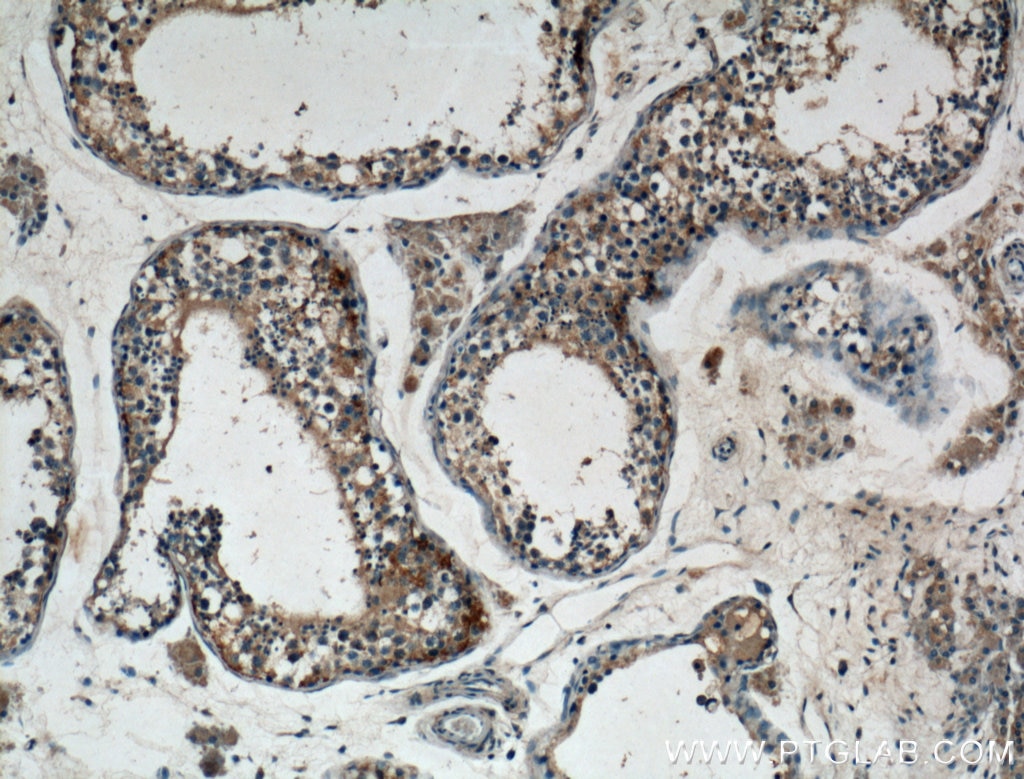



Tested Applications
| Positive WB detected in | mouse ovary tissue, mouse testis tissue |
| Positive IHC detected in | human testis tissue, rat testis tissue, mouse testis tissue, human pituitary adenoma tissue Note: suggested antigen retrieval with TE buffer pH 9.0; (*) Alternatively, antigen retrieval may be performed with citrate buffer pH 6.0 |
Recommended dilution
| Application | Dilution |
|---|---|
| Western Blot (WB) | WB : 1:500-1:1000 |
| Immunohistochemistry (IHC) | IHC : 1:50-1:500 |
| It is recommended that this reagent should be titrated in each testing system to obtain optimal results. | |
| Sample-dependent, Check data in validation data gallery. | |
Product Information
22462-1-AP targets GNRHR in WB, IHC, ELISA applications and shows reactivity with human, mouse, rat samples.
| Tested Reactivity | human, mouse, rat |
| Cited Reactivity | rat |
| Host / Isotype | Rabbit / IgG |
| Class | Polyclonal |
| Type | Antibody |
| Immunogen |
CatNo: Ag18005 Product name: Recombinant human GNRHR protein Source: e coli.-derived, PGEX-4T Tag: GST Domain: 226-285 aa of BC113546 Sequence: IMLICNAKIIFTLTRVLHQDPHELQLNQSKNNIPRARLKTLKMTVAFATSFTVCWTPYYV Predict reactive species |
| Full Name | GnRH receptor |
| Calculated Molecular Weight | 328 aa, 38 kDa |
| Observed Molecular Weight | 60 kDa, 50 kDa |
| GenBank Accession Number | BC113546 |
| Gene Symbol | GNRHR |
| Gene ID (NCBI) | 2798 |
| RRID | AB_2879109 |
| Conjugate | Unconjugated |
| Form | Liquid |
| Purification Method | Antigen affinity purification |
| UNIPROT ID | P30968 |
| Storage Buffer | PBS with 0.02% sodium azide and 50% glycerol, pH 7.3. |
| Storage Conditions | Store at -20°C. Stable for one year after shipment. Aliquoting is unnecessary for -20oC storage. 20ul sizes contain 0.1% BSA. |
Background Information
GNRHR, also named GRHR, belongs to the G-protein coupled receptor 1 family. GNRHR is a receptor for GnRH that mediates the action of GnRH to stimulate the secretion of the gonadotropic hormones luteinizing hormone (LH) and follicle-stimulating hormone (FSH). It mediates its action by association with G-proteins that activate a phosphatidylinositol-calcium second messenger system. Isoform2 of GNRHR may act as an inhibitor of GnRH-R signaling. Defects in GNRHR are a cause of idiopathic hypogonadotropic hypogonadism (IHH). Defects in GNRHR are a cause of fertile eunuch syndrome. The antibody only recognizes the isoform1 of GNRHR. The predicted unmodified molecular weight of the human GNRHR is ~38 kDa, the larger band (50-65 kDa) is likely to represent a glycosylated form of GNRHR.
Protocols
| Product Specific Protocols | |
|---|---|
| IHC protocol for GNRHR antibody 22462-1-AP | Download protocol |
| WB protocol for GNRHR antibody 22462-1-AP | Download protocol |
| Standard Protocols | |
|---|---|
| Click here to view our Standard Protocols |
Publications
What published studies show
The GNRHR Polyclonal antibody (Cat# 22462-1-AP) has 1 citation to date. It was used in an immunohistochemistry study published in Food and Chemical Toxicology (2025), investigating how prenatal genistein exposure in rats affects pubertal onset and reproductive hormone levels in male offspring via the hypothalamic-pituitary-gonadal axis. The research falls within the fields of developmental toxicology and reproductive endocrinology.
| Species | Application | Title |
|---|---|---|
Food Chem Toxicol Prenatal genistein exposure in rats affects pubertal onset and serum reproductive hormone levels in male offsprings via the hypothalamic-pituitary-gonadal axis |





