

Tested Applications
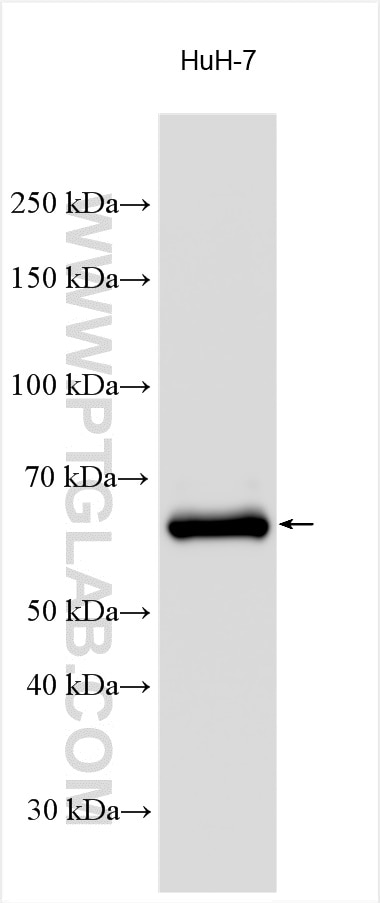
| Positive WB detected in | HuH-7 cells |
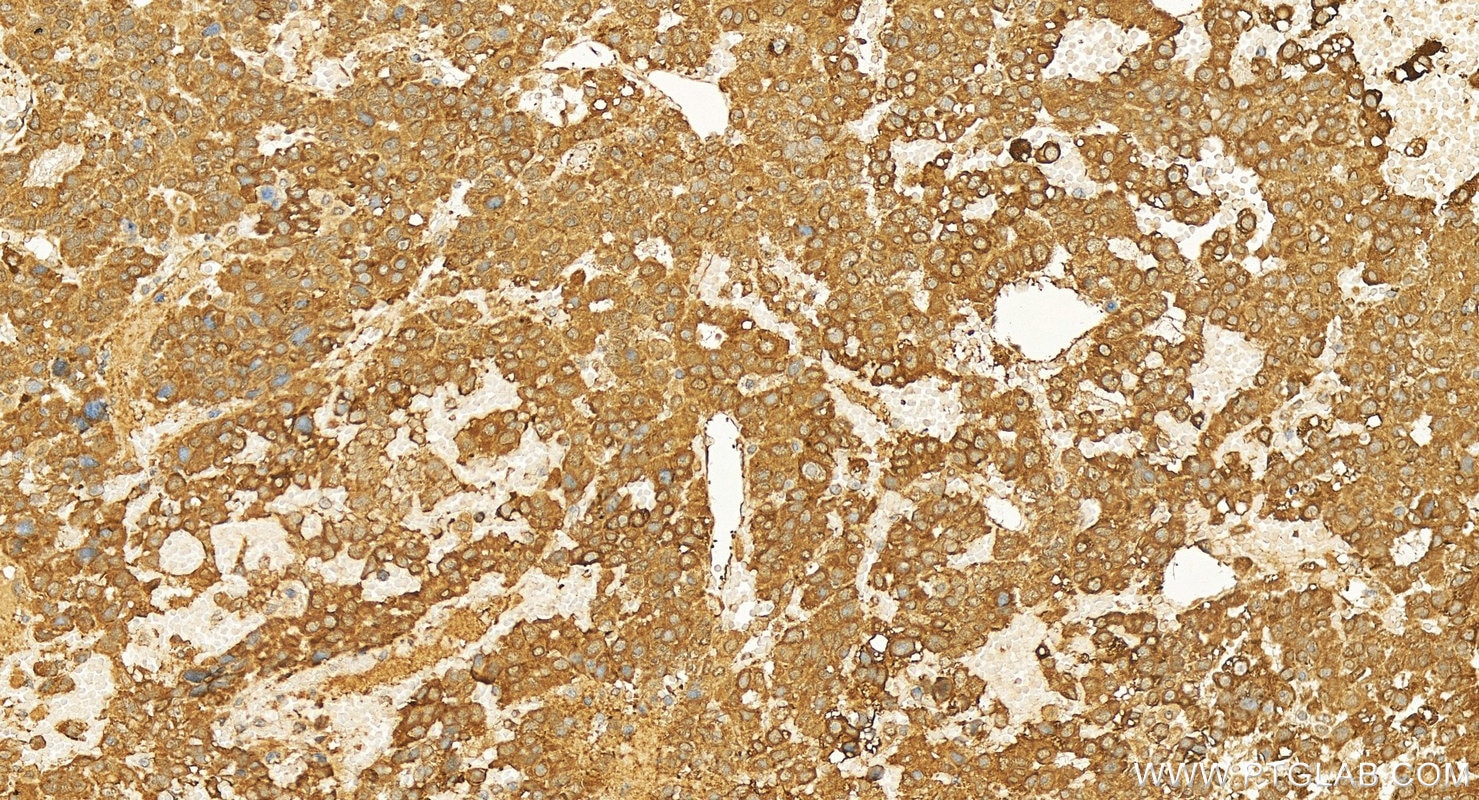
| Positive IHC detected in | human hepatocellular carcinoma Note: suggested antigen retrieval with TE buffer pH 9.0; (*) Alternatively, antigen retrieval may be performed with citrate buffer pH 6.0 |
Recommended dilution
| Application | Dilution |
|---|---|
| Western Blot (WB) | WB : 1:1000-1:8000 |
| Immunohistochemistry (IHC) | IHC : 1:50-1:500 |
| It is recommended that this reagent should be titrated in each testing system to obtain optimal results. | |
| Sample-dependent, Check data in validation data gallery. | |
Product Information
30021-1-AP targets Glypican 3 in WB, IHC, ELISA applications and shows reactivity with human samples.
| Tested Reactivity | human |
| Cited Reactivity | human |
| Host / Isotype | Rabbit / IgG |
| Class | Polyclonal |
| Type | Antibody |
| Immunogen |
CatNo: Ag32559 Product name: Recombinant human GPC3 protein Source: e coli.-derived, PGEX-4T Tag: GST Domain: 415-554 aa of BC035972 Sequence: VAENDTLCWNGQELVERYSQKAARNGMKNQFNLHELKMKGPEPVVSQIIDKLKHINQLLRTMSMPKGRVLDKNLDEEGFESGDCGDDEDECIGGSGDGMIKVKNQLRFLAELAYDLDVDDAPGNSQQATPKDNEISTFHN Predict reactive species |
| Full Name | glypican 3 |
| Calculated Molecular Weight | 580 aa, 66 kDa |
| Observed Molecular Weight | 66 kDa |
| GenBank Accession Number | BC035972 |
| Gene Symbol | GPC3 |
| Gene ID (NCBI) | 2719 |
| RRID | AB_2935499 |
| Conjugate | Unconjugated |
| Form | Liquid |
| Purification Method | Antigen affinity purification |
| UNIPROT ID | P51654 |
| Storage Buffer | PBS with 0.02% sodium azide and 50% glycerol, pH 7.3. |
| Storage Conditions | Store at -20°C. Stable for one year after shipment. Aliquoting is unnecessary for -20oC storage. 20ul sizes contain 0.1% BSA. |
Background Information
Glypicans (GPCs) are a family of glycosylphosphatidylinositol (GPI)-anchored heparan sulfate proteoglycans (HSPGs) that may play a role in the control of cell division and growth regulation. In mammals, there are six GPCs (GPC1 to GPC6), all of which have a similar core-protein size of approx. 60 kDa and the clustering of glycosaminoglycan attachment site near the C-terminus. They are tethered to the cell surface by GPI linkages, which can be cleaved by endogenous phospholipases, thus releasing the protein. Glypican 3 (GPC3) is highly expressed in many tissues during development and plays an important role in the regulation of embryonic growth (PMID: 22467855). Loss-of-function mutations of GPC3 result in the Simpson-Golabi-Behmel overgrowth syndrome (SGBS), and Gpc-3 null mice display developmental overgrowth (PMID: 8589713; 18477453). In hepatocellular carcinoma (HCC), the overexpression of glypican 3 has been demonstrated to be a reliable diagnostic indicator (PMID: 19212669; 22706665). The calculated molecular weight of native glypican 3 is 66 kDa, and glycinate forms of glypican 3 have higher molecular weights than 66 kDa (PMID: 12851874; 16024626; 19574424).
Protocols
| Product Specific Protocols | |
|---|---|
| IHC protocol for Glypican 3 antibody 30021-1-AP | Download protocol |
| WB protocol for Glypican 3 antibody 30021-1-AP | Download protocol |
| Standard Protocols | |
|---|---|
| Click here to view our Standard Protocols |
Publications
What published studies show
The GPC3 antibody (catalog 30021-1-AP) has 11 citations. These appear in journals including Molecular Cancer, Journal of Nanobiotechnology, Cancer Letters, Molecular Therapy, Journal of Hazardous Materials, Molecular Cancer Research, Cell Oncology, Molecular Pharmaceutics, Metabolism Open, Future Science OA, and Journal of Controlled Release. The research fields center on hepatocellular carcinoma (HCC), covering tumor heterogeneity, immunotherapy, stemness and drug resistance, metastasis, imaging, and targeted degradation of GPC3, with applications in IHC and Western blot.
| Species | Application | Title |
|---|---|---|
Mol Cancer Integrating single cell- and spatial- resolved transcriptomics unravels the inter-tumor heterogeneity and immunosuppressive landscape in HBV- and Clonorchis sinensis-associated hepatocellular carcinoma. | ||
J Nanobiotechnology An in situ generated CAR-M with IFN-γ and negative dominance Sirpα isoform augments hepatocellular carcinoma immunotherapy. | ||
Cancer Lett The BTN3A3-TOMM22 axis preserves mitochondrial homeostasis to facilitate HCC stemness and drug resistance. | ||
Mol Ther TOX-induced lnc-SUMF2-8 compromises antitumor function and anti-PD-1 response of CD8(+) T cells via lysosome-dependent degradation of TCF-1. | ||
J Hazard Mater Diesel exhaust promoted diethylnitrosamine-induced hepatocarcinogenesis in mice | ||
Mol Cancer Res METTL3-mediated m6A modification regulates the polycomb repressive complex 1 (PRC1) components BMI1 and RNF2 in hepatocellular carcinoma cells |
Reviews
What customers say
The single review for 30021-1-AP is highly positive, with a 5-star rating. The reviewer used the antibody for Western Blot at a 1:1000 dilution and reported that it "works very good in western blot." Overall, the feedback indicates strong performance and reliability for WB applications.
The reviews below have been submitted by verified Proteintech customers who received an incentive for providing their feedback.
HADI (Verified Customer) (11-06-2025) | works very good in westerblot.
|



