



Tested Applications
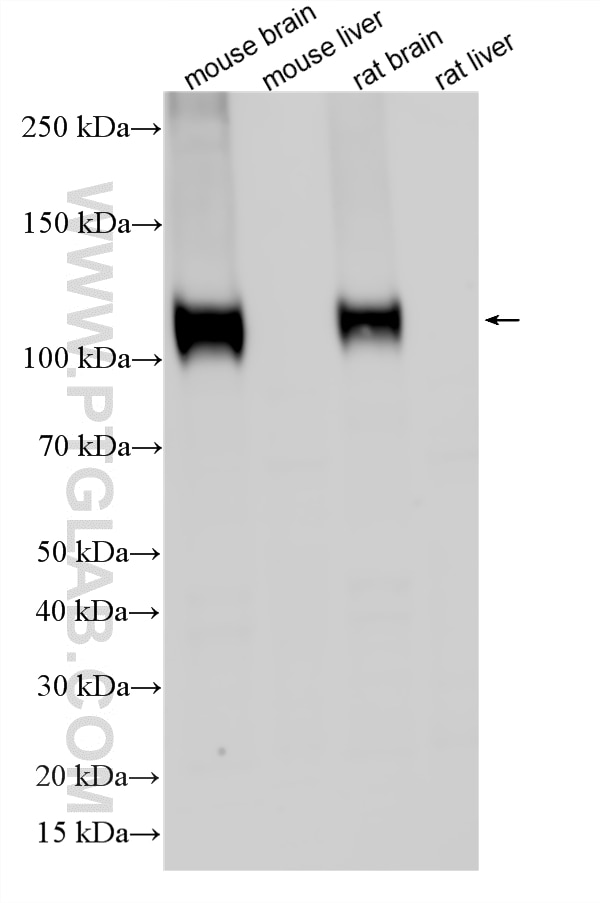
| Positive WB detected in | mouse brain tissue |
| Positive IP detected in | mouse brain tissue |
| Positive IHC detected in | mouse cerebellum tissue, mouse brain tissue Note: suggested antigen retrieval with TE buffer pH 9.0; (*) Alternatively, antigen retrieval may be performed with citrate buffer pH 6.0 |
| Positive IF-P detected in | mouse brain tissue |
| Positive IF-Fro detected in | mouse brain tissue |
Recommended dilution
| Application | Dilution |
|---|---|
| Western Blot (WB) | WB : 1:500-1:3000 |
| Immunoprecipitation (IP) | IP : 0.5-4.0 ug for 1.0-3.0 mg of total protein lysate |
| Immunohistochemistry (IHC) | IHC : 1:50-1:500 |
| Immunofluorescence (IF)-P | IF-P : 1:50-1:500 |
| Immunofluorescence (IF)-FRO | IF-FRO : 1:50-1:500 |
| It is recommended that this reagent should be titrated in each testing system to obtain optimal results. | |
| Sample-dependent, Check data in validation data gallery. | |
Product Information
27676-1-AP targets NMDAR1/GRIN1 in WB, IHC, IF-P, IF-Fro, IP, ELISA applications and shows reactivity with human, mouse, rat samples.
| Tested Reactivity | human, mouse, rat |
| Cited Reactivity | human, mouse, rat |
| Host / Isotype | Rabbit / IgG |
| Class | Polyclonal |
| Type | Antibody |
| Immunogen |
CatNo: Ag26364 Product name: Recombinant human GRIN1 protein Source: e coli.-derived, PGEX-4T Tag: GST Domain: 167-280 aa of NM_000832 Sequence: MVSDDHEGRAAQKRLETLLEERESKAEKVLQFDPGTKNVTALLMEAKELEARVIILSASEDDAATVYRAAAMLNMTGSGYVWLVGEREISGNALRYAPDGILGLQLINGKNESAH Predict reactive species |
| Full Name | glutamate receptor, ionotropic, N-methyl D-aspartate 1 |
| Calculated Molecular Weight | 105 kDa |
| Observed Molecular Weight | 120 kDa |
| GenBank Accession Number | NM_000832 |
| Gene Symbol | NMDAR1 |
| Gene ID (NCBI) | 2902 |
| RRID | AB_2880944 |
| Conjugate | Unconjugated |
| Form | Liquid |
| Purification Method | Antigen affinity purification |
| UNIPROT ID | Q05586 |
| Storage Buffer | PBS with 0.02% sodium azide and 50% glycerol, pH 7.3. |
| Storage Conditions | Store at -20°C. Stable for one year after shipment. Aliquoting is unnecessary for -20oC storage. 20ul sizes contain 0.1% BSA. |
Protocols
| Product Specific Protocols | |
|---|---|
| IF protocol for NMDAR1/GRIN1 antibody 27676-1-AP | Download protocol |
| IHC protocol for NMDAR1/GRIN1 antibody 27676-1-AP | Download protocol |
| IP protocol for NMDAR1/GRIN1 antibody 27676-1-AP | Download protocol |
| WB protocol for NMDAR1/GRIN1 antibody 27676-1-AP | Download protocol |
| Standard Protocols | |
|---|---|
| Click here to view our Standard Protocols |
Publications
What published studies show
The anti-GluN1 (NMDAR1) antibody, catalog number 27676-1-AP, has 27 citations. These appear in journals including Cell Discovery, Journal of Clinical Investigation, Advanced Science, Science Advances, Molecular Psychiatry, Cell Reports, Brain, Behavior, and Immunity, Journal of Ethnopharmacology, JCI Insight, Biochemical Pharmacology, Life Sciences, Aging, European Journal of Pharmacology, Neurochemistry International, Experimental Neurology, Brain Research Bulletin, ACS Chemical Neuroscience, Journal of Neuroscience, and Heliyon. Research fields span neuroscience, synaptic transmission, NMDA receptor signaling, depression, Alzheimer's disease, epilepsy, and neuroinflammation.
| Species | Application | Title |
|---|---|---|
Cell Discov Postsynaptic lncRNA Sera/Pkm2 pathway orchestrates the transition from social competition to rank by remodeling the neural ensemble in mPFC | ||
Adv Sci (Weinh) Pathophysiology-Directed Engineering of a Combination Nanoanalgesic for Neuropathic Pain | ||
Sci Adv RNF220 is an E3 ubiquitin ligase for AMPA receptors to regulate synaptic transmission | ||
J Hazard Mater Cu(OH)(2) nanopesticide induced adolescent social behavior deficits via long noncoding RNA-mediated synaptic network dysfunction. | ||
Mol Psychiatry PIAS1-mediated GSK3β SUMOylation exacerbates tauopathy and cognitive deficits in Alzheimer's disease models. |



