

Tested Applications
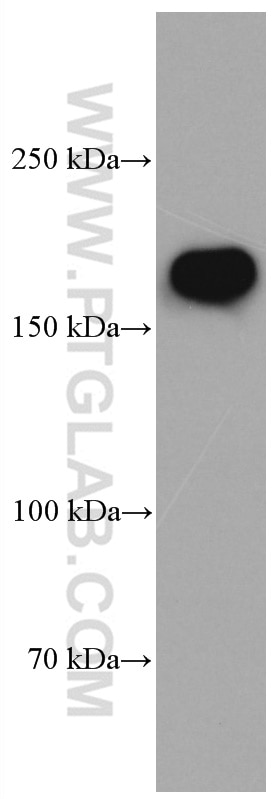
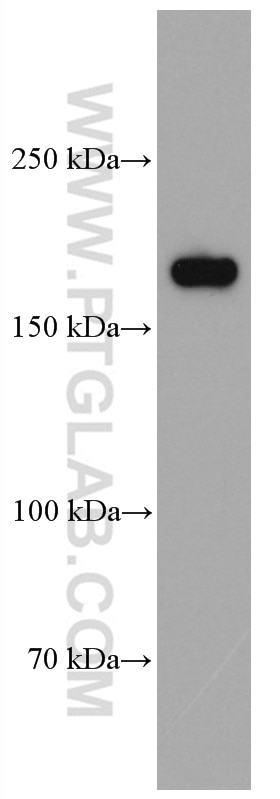
| Positive WB detected in | mouse brain tissue, rat brain tissue |
Recommended dilution
| Application | Dilution |
|---|---|
| Western Blot (WB) | WB : 1:1000-1:6000 |
| It is recommended that this reagent should be titrated in each testing system to obtain optimal results. | |
| Sample-dependent, Check data in validation data gallery. | |
Product Information
66565-1-Ig targets NMDAR2B/GRIN2B in WB, ELISA applications and shows reactivity with Human, Mouse, Rat samples.
| Tested Reactivity | Human, Mouse, Rat |
| Cited Reactivity | human, mouse, rat |
| Host / Isotype | Mouse / IgG1 |
| Class | Monoclonal |
| Type | Antibody |
| Immunogen |
CatNo: Ag16718 Product name: Recombinant human GRIN2B protein Source: e coli.-derived, PET28a Tag: 6*His Domain: 1133-1485 aa of BC113620 Sequence: YLDQFRTKENSPHWEHVDLTDIYKERSDDFKRDSVSGGGPCTNRSHIKHGTGDKHGVVSGVPAPWEKNLTNVEWEDRSGGNFCRSCPSKLHNYSTTVTGQNSGRQACIRCEACKKAGNLYDISEDNSLQELDQPAAPVAVTSNASTTKYPQSPTNSKAQKKNRNKLRRQHSYDTFVDLQKEEAALAPRSVSLKDKGRFMDGSPYAHMFEMSAGESTFANNKSSVPTAGHHHHNNPGGGYMLSKSLYPDRVTQNPFIPTFGDDQCLLHGSKSYFFRQPTVAGASKARPDFRALVTNKPVVSALHGAVPARFQKDICIGNQSNPCVPNNKNPRAFNGSSNGHVYEKLSSIESDV Predict reactive species |
| Full Name | glutamate receptor, ionotropic, N-methyl D-aspartate 2B |
| Calculated Molecular Weight | 1484 aa, 166 kDa |
| Observed Molecular Weight | 166 kDa |
| GenBank Accession Number | BC113620 |
| Gene Symbol | GRIN2B |
| Gene ID (NCBI) | 2904 |
| RRID | AB_2881926 |
| Conjugate | Unconjugated |
| Form | Liquid |
| Purification Method | Protein G purification |
| UNIPROT ID | Q13224 |
| Storage Buffer | PBS with 0.02% sodium azide and 50% glycerol, pH 7.3. |
| Storage Conditions | Store at -20°C. Stable for one year after shipment. Aliquoting is unnecessary for -20oC storage. 20ul sizes contain 0.1% BSA. |
Background Information
GRIN2B (also known as GluN2B or NMDAR2B) is a member of the N-methyl-D-aspartate (NMDA) receptor family within the ionotropic glutamate receptor superfamily. NMDA receptors are widely expressed in the central nervous system and play a major role in excitatory synaptic transmission and plasticity (PMID: 23223336). NMDA receptors large multi-subunit complexes arranged into heteromeric assemblies composed of four homologous subunits within a repertoire of over 10 different subunits: eight GluN1 isoforms, four GluN2 subunits (A-D) and two GluN3 subunits (A and B) (PMID: 21395862). Naturally occurring mutations within GRIN2B gene are associated with neurodevelopmental disorders including autism spectrum disorder, attention deficit hyperactivity disorder, epilepsy, and schizophrenia.
Protocols
| Product Specific Protocols | |
|---|---|
| WB protocol for NMDAR2B/GRIN2B antibody 66565-1-Ig | Download protocol |
| Standard Protocols | |
|---|---|
| Click here to view our Standard Protocols |
Publications
What published studies show
The NMDAR2B/GRIN2B Monoclonal antibody (1C5E12), catalog number 66565-1-Ig, has 4 total citations. These appear in Nature, Neuron, Molecular Cell, and Philosophical Transactions of the Royal Society B. The research fields span autism spectrum disorder, NMDA receptor channel gating, circRNA-mediated translational repression, and synaptic plasticity in fragile X syndrome. All citations used the antibody for Western blot in human, mouse, or rat samples.
| Species | Application | Title |
|---|---|---|
Neuron Structural basis for channel gating and blockade in tri-heteromeric GluN1-2B-2D NMDA receptor | ||
Mol Cell Global mapping of circRNA-target RNA interactions reveal P-body-mediated translational repression. | ||
Philos Trans R Soc Lond B Biol Sci Cage effects on synaptic plasticity and its modulation in a mouse model of fragile X syndrome |
Reviews
What customers say
One review rated this antibody 4 out of 5 stars for Western Blot on hiPSCs-derived neurons at a 1:1000 dilution. The reviewer noted that the signal is not very strong or specific in this cell type—it is detectable with approximately 90 seconds of exposure, but occasionally produces aspecific bands. Overall, the antibody works but may require optimization for sensitive or low-abundance targets in neuronal applications.
The reviews below have been submitted by verified Proteintech customers who received an incentive for providing their feedback.
Lisa (Verified Customer) (10-04-2021) | The antibody signal is not very strong and specific on hiPSCs derived neurons: it is detectable with an exposure of about 90 seconds, but sometimes gives aspecific bands
|



