
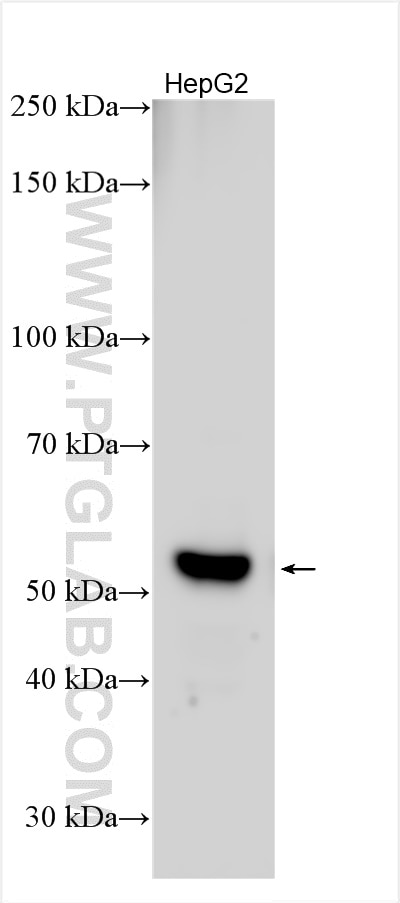
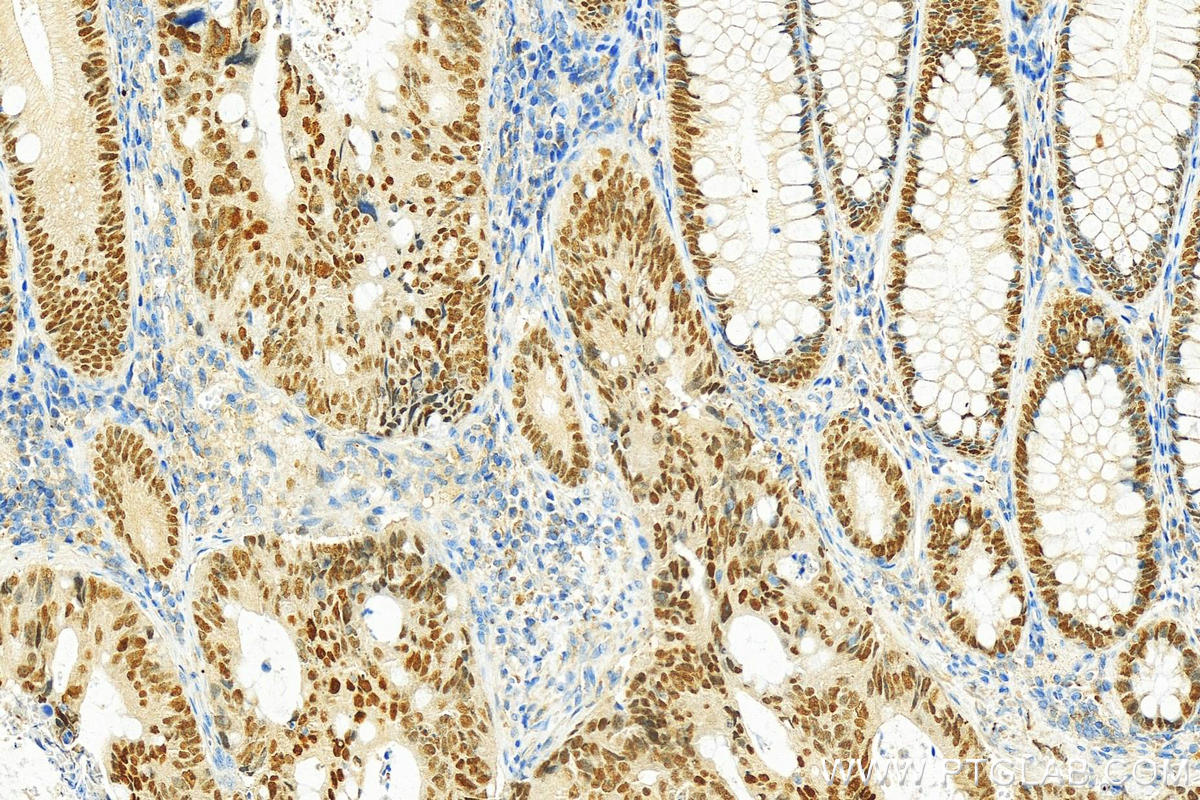
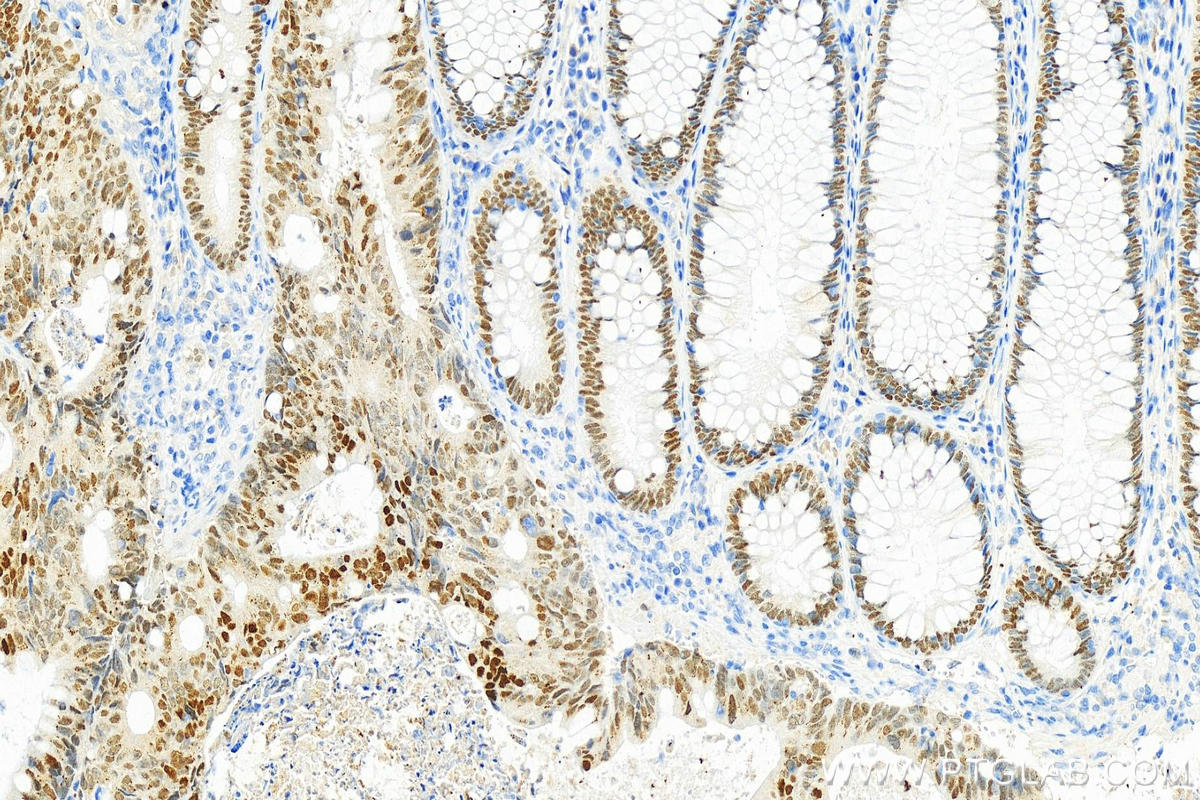

Tested Applications
| Positive WB detected in | HepG2 cells |
| Positive IHC detected in | human colon cancer tissue Note: suggested antigen retrieval with TE buffer pH 9.0; (*) Alternatively, antigen retrieval may be performed with citrate buffer pH 6.0 |
Recommended dilution
| Application | Dilution |
|---|---|
| Western Blot (WB) | WB : 1:2000-1:12000 |
| Immunohistochemistry (IHC) | IHC : 1:600-1:2400 |
| It is recommended that this reagent should be titrated in each testing system to obtain optimal results. | |
| Sample-dependent, Check data in validation data gallery. | |
Product Information
26245-1-AP targets HNF4A in WB, IHC, IF, ELISA applications and shows reactivity with human samples.
| Tested Reactivity | human |
| Cited Reactivity | human, mouse |
| Host / Isotype | Rabbit / IgG |
| Class | Polyclonal |
| Type | Antibody |
| Immunogen |
CatNo: Ag24637 Product name: Recombinant human HNF4A protein Source: e coli.-derived, PET30a Tag: 6*His Domain: 1-350 aa of BC137539 Sequence: MRLSKTLVDMDMADYSAALDPAYTTLEFENVQVLTMGNDTSPSEGTNLNAPNSLGVSALCAICGDRATGKHYGASSCDGCKGFFRRSVRKNHMYSCRFSRQCVVDKDKRNQCRYCRLKKCFRAGMKKEAVQNERDRISTRRSSYEDSSLPSINALLQAEVLSRQITSPVSGINGDIRAKKIASIADVCESMKEQLLVLVEWAKYIPAFCELPLDDQVALLRAHAGEHLLLGATKRSMVFKDVLLLGNDYIVPRHCPELAEMSRVSIRILDELVLPFQELQIDDNEYAYLKAIIFFDPDAKGLSDPGKIKRLRSQVQVSLEDYINDRQYDSRGRFGELLLLLPTLQSITWQ Predict reactive species |
| Full Name | hepatocyte nuclear factor 4, alpha |
| Calculated Molecular Weight | 53 kDa |
| Observed Molecular Weight | 52 kDa |
| GenBank Accession Number | BC137539 |
| Gene Symbol | HNF4A |
| Gene ID (NCBI) | 3172 |
| RRID | AB_3085850 |
| Conjugate | Unconjugated |
| Form | Liquid |
| Purification Method | Antigen affinity purification |
| UNIPROT ID | P41235 |
| Storage Buffer | PBS with 0.02% sodium azide and 50% glycerol, pH 7.3. |
| Storage Conditions | Store at -20°C. Stable for one year after shipment. Aliquoting is unnecessary for -20oC storage. 20ul sizes contain 0.1% BSA. |
Background Information
HNF4A (Hepatocyte nuclear factor 4 α) is highly conserved between humans and mice. Using conditional knockouts, epithelial HNF4A is indispensable for protecting against acute chemical-induced colitis and spontaneous colonic inflammation in aged animals (PMID:35792863). Moreover, reduced expression of HNF4A has been reported in liver fibrosis and viral vector-mediated HNF4A restoration has previously been demonstrated to reverse features of chronic liver injury. Therefore, HNF4A has been suggested as a therapeutic target for the treatment of liver fibrosis (PMID:34453962).
Protocols
| Product Specific Protocols | |
|---|---|
| IHC protocol for HNF4A antibody 26245-1-AP | Download protocol |
| WB protocol for HNF4A antibody 26245-1-AP | Download protocol |
| Standard Protocols | |
|---|---|
| Click here to view our Standard Protocols |
Publications
What published studies show
The HNF4A Polyclonal antibody (Cat# 26245-1-AP) has 9 citations. These appear in journals including Autophagy, J Adv Res, Small, J Transl Med, J Cell Mol Med, BMC Complement Med Ther, FASEB J, J Pharm Biomed Anal, and Virol J. Research fields span liver disease and hepatotoxicity, autophagy/mitophagy, cholesterol metabolism, inflammatory liver injury, stem cell differentiation, diabetic nephropathy, hepatic drug metabolism, and HBV virology.
| Species | Application | Title |
|---|---|---|
Autophagy Hypoxia-preconditioned dental pulp stem cells alleviate acetaminophen-induced liver failure via promoting MYC-HIF1A/HIF-1α-BNIP3-mediated mitophagy. | ||
J Adv Res Phytosterol alleviates cholesterol accumulation by influencing intestinal esterification rather than competitive solubilization under dietary MUFA. | ||
Small Microperfused Biomimetic Liver-on-a-Chip for High-Throughput Hepatotoxicity Screening. | ||
J Transl Med Adoptive transfer of VSIG4(+) macrophages interrupts the CCL2-CCR2 inflammatory amplification loop to mitigate acetaminophen-induced acute liver injury in murine and human organoid models. | ||
J Cell Mol Med S-Nitrosylation of NOTCH1 Regulates Mesenchymal Stem Cells Differentiation Into Hepatocyte-Like Cells by Inhibiting Notch Signalling Pathway | ||
BMC Complement Med Ther Revealing active components, action targets and molecular mechanism of Gandi capsule for treating diabetic nephropathy based on network pharmacology strategy. |
Reviews
What customers say
The single review for this product reports a 5-star rating from a Western Blot experiment performed on Hep40 cells at a 1:5000 dilution. The reviewer noted a strong band was observed, indicating reliable performance under the tested conditions. Overall, the feedback is positive, confirming the antibody's effectiveness for WB applications at the recommended dilution.
The reviews below have been submitted by verified Proteintech customers who received an incentive for providing their feedback.
Claudia (Verified Customer) (03-06-2026) | Strong band in western blot at 1:5000
|




