

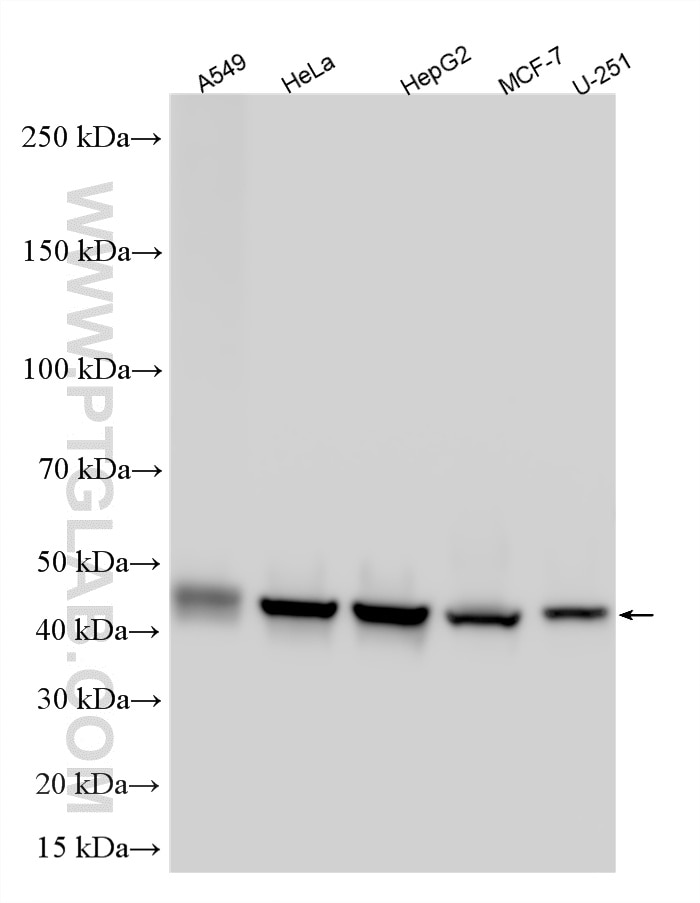



Tested Applications
| Positive WB detected in | A549 cells, HepG2 cells, HeLa cells, MCF-7 cells, U-251 cells |
| Positive IHC detected in | human liver cancer tissue, human prostate cancer tissue Note: suggested antigen retrieval with TE buffer pH 9.0; (*) Alternatively, antigen retrieval may be performed with citrate buffer pH 6.0 |
| Positive IF/ICC detected in | HeLa cells |
Recommended dilution
| Application | Dilution |
|---|---|
| Western Blot (WB) | WB : 1:1000-1:8000 |
| Immunohistochemistry (IHC) | IHC : 1:50-1:500 |
| Immunofluorescence (IF)/ICC | IF/ICC : 1:50-1:500 |
| It is recommended that this reagent should be titrated in each testing system to obtain optimal results. | |
| Sample-dependent, Check data in validation data gallery. | |
Product Information
15631-1-AP targets HSDL2 in WB, IHC, IF/ICC, ELISA applications and shows reactivity with human samples.
| Tested Reactivity | human |
| Cited Reactivity | human, mouse |
| Host / Isotype | Rabbit / IgG |
| Class | Polyclonal |
| Type | Antibody |
| Immunogen |
CatNo: Ag7987 Product name: Recombinant human HSDL2 protein Source: e coli.-derived, PGEX-4T Tag: GST Domain: 1-345 aa of BC004331 Sequence: MLPNTGRLAGCTVFITGASRGIGKAIALKAAKDGANIVIAAKTAQPHPKLLGTIYTAAEEIEAVGGKALPCIVDVRDEQQISAAVEKAIKKFGAYTIAKYGMSMYVLGMAEEFKGEIAVNALWPKTAIHTAAMDMLGGPGIESQCRKVDIIADAAYSIFQKPKSFTGNFVIDENILKEEGIENFDVYAIKPGHPLQPDFFLDEYPEAVSKKVESTGAVPEFKEEKLQLQPKPRSGAVEETFRIVKDSLSDDVVKATQAIYLFELSGEDGGTWFLDLKSKGGNVGYGEPSDQADVVMSMTTDDFVKMFSGKLKPTMAFMSGKLKIKGNMALAIKLEKLMNQMNARL Predict reactive species |
| Full Name | hydroxysteroid dehydrogenase like 2 |
| Calculated Molecular Weight | 45 kDa |
| Observed Molecular Weight | 45 kDa |
| GenBank Accession Number | BC004331 |
| Gene Symbol | HSDL2 |
| Gene ID (NCBI) | 84263 |
| RRID | AB_2120238 |
| Conjugate | Unconjugated |
| Form | Liquid |
| Purification Method | Antigen affinity purification |
| UNIPROT ID | Q6YN16 |
| Storage Buffer | PBS with 0.02% sodium azide and 50% glycerol, pH 7.3. |
| Storage Conditions | Store at -20°C. Stable for one year after shipment. Aliquoting is unnecessary for -20oC storage. 20ul sizes contain 0.1% BSA. |
Background Information
Human hydroxysteroid dehydrogenase-like 2 (HSDL2) is a characterized SDR gene that not only catalyses the oxidation and reduction of multiple substrates but also regulates different metabolic and signalling pathways. Accumulating evidences suggest that HSDL2 play an important role in cancer progression. HSDL2 has promoting effects on tumor progression in papillary thyroid cancer, bladder cancer, ovarian cancer, and glioma, but has suppressing effects in cholangiocarcinoma . ( PMID: 31372054, PMID: 32211805)
Protocols
| Product Specific Protocols | |
|---|---|
| IF protocol for HSDL2 antibody 15631-1-AP | Download protocol |
| IHC protocol for HSDL2 antibody 15631-1-AP | Download protocol |
| WB protocol for HSDL2 antibody 15631-1-AP | Download protocol |
| Standard Protocols | |
|---|---|
| Click here to view our Standard Protocols |
Publications
What published studies show
The anti-HSDL2 antibody (Cat# 15631-1-AP) has 10 citations published in journals including Science Advances, Neurotherapeutics, BMC Cancer, Proteomics, Chinese Medicine, Drug Design, Development and Therapy, Cell Biology and Toxicology, Cancer Management and Research, OncoTargets and Therapy, and Nan Fang Yi Ke Da Xue Xue Bao. Research fields span lipid metabolism, bile acid/cholesterol homeostasis, epilepsy, cardiomyocyte protection, diabetic cognitive dysfunction, virology, and multiple cancers including melanoma, cervical, breast, pancreatic, and rectal cancer.
| Species | Application | Title |
|---|---|---|
Neurotherapeutics Mitochondria-related HSDL2 is a potential biomarker in temporal lobe epilepsy by modulating astrocytic lipid metabolism
| ||
Chin Med Cucurbitacin E inhibits cellular proliferation and induces apoptosis in melanoma by suppressing HSDL2 expression.
| ||
Drug Des Devel Ther Semaglutide Reduces Cardiomyocyte Damage Caused by High-Fat Through HSDL2
| ||
Cell Biol Toxicol SIRT5-mediated HSDL2 desuccinylation promotes diabetic-associated cognitive dysfunction via disrupting mitochondrial TRAP1. | ||
Proteomics Proteome analysis of porcine epidemic diarrhea virus (PEDV)-infected vero cells. |




