
Filter:

Able AI
What's the best dilution for His-Bacteria-Protein in ?
Tested Applications
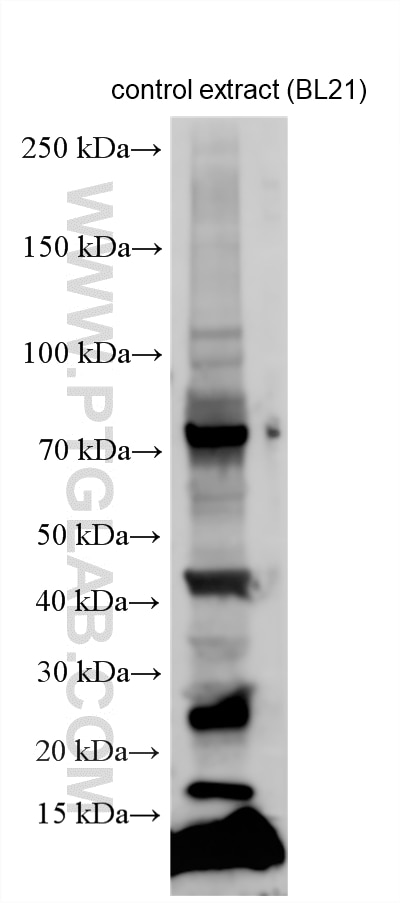
| Positive WB detected in | Bacteria |
Recommended dilution
| Application | Dilution |
|---|---|
| Western Blot (WB) | WB : 1:500-1:2000 |
| It is recommended that this reagent should be titrated in each testing system to obtain optimal results. | |
| Sample-dependent, Check data in validation data gallery. | |
Product Information
10560-1-Ig targets His-Bacteria-Protein in WB, ELISA applications and shows reactivity with bacteria samples.
| Tested Reactivity | bacteria |
| Host / Isotype | Rabbit / IgG |
| Class | Polyclonal |
| Type | Antibody |
| Immunogen |
CatNo: Ag0050 Product name: Recombinant His-Bacteria-Protein protein Source: e coli.-derived, Unknow Tag: N/A Domain: His Bacteria Protein of Sequence: Predict reactive species |
| Full Name | His-Bacteria-Protein |
| Calculated Molecular Weight | 30 kDa |
| Gene Symbol | |
| Gene ID (NCBI) | |
| RRID | AB_1607770 |
| Conjugate | Unconjugated |
| Form | Liquid |
| Purification Method | Protein A purification |
| Storage Buffer | PBS with 0.02% sodium azide and 50% glycerol, pH 7.3. |
| Storage Conditions | Store at -20°C. Stable for one year after shipment. Aliquoting is unnecessary for -20oC storage. 20ul sizes contain 0.1% BSA. |
Background Information
This antibody detects the native proteins with multiple Histidines of Bacterial, such as BL21(DE3).
Protocols
| Product Specific Protocols | |
|---|---|
| WB protocol for His-Bacteria-Protein antibody 10560-1-Ig | Download protocol |
| Standard Protocols | |
|---|---|
| Click here to view our Standard Protocols |
Publications
What published studies show
The His-Bacteria-Protein Polyclonal antibody (Cat# 10560-1-Ig) has a total of 1 citation. It appears in the journal eLife (2018), in a study investigating how SPIN1 promotes tumorigenesis by blocking the uL18-MDM2-p53 pathway in human cancer. The associated research field is oncology/cancer biology.
| Species | Application | Title |
|---|---|---|
Elife SPIN1 promotes tumorigenesis by blocking the uL18 (universal large ribosomal subunit protein 18)-MDM2-p53 pathway in human cancer. |


