
Human IFNA1 ELISA Kit
Cat no : KE00044
Synonyms
IFL, IFN, IFN ALPHA, IFN alpha 1/13, IFNA@, IFNA1, IFNA13, IFN-alpha, Interferon alpha 1/13, Interferon alpha D, interferon, alpha 1, LeIF D
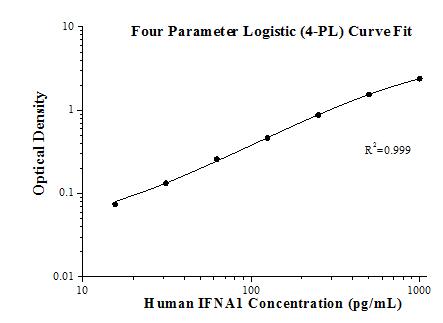
Validation Data Gallery
Product Information
KE00044 is a solid phase sandwich Enzyme Linked-Immuno-Sorbent Assay (Sandwich ELISA). The IFNA1 ELISA kit is to be used to detect and quantify protein levels of endogenous IFNA1. The assay recognizes human IFNA1. An antibody specific for IFNA1 has been pre-coated onto the microwells. The IFNA1 protein in samples is captured by the coated antibody after incubation. Following extensive washing, another antibody specific for IFNA1 is added to detect the captured IFNA1 protein. For signal development, horseradish peroxidase (HRP)-conjugated antibody is added, followed by Tetramethyl-benzidine (TMB) reagent. Solution containing sulfuric acid is used to stop color development and the color intensity which is proportional to the quantity of bound protein is measurable at 450 nm with the correction wavelength set at 630 nm.
| Product name | Human IFNA1 ELISA Kit |
| Tests | 1 X 96 well plate |
| Sample type | Serum, Plasma |
| Assay type | Sandwich |
| Sensitivity | 1.5 pg/mL |
| Range | 15.6-1000 pg/mL |
| Reactivity | Human |
| Tested applications | Sandwich ELISA |
| Gene ID (NCBI) | 3439 |
Recovery
| Sample Type | Average | Range |
|---|---|---|
| Human plasma | 102% | 78%-121% |
IntraAssay
| Sample | n | mean ( pg/mL) | SD | CV% |
|---|---|---|---|---|
| 1 | 20 | 114.9 | 9.9 | 8.6 |
| 2 | 20 | 348.9 | 19.1 | 5.5 |
| 3 | 20 | 688.8 | 64.3 | 9.3 |
InterAssay
| Sample | n | mean ( pg/mL) | SD | CV% |
|---|---|---|---|---|
| 1 | 24 | 122.4 | 4.7 | 3.9 |
| 2 | 24 | 380.4 | 21.6 | 5.7 |
| 3 | 24 | 703.5 | 37.3 | 5.3 |
Background Information
IFNA1 is a member of the Type I IFN (1) family best known for their antiviral activity. It is a key cytokine regulating the activity of B cells, T-helper cells (Th cells), cDCs and natural killer cells (NK cells). Interferon-alpha induces B cell maturation into plasma cells and immunoglobulin production. Interferon-alpha plays an important role in the pathogenesis of systemic lupus erythematosus (SLE). Interferon-alpha was the first cytokine to show clinical benefit in the treatment of certain types of cancer, including melanoma, chronic myelogenous leukemia, and renal cancer.
Properties
| Storage Instructions | All the reagents are stored at 2-8℃ for 6 months or -20℃ for 12 months. Refer to the protocol for further storage instructions. |
| Synonyms | IFL, IFN, IFN ALPHA, IFN alpha 1/13, IFNA@, IFNA1, IFNA13, IFN-alpha, Interferon alpha 1/13, Interferon alpha D, interferon, alpha 1, LeIF D |
FAQ
1、I have limited sample diluent. How should I handle samples requiring high dilution factors?
Answer: We recommend performing a serial dilution. For example, if human serum requires a 1,000,000-fold dilution, you can use a three-step 100× dilution method as follows:
Step 1: Take 2 uL of human serum and add it to 198 uL of sample diluent, mix thoroughly to obtain a 100-fold diluted sample.
Step 2: Take 2 uL of the 100-fold diluted sample and add it to 198 uL of sample diluent, mix thoroughly to obtain a 10,000-fold diluted sample.
Step 3: Take 2 uL of the 10,000-fold diluted sample and add it to 198 uL of sample diluent, mix thoroughly to obtain a 1,000,000-fold diluted sample.
If further dilution is required, additional serial steps can be used. We do not recommend using any other solutions or water for dilution, except for the sample diluent we suggest. If your sample diluent is still insufficient, please contact our customer service for more sample diluent.
Publications
| Species | Sample Type | Title |
|---|---|---|
Autophagy TRIM7/RNF90 promotes autophagy via regulation of ATG7 ubiquitination during L. monocytogenes infection | ||
Biomark Res Single cell analysis identified IFN signaling activation contributes to the pathogenesis of pediatric steroid-sensitive nephrotic syndrome | ||
J Exp Clin Cancer Res Unveiling the role of HP1α-HDAC1-STAT1 axis as a therapeutic target for HP1α-positive intrahepatic cholangiocarcinoma. | ||
Sci Adv CKS1B is a tumor-intrinsic factor driving CD8(+) T cell exhaustion via maintaining persistent tumor-antigen stimulation. | ||
Cancer Immunol Immunother Mechanism of action of a T cell-dependent bispecific antibody as a breakthrough immunotherapy against refractory colorectal cancer with an oncogenic mutation. | ||
Commun Biol KLF4-PFKFB3-driven glycolysis is essential for phenotypic switching of vascular smooth muscle cells |