

Tested Applications
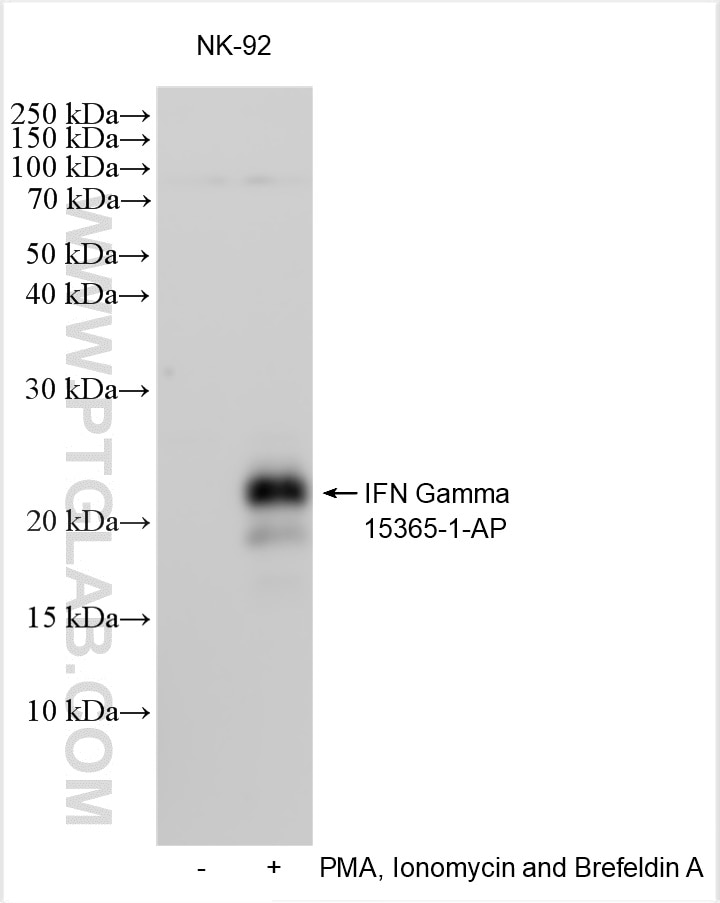
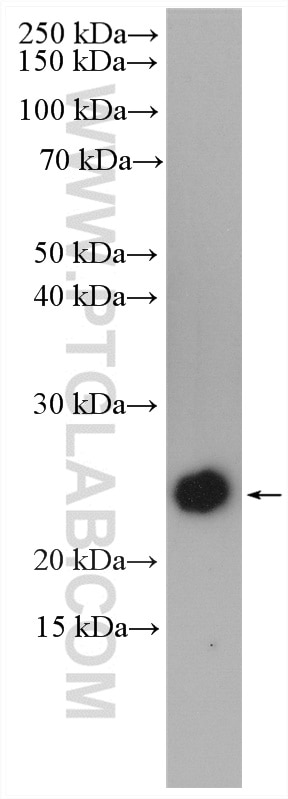
| Positive WB detected in | NK-92 cells, Recombinant protein |
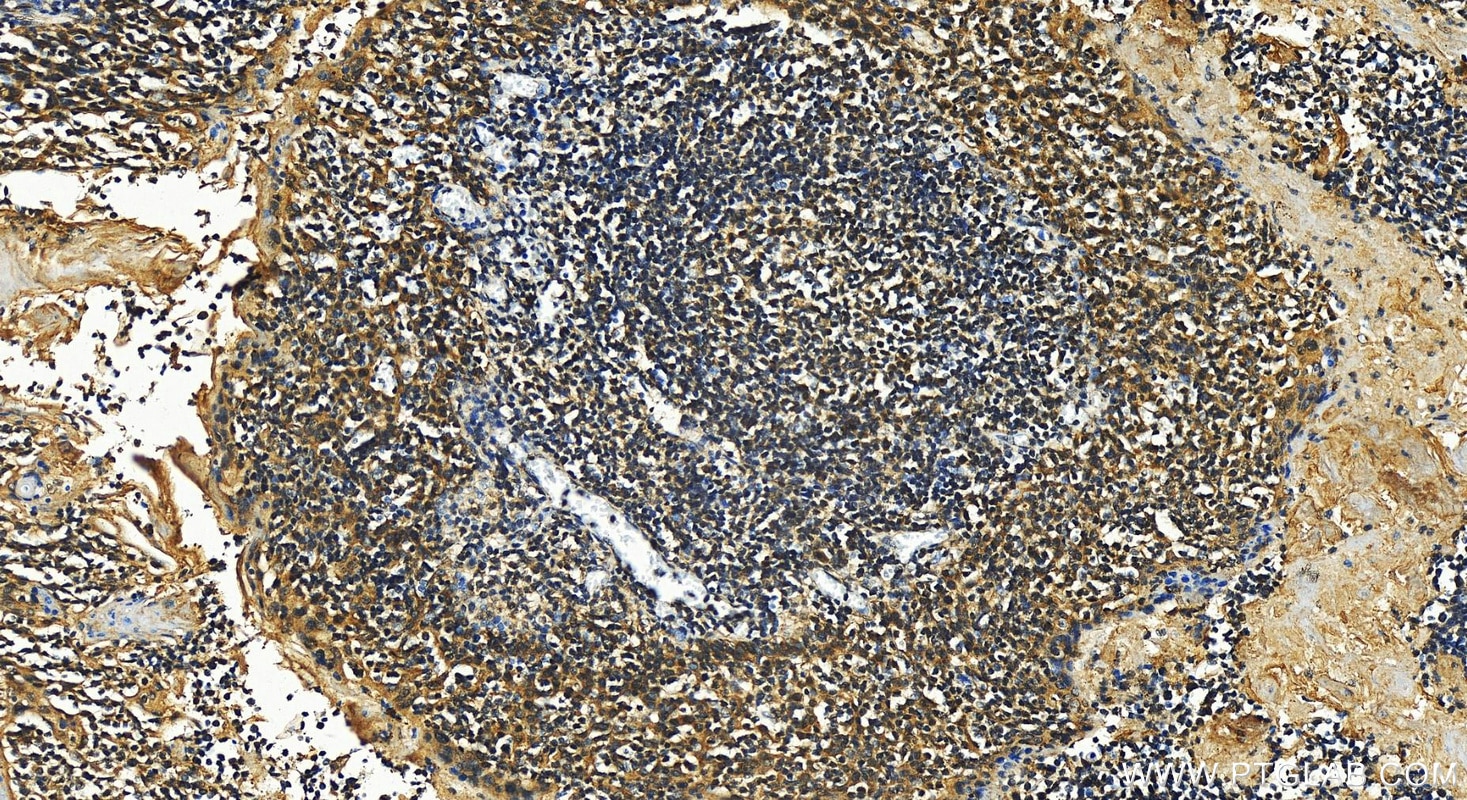
| Positive IHC detected in | human tonsillitis tissue Note: suggested antigen retrieval with TE buffer pH 9.0; (*) Alternatively, antigen retrieval may be performed with citrate buffer pH 6.0 |
Recommended dilution
| Application | Dilution |
|---|---|
| Western Blot (WB) | WB : 1:1000-1:6000 |
| Immunohistochemistry (IHC) | IHC : 1:50-1:500 |
| It is recommended that this reagent should be titrated in each testing system to obtain optimal results. | |
| Sample-dependent, Check data in validation data gallery. | |
Product Information
15365-1-AP targets IFN-gamma in WB, IHC, IF, ELISA applications and shows reactivity with human samples.
| Tested Reactivity | human |
| Cited Reactivity | human, rat, pig |
| Host / Isotype | Rabbit / IgG |
| Class | Polyclonal |
| Type | Antibody |
| Immunogen |
CatNo: Ag8321 Product name: Recombinant human IFNG protein Source: e coli.-derived, PGEX-4T Tag: GST Domain: 22-166 aa of BC070256 Sequence: YCQDPYVKEAENLKKYFNAGHSDVADNGTLFLGILKNWKEESDRKIMQSQIVSFYFKLFKNFKDDQSIQKSVETIKEDMNVKFFNSNKKKRDDFEKLTNYSVTDLNVQRKAIHELIQVMAELSPAAKTGKRKRSQMLFRGRRASQ Predict reactive species |
| Full Name | IFN gamma |
| Calculated Molecular Weight | 166 aa, 19 kDa |
| Observed Molecular Weight | 22 kDa |
| GenBank Accession Number | BC070256 |
| Gene Symbol | IFNG |
| Gene ID (NCBI) | 3458 |
| ENSEMBL Gene ID | ENSG00000111537 |
| RRID | AB_2123037 |
| Conjugate | Unconjugated |
| Form | Liquid |
| Purification Method | Antigen affinity purification |
| UNIPROT ID | P01579 |
| Storage Buffer | PBS with 0.02% sodium azide and 50% glycerol, pH 7.3. |
| Storage Conditions | Store at -20°C. Stable for one year after shipment. Aliquoting is unnecessary for -20oC storage. 20ul sizes contain 0.1% BSA. |
Background Information
IFN gamma (IFNG) is a soluble cytokine that is the only member of the type II class of IFN. It is secreted by Th1 cells, cytotoxic T cells and NK cells. The cytokine is associated with antiviral, immunoregulatory and anti-tumor properties and is a potent activator of macrophages. It plays crucial roles in pathogen clearance. Aberrant IFNG expression is associated with a number of autoinflammatory and autoimmune diseases. It has been identified in many studies as a biomarker for pleural tuberculosis (TB). Mutations in this gene are associated with aplastic anemia.
Protocols
| Product Specific Protocols | |
|---|---|
| IHC protocol for IFN-gamma antibody 15365-1-AP | Download protocol |
| WB protocol for IFN-gamma antibody 15365-1-AP | Download protocol |
| Standard Protocols | |
|---|---|
| Click here to view our Standard Protocols |
Publications
What published studies show
The IFN-gamma Polyclonal antibody (Cat# 15365-1-AP) has accumulated 163 citations. Publications span high-impact journals including Science, Nature Immunology, Nature Communications, Gastroenterology, Cancer Research, Signal Transduction and Targeted Therapy, Molecular Cancer, Advanced Science, Cell Reports, and Frontiers in Immunology. Research fields encompass cancer immunotherapy, inflammatory and autoimmune diseases, fibrosis, infectious diseases, neuroinflammation, wound healing, reproductive immunology, and macrophage/T-cell biology. Primary applications include WB, IHC, IF, and ELISA across human, mouse, rat, and pig species, reflecting broad utility in both basic and translational immunology research.
| Species | Application | Title |
|---|---|---|
Signal Transduct Target Ther Corynebacterium parakroppenstedtii secretes a novel glycolipid to promote the development of granulomatous lobular mastitis | ||
J Hematol Oncol PD-1 axis expression in musculoskeletal tumors and antitumor effect of nivolumab in osteosarcoma model of humanized mouse. | ||
Science Aberrant hyperexpression of the RNA binding protein FMRP in tumors mediates immune evasion | ||
Mol Cancer The construction of modular universal chimeric antigen receptor T (MU-CAR-T) cells by covalent linkage of allogeneic T cells and various antibody fragments | ||
Gastroenterology Interferon-γ-stimulated genes, but not USP18, are expressed in livers of patients with acute hepatitis C. | ||
Nat Immunol Targeting regulator of G protein signaling 1 in tumor-specific T cells enhances their trafficking to breast cancer. |




