
Product Information
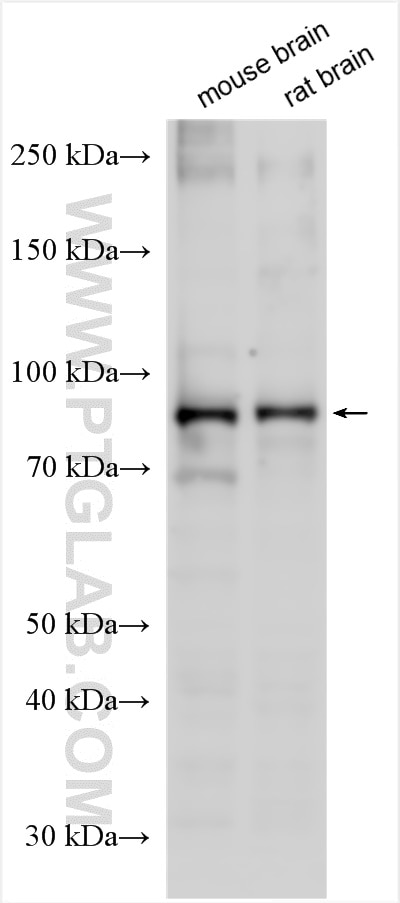
24580-1-PBS targets KCNQ3 in WB, Indirect ELISA applications and shows reactivity with human, mouse, rat samples.
| Tested Reactivity | human, mouse, rat |
| Host / Isotype | Rabbit / IgG |
| Class | Polyclonal |
| Type | Antibody |
| Immunogen |
CatNo: Ag20147 Product name: Recombinant human KCNQ3 protein Source: e coli.-derived, PET28a Tag: 6*His Domain: 379-517 aa of BC128576 Sequence: PNRIDLVATWRFYESVVSFPFFRKEQLEAASSQKLGLLDRVRLSNPRGSNTKGKLFTPLNVDAIEESPSKEPKPVGLNNKERFRTAFRMKAYAFWQSSEDAGTGDPMAEDRGYGNDFPIEDMIPTLKAAIRAVRILQFR Predict reactive species |
| Full Name | potassium voltage-gated channel, KQT-like subfamily, member 3 |
| Calculated Molecular Weight | 872 aa, 97 kDa |
| Observed Molecular Weight | ~90 kDa |
| GenBank Accession Number | BC128576 |
| Gene Symbol | KCNQ3 |
| Gene ID (NCBI) | 3786 |
| RRID | AB_3085739 |
| Conjugate | Unconjugated |
| Form | Liquid |
| Purification Method | Antigen affinity purification |
| UNIPROT ID | O43525 |
| Storage Buffer | PBS only, pH 7.3. |
| Storage Conditions | Store at -80°C. |
Background Information
KCNQ3, also named as BFNC2, EBN2 and KV7.3, belongs to the potassium channel family and KQT subfamily. KCNQ3 is probably important in the regulation of neuronal excitability. Associates with KCNQ2 or KCNQ5, KCNQ3 forms a potassium channel with essentially identical properties to the channel underlying the native M-current, a slowly activating and deactivating potassium conductance which plays a critical role in determining the subthreshold electrical excitability of neurons as well as the responsiveness to synaptic inputs. Defects in KCNQ3 are the cause of benign neonatal epilepsy type 2 (EBN2).


