
Product Information
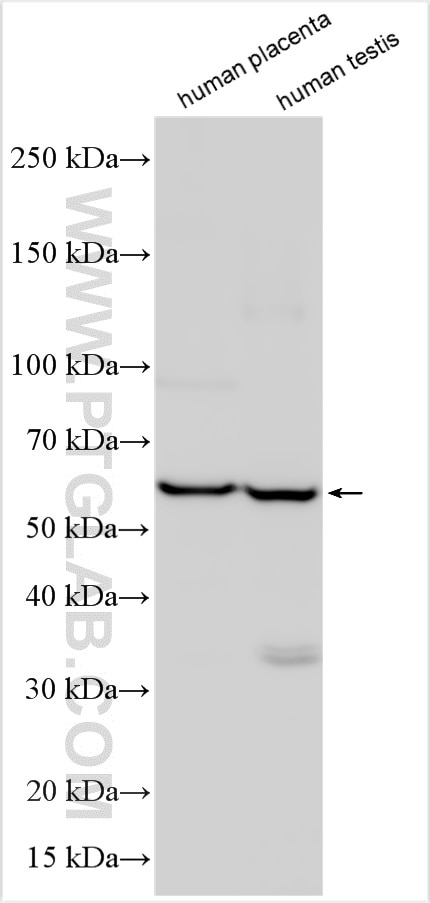
32488-1-PBS targets KCTD7 in WB, Indirect ELISA applications and shows reactivity with human samples.
| Tested Reactivity | human |
| Host / Isotype | Rabbit / IgG |
| Class | Polyclonal |
| Type | Antibody |
| Immunogen |
CatNo: Ag35756 Product name: Recombinant human KCTD7 protein Source: e coli.-derived, PGEX-4T Tag: GST Domain: 80-220 aa of NM_153033.4 Sequence: PTDSEGRYFIDRDGTHFGDVLNFLRSGDLPPRERVRAVYKEAQYYAIGPLLEQLENMQPLKGEKVRQAFLGLMPYYKDHLERIVEIARLRAVQRKARFAKLKVCVFKEEMPITPYECPLLNSLRFERSESDGQ Predict reactive species |
| Full Name | potassium channel tetramerisation domain containing 7 |
| Calculated Molecular Weight | 33 kDa,289 aa |
| Observed Molecular Weight | 62 kDa |
| GenBank Accession Number | NM_153033.4 |
| Gene Symbol | KCTD7 |
| Gene ID (NCBI) | 154881 |
| RRID | AB_3742631 |
| Conjugate | Unconjugated |
| Form | Liquid |
| Purification Method | Antigen affinity Purification |
| UNIPROT ID | Q96MP8 |
| Storage Buffer | PBS only, pH 7.3. |
| Storage Conditions | Store at -80°C. |
Background Information
KCTD7, or Potassium Channel Tetramerization Domain Containing 7, is a member of the KCTD family of proteins. The role of KCTD7 in regulating autophagy-lysosome pathways, which are essential for cellular homeostasis and response to nutrient stress (PMID: 36964131). It has been implicated in several neurodegenerative disorders, particularly progressive myoclonic epilepsy (PME) and neuronal ceroid lipofuscinosis (NCL). The deficiency of KCTD7 results in the accumulation of lipofuscin and lipid droplets, which are hallmarks of NCL (PMID: 33970744). The 62 kDa form most likely corresponds to an SDS-stable dimer (PMID: 22748208).


