
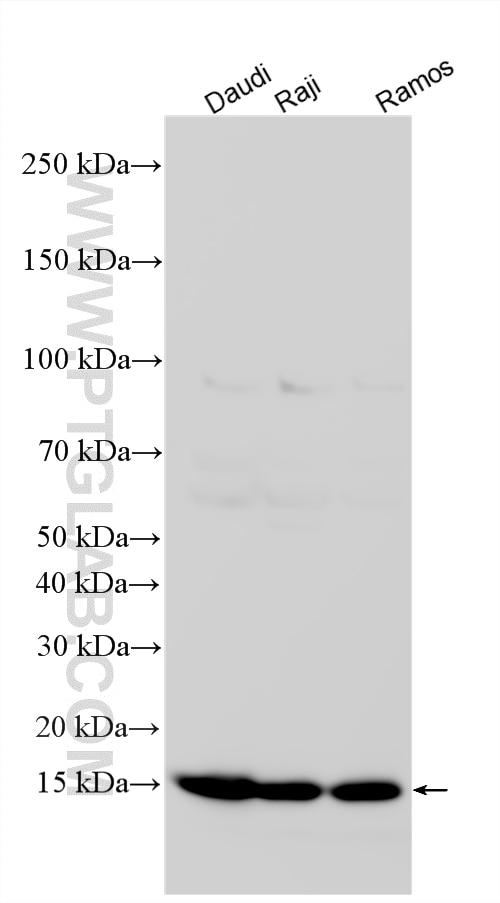



Tested Applications
| Positive WB detected in | Daudi cells, Raji cells, U-937 cells, Ramos cells |
| Positive IHC detected in | human ovary cancer tissue, human brain tissue, human liver cancer tissue Note: suggested antigen retrieval with TE buffer pH 9.0; (*) Alternatively, antigen retrieval may be performed with citrate buffer pH 6.0 |
Recommended dilution
| Application | Dilution |
|---|---|
| Western Blot (WB) | WB : 1:1000-1:4000 |
| Immunohistochemistry (IHC) | IHC : 1:50-1:500 |
| It is recommended that this reagent should be titrated in each testing system to obtain optimal results. | |
| Sample-dependent, Check data in validation data gallery. | |
Product Information
15471-1-AP targets LIMD2 in WB, IHC, IF, ELISA applications and shows reactivity with human, mouse, rat samples.
| Tested Reactivity | human, mouse, rat |
| Cited Reactivity | human |
| Host / Isotype | Rabbit / IgG |
| Class | Polyclonal |
| Type | Antibody |
| Immunogen |
CatNo: Ag7775 Product name: Recombinant human LIMD2 protein Source: e coli.-derived, PGEX-4T Tag: GST Domain: 1-127 aa of BC004400 Sequence: MFQAAGAAQATPSHDAKGGGSSTVQRSKSFSLRAQVKETCAACQKTVYPMERLVADKLIFHNSCFCCKHCHTKLSLGSYAALHGEFYCKPHFQQLFKSKGNYDEGFGRKQHKELWAHKEVDPGTKTA Predict reactive species |
| Full Name | LIM domain containing 2 |
| Calculated Molecular Weight | 14 kDa |
| Observed Molecular Weight | 16-20 kDa |
| GenBank Accession Number | BC004400 |
| Gene Symbol | LIMD2 |
| Gene ID (NCBI) | 80774 |
| RRID | AB_10859817 |
| Conjugate | Unconjugated |
| Form | Liquid |
| Purification Method | Antigen affinity purification |
| UNIPROT ID | Q9BT23 |
| Storage Buffer | PBS with 0.02% sodium azide and 50% glycerol, pH 7.3. |
| Storage Conditions | Store at -20°C. Stable for one year after shipment. Aliquoting is unnecessary for -20oC storage. 20ul sizes contain 0.1% BSA. |
Background Information
LIMD2 belongs to the LIM protein family. Members of this family typically mediate protein-protein interactions via the LIM domain and are involved in biological processes such as cell signal transduction, gene expression regulation, and cytoskeleton remodeling (PMID: 24590809). LIMD2 regulates cell motility and tumor progression by directly binding to and activating the integrin-linked kinase(PMID: 24590809).
Protocols
| Product Specific Protocols | |
|---|---|
| IHC protocol for LIMD2 antibody 15471-1-AP | Download protocol |
| WB protocol for LIMD2 antibody 15471-1-AP | Download protocol |
| Standard Protocols | |
|---|---|
| Click here to view our Standard Protocols |
Publications
What published studies show
The LIMD2 Polyclonal antibody (catalog number 15471-1-AP) has 3 total citations. These appear in Molecular Biology Reports, Discover Oncology, and Bioengineered. The associated research fields focus on cancer biology, specifically ovarian carcinoma and colon cancer, examining LIMD2's roles in tumor progression, migration, prognosis, and signaling pathways such as ERK1/2 and focal adhesion. Applications include Western blot, immunohistochemistry, and immunofluorescence in human samples.
| Species | Application | Title |
|---|---|---|
Mol Biol Rep Knockdown of LIMD2 inhibits the progression of ovarian carcinoma through ERK1/2 pathway
| ||
Discov Oncol High expression of LIMD2 predicts a poor prognosis and promotes migration of colon cancer cells. | ||
Bioengineered LIM domain-containing 2 (LIMD2) promotes the progress of ovarian cancer via the focal adhesion signaling pathway. |



