
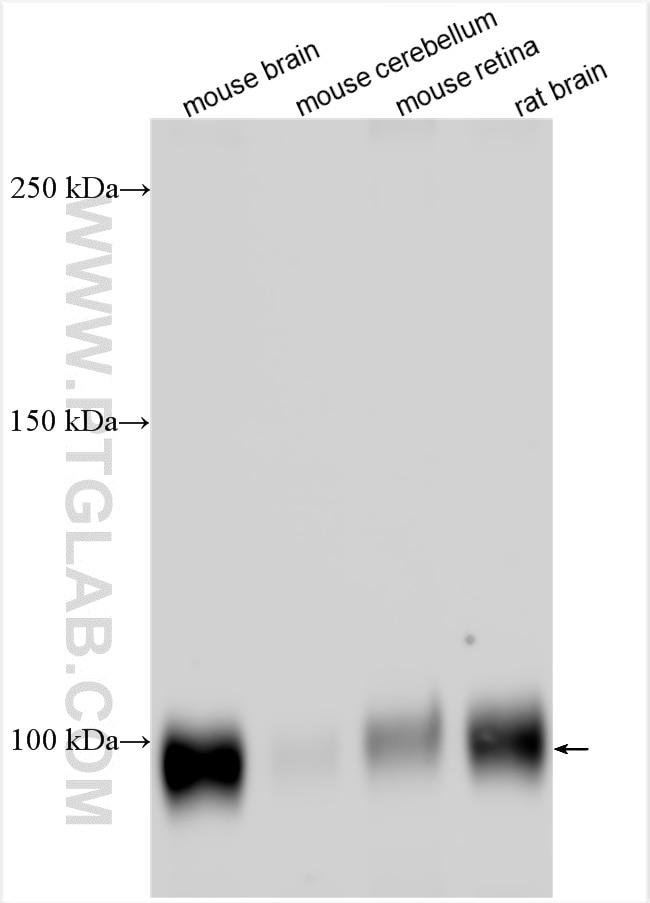

Tested Applications
| Positive WB detected in | mouse brain tissue, mouse cerebellum tissue, mouse retina tissue, rat brain tissue |
Recommended dilution
| Application | Dilution |
|---|---|
| Western Blot (WB) | WB : 1:1000-1:8000 |
| It is recommended that this reagent should be titrated in each testing system to obtain optimal results. | |
| Sample-dependent, Check data in validation data gallery. | |
Product Information
27576-1-AP targets LRFN2 in WB, ELISA applications and shows reactivity with human, mouse, rat samples.
| Tested Reactivity | human, mouse, rat |
| Host / Isotype | Rabbit / IgG |
| Class | Polyclonal |
| Type | Antibody |
| Immunogen |
CatNo: Ag24558 Product name: Recombinant human LRFN2 protein Source: e coli.-derived, PET28a Tag: 6*His Domain: 371-486 aa of BC142616 Sequence: MVEVSIVQLPHLSNSTSRTAPPKSRLSDITGSSKTSRGGGGSGGGEPPKSPPERAVLVSEVTTTSALVKWSVSKSAPRVKMYQLQYNCSDDEVLIYRMIPASNKAFVVNNLVSGTG Predict reactive species |
| Full Name | leucine rich repeat and fibronectin type III domain containing 2 |
| Calculated Molecular Weight | 789 aa, 85 kDa |
| Observed Molecular Weight | 85-100 kDa |
| GenBank Accession Number | BC142616 |
| Gene Symbol | LRFN2 |
| Gene ID (NCBI) | 57497 |
| RRID | AB_3742240 |
| Conjugate | Unconjugated |
| Form | Liquid |
| Purification Method | Antigen affinity purification |
| UNIPROT ID | Q9ULH4 |
| Storage Buffer | PBS with 0.02% sodium azide and 50% glycerol, pH 7.3. |
| Storage Conditions | Store at -20°C. Stable for one year after shipment. Aliquoting is unnecessary for -20oC storage. 20ul sizes contain 0.1% BSA. |
Background Information
LRFN2, also known as SALM1. It is mainly located in cell membrane and cytoplasm, and it is expressed at the synaptic contact at the base of cone cells, especially at the base of presynaptic endings, which is closely related to the dendrites of OFF bipolar cells (PMID: 40251167). In mammals, LRFN2 is mainly expressed in cone cells, but not in rod cells, and its expression in other retinal neurons is limited. In addition, the expression level in embryonic nerve cells is relatively low, mainly in more mature cells. LRFN2 plays a key role in synaptic transmission between cone cells and OFF bipolar cells. It can maintain the physical connection between cone cells and OFF bipolar cells, and gather glutamate receptors at the postsynaptic membrane to ensure strong dendritic transmission in OFF pathway, thus participating in the transmission of visual signals, which is very important for the coding of visual contrast and the defense behavior driven by looming. In bladder cancer, the increased expression of LRFN2 will inhibit the infiltration and functional transformation of CD8+ T cells, thus weakening the anti-tumor immune response, leading to bladder cancer resistance to immune checkpoint inhibitors, and its high expression is related to the poor prognosis of bladder cancer patients (PMID:37802603).
Protocols
| Product Specific Protocols | |
|---|---|
| WB protocol for LRFN2 antibody 27576-1-AP | Download protocol |
| Standard Protocols | |
|---|---|
| Click here to view our Standard Protocols |


