

Tested Applications
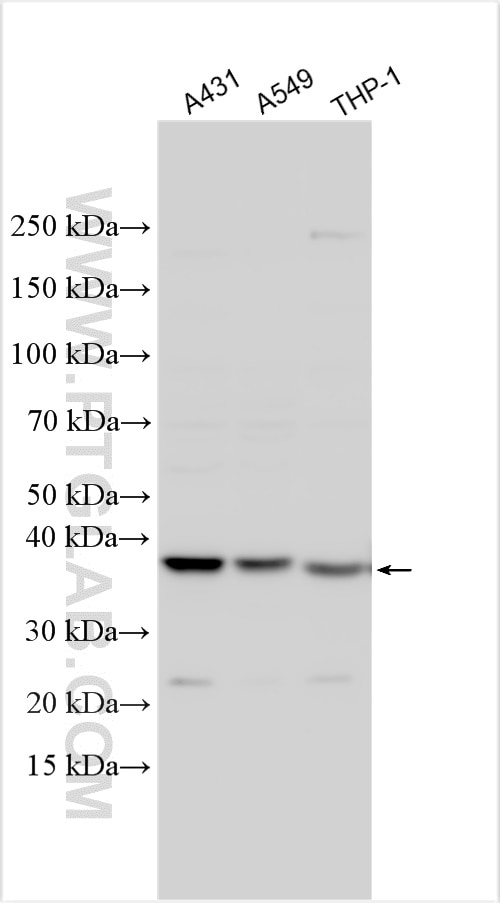
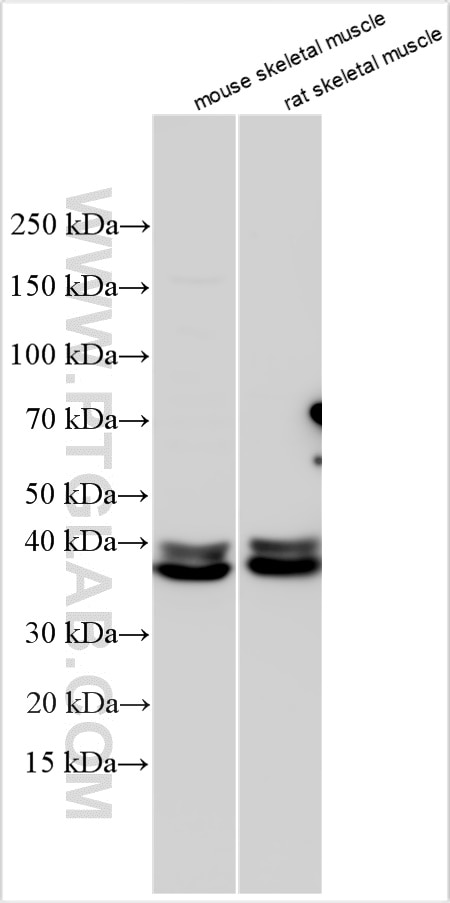
| Positive WB detected in | A431 cells, mouse skeletal muscle tissue, A549 cells, THP-1 cells, rat skeletal muscle tissue |
Recommended dilution
| Application | Dilution |
|---|---|
| Western Blot (WB) | WB : 1:1000-1:4000 |
| It is recommended that this reagent should be titrated in each testing system to obtain optimal results. | |
| Sample-dependent, Check data in validation data gallery. | |
Product Information
13898-1-AP targets MAP2K3 in WB, ELISA applications and shows reactivity with human, mouse, rat samples.
| Tested Reactivity | human, mouse, rat |
| Cited Reactivity | human, mouse, rat |
| Host / Isotype | Rabbit / IgG |
| Class | Polyclonal |
| Type | Antibody |
| Immunogen |
CatNo: Ag4861 Product name: Recombinant human MAP2K3 protein Source: e coli.-derived, T-HIS Tag: 6*His Domain: 1-347 aa of BC032478 Sequence: MESPASSQPASMPQSKGKSKRKKDLRISCMSKPPAPNPTPPRNLDSRTFITIGDRNFEVEADDLVTISELGRGAYGVVEKVRHAQSGTIMAVKRIRATVNSQEQKRLLMDLDINMRTVDCFYTVTFYGALFREGDVWICMELMDTSLDKFYRKVLDKNMTIPEDILGEIAVSIVRALEHLHSKLSVIHRDVKPSNVLINKEGHVKMCDFGISGYLVDSVAKTMDAGCKPYMAPERINPELNQKGYNVKSDVWSLGITMIEMAILRFPYESWGTPFQQLKQVVEEPSPQLPADRFSPEFVDFTAQCLRKNPAERMSYLELMEHPFFTLHKTKKTDIAAFVKEILGEDS Predict reactive species |
| Full Name | mitogen-activated protein kinase kinase 3 |
| Calculated Molecular Weight | 347 aa, 39 kDa |
| Observed Molecular Weight | 36-40 kDa |
| GenBank Accession Number | BC032478 |
| Gene Symbol | MAP2K3 |
| Gene ID (NCBI) | 5606 |
| RRID | AB_10642959 |
| Conjugate | Unconjugated |
| Form | Liquid |
| Purification Method | Antigen affinity purification |
| UNIPROT ID | P46734 |
| Storage Buffer | PBS with 0.02% sodium azide and 50% glycerol, pH 7.3. |
| Storage Conditions | Store at -20°C. Stable for one year after shipment. Aliquoting is unnecessary for -20oC storage. 20ul sizes contain 0.1% BSA. |
Background Information
MAP2K3, also named MKK3, is a member of the dual specificity kinase group and serves as a specific activator of p38 MAPK with MKK6. MKK3 can be phosphorylated by cytokines and environmental stress at sites Ser189 and Thr193 by MKKK proteins (MEKK 1-4). MKK3 plays a key role in cell differentiation, motility, division, and death. It has been reported that MKK3 targeting may represent an effective and potentially safe therapeutic strategy to selectively kill cancer cells in colorectal cancer patients. (PMID: 31695024, 30770795, 26805700, 8622669)
Protocols
| Product Specific Protocols | |
|---|---|
| WB protocol for MAP2K3 antibody 13898-1-AP | Download protocol |
| Standard Protocols | |
|---|---|
| Click here to view our Standard Protocols |
Publications
What published studies show
MAP2K3 (MKK3) Polyclonal Antibody (Cat# 13898-1-AP) has 10 citations across journals including Acta Pharmacologica Sinica, International Journal of Molecular Medicine, Biomedicine & Pharmacotherapy, Cell & Molecular Life Sciences, Biochemical Pharmacology, Food & Function, Scientific Reports, Molecular Immunology, PLoS ONE, and Bioengineered. Research fields span gastric and lung cancer, oxidative stress, inflammation, cell migration, apoptosis, proteostasis, urate reabsorption, and liver fibrosis, all centered on the MKK3/p38 MAPK signaling pathway.
| Species | Application | Title |
|---|---|---|
Acta Pharmacol Sin Targeting PRSS23 with tipranavir induces gastric cancer stem cell apoptosis and inhibits growth of gastric cancer via the MKK3/p38 MAPK-IL24 pathway
| ||
Int J Mol Med Protective effects of CXCR3/HO‑1 gene‑modified BMMSCs on damaged intestinal epithelial cells: Role of the p38‑MAPK signaling pathway. | ||
Biomed Pharmacother Identification of MAP Kinase Kinase 3 as a protein target of myricetin in non-small cell lung cancer cells
| ||
Biochem Pharmacol Sodium butyrate upregulates URAT1-mediated urate reabsorption in HK2 cells by activating FFAR2/p38 MAPK/ELK1/ARRB2 axis and relieving NF-κB-HNF1β competitive binding. | ||
Cell Mol Life Sci HERC2 deficiency activates C-RAF/MKK3/p38 signalling pathway altering the cellular response to oxidative stress | ||
Food Funct L-Theanine mediates the p38MAPK signaling pathway to alleviate heat-induced oxidative stress and inflammation in mice. |



