
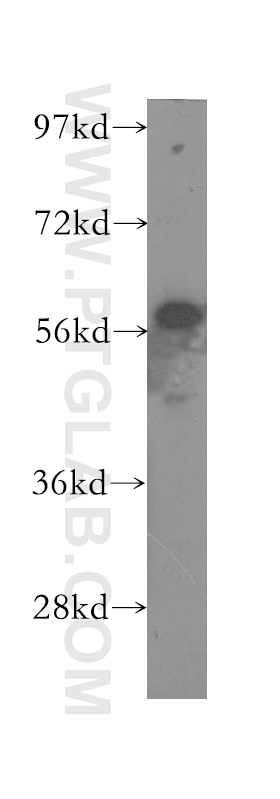

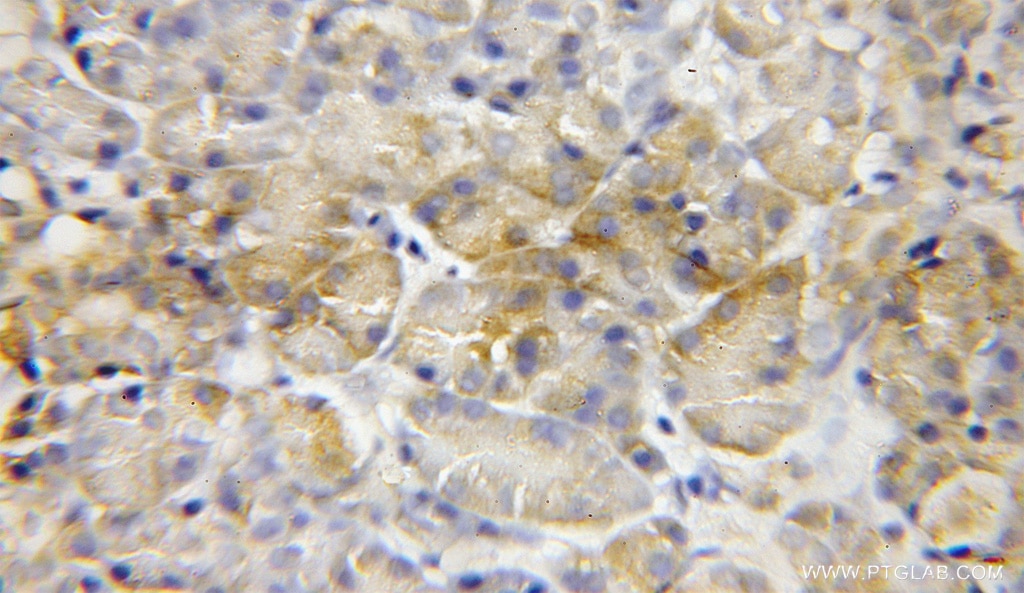

Tested Applications
| Positive WB detected in | human liver tissue |
| Positive IP detected in | mouse kidney tissue |
| Positive IHC detected in | human pancreas cancer tissue Note: suggested antigen retrieval with TE buffer pH 9.0; (*) Alternatively, antigen retrieval may be performed with citrate buffer pH 6.0 |
Recommended dilution
| Application | Dilution |
|---|---|
| Western Blot (WB) | WB : 1:500-1:1000 |
| Immunoprecipitation (IP) | IP : 0.5-4.0 ug for 1.0-3.0 mg of total protein lysate |
| Immunohistochemistry (IHC) | IHC : 1:20-1:200 |
| It is recommended that this reagent should be titrated in each testing system to obtain optimal results. | |
| Sample-dependent, Check data in validation data gallery. | |
Product Information
12117-1-AP targets MCCC2 in WB, IHC, IF, IP, CoIP, ELISA applications and shows reactivity with human, mouse, rat samples.
| Tested Reactivity | human, mouse, rat |
| Cited Reactivity | human, mouse |
| Host / Isotype | Rabbit / IgG |
| Class | Polyclonal |
| Type | Antibody |
| Immunogen |
CatNo: Ag2767 Product name: Recombinant human MCCC2 protein Source: e coli.-derived, PGEX-4T Tag: GST Domain: 1-329 aa of BC014897 Sequence: MWAVLRLALRPCARASPAGPRAYHGDSVASLGTQPDLGSALYQENYKQMKALVNQLHERVEHIKLGGGEKARALHISRGKLLPRERIDNLIDPGSPFLELSQFAGYQLYDNEEVPGGGIITGIGRVSGVECMIIANDATVKGGAYYPVTVKKQLRAQEIAMQNRLPCIYLVDSGGAYLPRQADVFPDRDHFGRTFYNQAIMSSKNIAQVKAATGEEVSAEDLGGADLHCRKSGVSDHWALDDHHALHLTRKVVRNLNYQKKLDVTIEPSEEPLFPADELYGIVGANLKRSFDVREVIARIVDGSRFTEFKAFYGDTLVTGIKPLEKHKT Predict reactive species |
| Full Name | methylcrotonoyl-Coenzyme A carboxylase 2 (beta) |
| Calculated Molecular Weight | 563 aa, 61 kDa |
| Observed Molecular Weight | 61 kDa |
| GenBank Accession Number | BC014897 |
| Gene Symbol | MCCC2 |
| Gene ID (NCBI) | 64087 |
| RRID | AB_2143810 |
| Conjugate | Unconjugated |
| Form | Liquid |
| Purification Method | Antigen affinity purification |
| UNIPROT ID | Q9HCC0 |
| Storage Buffer | PBS with 0.02% sodium azide and 50% glycerol, pH 7.3. |
| Storage Conditions | Store at -20°C. Stable for one year after shipment. Aliquoting is unnecessary for -20oC storage. 20ul sizes contain 0.1% BSA. |
Background Information
MCCC2(Methylcrotonoyl-CoA carboxylase beta chain, mitochondrial) is also named as MCCB and belongs to the AccD/PCCB family. The putative 563-amino acid polypeptide has a calculated molecular mass of 61 kD and contains an N-terminal mitochondrial targeting sequence(PMID:11181649). It catalyzes carboxylation of 3 methylcrotonyl COA to form 3 methylglutaconyl-COA and is probably a dodecamer composed of six biotin-containing alpha subunits and six beta subunits. Defects in MCCC2 are the cause of methylcrotonoyl-CoA carboxylase 2 deficiency (MCC2D).
Protocols
| Product Specific Protocols | |
|---|---|
| IHC protocol for MCCC2 antibody 12117-1-AP | Download protocol |
| IP protocol for MCCC2 antibody 12117-1-AP | Download protocol |
| WB protocol for MCCC2 antibody 12117-1-AP | Download protocol |
| Standard Protocols | |
|---|---|
| Click here to view our Standard Protocols |
Publications
What published studies show
The MCCC2 Polyclonal antibody (Cat# 12117-1-AP) has 7 citations published in Cell Metabolism, Molecular Medicine, Cancer Cell International, Journal of Proteome Research, Kidney Research and Clinical Practice, Andrology, and Endocrine Connections. Research fields span mitochondrial metabolism under hypoxia, gastric cancer, hepatocellular carcinoma, prostate cancer proteomics, cisplatin-induced kidney injury, reproductive biology, and branched-chain amino acid catabolism in obesity.
| Species | Application | Title |
|---|---|---|
Mol Med ECHDC2 inhibits the proliferation of gastric cancer cells by binding with NEDD4 to degrade MCCC2 and reduce aerobic glycolysis | ||
Cancer Cell Int MCCC2 promotes HCC development by supporting leucine oncogenic function.
| ||
J Proteome Res Profiling protein markers associated with lymph node metastasis in prostate cancer by DIGE-based proteomics analysis. | ||
Kidney Res Clin Pract Methylcrotonyl-CoA carboxylase 2 supports leucine catabolism to promote mitochondrial biogenesis and alleviate cisplatin-induced acute kidney injury. | ||
Andrology Nicotine elevates sperm motility and induces Pfn1 promoter hypomethylation in mouse testis. |




