
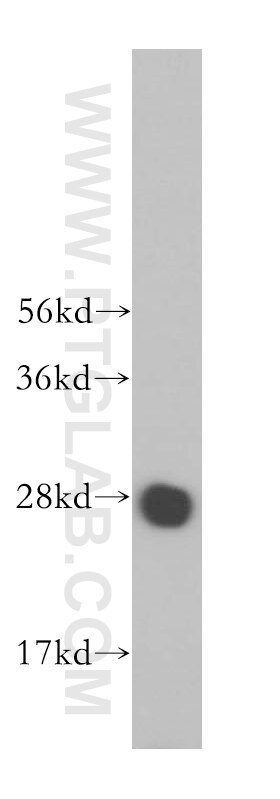
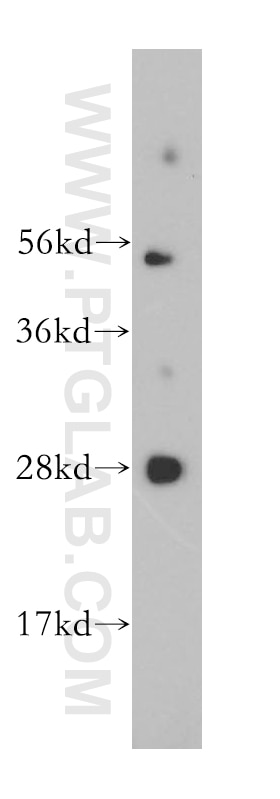

Tested Applications
| Positive WB detected in | K-562 cells, HeLa cells |
Recommended dilution
| Application | Dilution |
|---|---|
| Western Blot (WB) | WB : 1:500-1:2000 |
| It is recommended that this reagent should be titrated in each testing system to obtain optimal results. | |
| Sample-dependent, Check data in validation data gallery. | |
Product Information
17598-1-AP targets MED20 in WB, ELISA applications and shows reactivity with human samples.
| Tested Reactivity | human |
| Cited Reactivity | human, mouse |
| Host / Isotype | Rabbit / IgG |
| Class | Polyclonal |
| Type | Antibody |
| Immunogen |
CatNo: Ag11598 Product name: Recombinant human MED20 protein Source: e coli.-derived, PGEX-4T Tag: GST Domain: 1-212 aa of BC040950 Sequence: MGVTCVSQMPVAEGKSVQQTVELLTRKLEMLGAEKQGTFCVDCETYHTAASTLGSQGQTGKLMYVMHNSEYPLSCFALFENGPCLIADTNFDVLMVKLKGFFQSAKASKIETRGTRYQYCDFLVKVGTVTMGPSARGISVEVEYGPCVVASDCWSLLLEFLQSFLGSHTPGAPAVFGNRHDAVYGPADTMVQYMELFNKIRKQQQVPVAGIR Predict reactive species |
| Full Name | mediator complex subunit 20 |
| Calculated Molecular Weight | 212 aa, 23 kDa |
| Observed Molecular Weight | 28 kDa |
| GenBank Accession Number | BC040950 |
| Gene Symbol | MED20 |
| Gene ID (NCBI) | 9477 |
| RRID | AB_2142162 |
| Conjugate | Unconjugated |
| Form | Liquid |
| Purification Method | Antigen affinity purification |
| UNIPROT ID | Q9H944 |
| Storage Buffer | PBS with 0.02% sodium azide and 50% glycerol, pH 7.3. |
| Storage Conditions | Store at -20°C. Stable for one year after shipment. Aliquoting is unnecessary for -20oC storage. 20ul sizes contain 0.1% BSA. |
Background Information
MED20(Mediator of RNA polymerase II transcription subunit 20) is also named as TRFP and belongs to the Mediator complex subunit 20 family. The deduced 209-amino acid protein shares 44% amino identity with Drosophila Trfp. TRFP had an apparent molecular mass of 28 kD by SDS-PAGE. It is identified TRFP as a component of an RNA polymerase II-SRB complex. The TRFP-containing complex could substitute for core RNA polymerase II in driving basal transcription from a minimal promoter.
Protocols
| Product Specific Protocols | |
|---|---|
| WB protocol for MED20 antibody 17598-1-AP | Download protocol |
| Standard Protocols | |
|---|---|
| Click here to view our Standard Protocols |
Publications
What published studies show
The MED20 Polyclonal antibody (Cat# 17598-1-AP) has 3 citations published in Nature Communications, Cell Reports, and Journal of Virology. The research fields span adipocyte biology and lipodystrophy (oxidative stress in fat cells), adipogenesis and diet-induced obesity (Mediator complex function), and viral transcription (adenovirus E1A-mediated recruitment of the super elongation complex). All three studies used the antibody for Western blot in human or mouse samples.
| Species | Application | Title |
|---|---|---|
Nat Commun Surplus fatty acid synthesis increases oxidative stress in adipocytes and lnduces lipodystrophy | ||
Cell Rep The Mediator subunit MED20 organizes the early adipogenic complex to promote development of adipose tissues and diet-induced obesity.
| ||
J Virol Adenovirus L-E1A activates transcription through mediator complex-dependent recruitment of the super elongation complex. |
Reviews
What customers say
Both reviews (5/5 stars) are for Western Blot applications. One user tested the antibody at 1:1000 on fibroblasts and reported it as the only one of five MED20 antibodies that truly worked for their variant studies. The other user used a 1:500 dilution on mouse embryo heart tissue and noted a clear band. Overall, customers highlight strong specificity and reliable performance in WB.
The reviews below have been submitted by verified Proteintech customers who received an incentive for providing their feedback.
Raphaël (Verified Customer) (11-12-2024) | I work on MED20 variants and your antibody againt MED20 is the best. I tried 5 differents antibodies and yours is the only one really working
|
siting (Verified Customer) (05-25-2021) | clear band
|



